As a child, Shen Wei studied calligraphy - which may explain why the dancers in his Rite of Spring make patterns as if the world depended on it. The work is performed on an abstract floor painting and, watched from above, Shen wields his own choreography like a paintbrush. He drips, spatters and spools the movement around the stage - sometimes stilling his brush to elegant doodles, sometimes stabbing it in savage blots and angry lines.
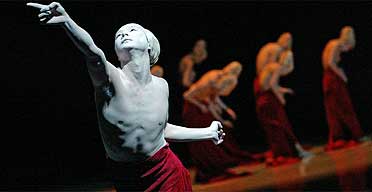
The dancers themselves are white faced, almost anonymous in their dark clothes but although Shen has deliberately sidestepped the narrative in Stravinsky's score, they look anything but blank. With their arms pressed to their sides, their faces timidly averted or blindly panicked, they seem to dance in a world too big for comprehension. Even when the choreography breaks into violent falls or swerving leaps the dancers look driven by forces beyond their choosing.
This sense of collective need is underlined by the unstoppable fluency of Shen's phrase making. Even the choreography's fiercest moments it doesn't falter in elegant pattern making, nor yield to the crushing down beat of Stravinsky's score. The 10 dancers skitter over the music's broiling energy as if they were dancing on the thin crust of a volcano, and only their urgently spun steps could hold the explosion in check.
It's an extraordinary piece of visual poetry - but what makes it pall is the fact that Stravinsky is all about cataclysm and in Shen's choreography the big moment is always deferred. Paradoxically it's in the infinitely slow, suspended Folding that you get the more satisfying dynamic.
Set to a mix of Buddhist chant and John Tavener this creates a different world of ritual. The dancers in their conical skullcaps, look like members of an arcane religious order, dedicated to a life of exquisite movement meditation. As they reach their apotheosis Shen and his fabulous dancers elevate body sculpture to an extreme level of beauty - so beautiful it's almost enough to fill the evening's long empty spaces.