
Closing summary
Before we close up, here is a summary of today’s main events.
Two key events have dominated. First, the Greek prime minister Alexis Tsipras was in Moscow to meet Russian President Vladimir Putin:
- At a joint press conference Tsipras said Greece was not in favour of Western sanctions imposed on Russia, adding that it risked the start of another Cold War
- Putin said that it was unfortunate the Greek economy had been hit by counter sanctions imposed by Russia, but no exceptions could be made for any country within the EU
- Putin said that Greece had not asked Russia for financial aid. But he added that Russia was willing to talk about investing in projects in Greece
- Austria warned Greece not to get too close to Russia
The second major event was the news that Shell has agreed to buy BG Group for £47bn. BG’s new chief executive Helge Lund - in the job for just two months - could walk away with up to £25m.
Shares in BG soared, helping to push the FTSE 100 up 0.5% earlier in the day. The FTSE’s gains were erased in later trading however, following other European indices lower.
Thank you for reading the blog today and for all your comments. Please join us again tomorrow, when it’s another deadline day for Greece. This time the Greek government must repay €450m of debt to the IMF.
Have a great evening. AM
European markets are down
The FTSE has been unable to hold on to gains made earlier, when it was boosted by news of Shell’s proposed £47bn takeover of BG Group.
It has followed other markets lower, ahead of the latest set of minutes from the Fed’s Open Market Committee (FOMC) tonight.
- FTSE 100: -0.3% at 6,944.57
- Germany’s DAX: -0.7% at 12,039
- France’s CAC: -0.3% at 5,136.54
- Italy’s FTSE MIB: -0.5% at 23,583.03
- Spain’s IBEX: -0.8% at 11,637.5
US markets have opened up slightly:
- Dow Jones: +0.1% at 17,885.63
- S&P 500: +0.1% at 2,078.15
- Nasdaq: +0.3% at 4,357.73
The press conference is over.
It ended with a few comments on Greece’s potential participation in the Turkish Stream pipeline project. Putin said nothing concrete was agreed, but Greece could potentially earn millions of euros every year from the project.
The Russian President added that Greece’s creditors would benefit should the Greek economy improve as a result of closer ties with Russia.
Updated
Putin: Russia will not lift ban on Greek food imports
Putin said that it is unfortunate that counter sanctions imposed by Russia on the West have affected Greece.
But we cannot make any exceptions for any country in the European Union.
He says he does not understand why such a fuss is being made about the Greek PMs visit to Russia [I’m paraphrasing there. AM].
Putin says we understand Greece was forced to vote for sanctions. Russia couldn't make exception for one country. Ending sanctions best way.
— Holger Zschaepitz (@Schuldensuehner) April 8, 2015
Updated
Tsipras: we do not agree with sanctions against Russia
Tsipras has just said that hostile relations between the West and Russia could lead to another Cold War.
The counter sanctions imposed by Russia have inflicted pain on the Greek economy. But we know the retaliations were a response to sanctions (against Russia), the logic of which we do not entirely share.
We openly disapproved of the sanctions. It is not an efficient solution. We think it could bring about a new Cold War between Russia and the West.
Putin says Greece has not asked for financial aid from Russia.
He adds Russia is ready to bid for projects in infrastructure in Greece, and all it would ask for is that Russian companies are not viewed any less favourably than companies bidding from other countries.
Tsipras says it is not a Greek crisis it is a European crisis, and that is why the solution must be a European solution.
#Greece is a sovereign state w/right to pursue nuanced foreign policy in line w/geopolitical role as European Mediterranean & Balkan country
— Alexis Tsipras (@tsipras_eu) April 8, 2015
At this morning's meeting w/@PutinRF_Eng we created a new foundation for Greek-Russian relations. #Greece
— Alexis Tsipras (@tsipras_eu) April 8, 2015
We respect our commitments to the international organizations we're a part of, but seek to explore all international opportunities. #Greece
— Alexis Tsipras (@tsipras_eu) April 8, 2015
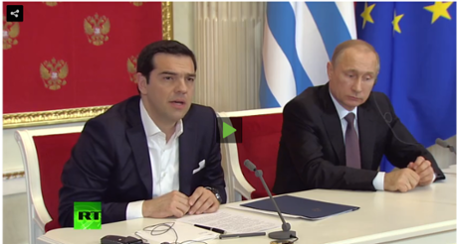
Vladimir Putin:
A major part of Greece’s relations with Russia is tourism. Greece is one of the most popular destinations for Russians. Last year Greek resorts and other attractions were visited by one million Russians.
The Greek PM Alexis Tsipras thanks Putin for his hospitality.
We have discussed in detail how we can boost Greek exports to Russia, covering the huge negative trade balance.
And how we can attract Russian investment into the Greek economy... branches such as tourism, infrastructure, and how we can further strengthen our cultural, scientific, educational, academic exchange ties.
I once again want to say how important it is to restart and to forget the past.
Tsipras/Putin press conference begins
Vladimir Putin says Greece and Russia have adopted a joint plan of action for 2015 and 2016.
We agreed to pay more attention to co-operation in investment, so far the figures have been quite humble here.
#Russia's Putin says #Greece can become European energy distribution hub. Russian railways in talks to modernize Greek port.
— Holger Zschaepitz (@Schuldensuehner) April 8, 2015
While we wait, an alternative view of the press conference room in the Kremlin.
The definition of “will begin shortly” is clearly open to interpretation...
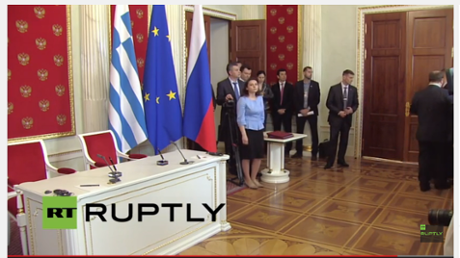
The Tsipras/Putin press conference will begin shortly...
Press conference with @PutinRF_Eng to begin shortly. #Greece pic.twitter.com/IHHfleb61c
— Alexis Tsipras (@tsipras_eu) April 8, 2015
Greek shares are lower today, with the ATG index in Athens down 1.1% at 768.63.
Elsewhere in Europe, markets remain mixed:
- FTSE 100: +0.3% at 6,981.42
- Germany’s DAX: -0.3% at 12,089.6
- France’s CAC: flat at 5,152.27
- Italy’s FTSE MIB: -0.1% at 23,673.99
- Spain’s IBEX: -0.2% at 11,702.3
Updated
The hotly-anticipated Putin/Tsipras press conference at the Kremlin has yet to kick off.
The select few member of the press attending the event in Moscow are being kept waiting back stage.
Coulisses de la rencontre Poutine-Tsipras : pour la presse, de longues h d'attente dans une salle aux rideaux fermés pic.twitter.com/sncjnJ92LW
— Paul Gypteau (@paulgypteau) April 8, 2015
Russia prepares to lift embargo on Greek food imports
Russia Today (RT) is reporting that Russia is preparing to lift the embargo on Greek food imports.
It reports:
Greece has been hit especially hard by the ban, as more than 40 percent of Greek exports are to Russia. In 2013, more than €178 million in fruits and conserves were exported to Russia, according to the Greek fruit export association, Incofruit-Hellas.
Up until the ban, Russia had been Greece’s biggest single trading partner worth $12.5 billion (€9.3 billion) by 2013, more than double the 2009 figure.
On March 3, Greece sent a letter to the Russian food watchdog Roselkhoznadzor requesting the temporary restrictions on agricultural products such as strawberries, kiwis, peaches, and seafood is lifted.
Russia’s agricultural food ban applies to EU countries and is not due to expire until August 2015, a year after the restrictions were imposed in response to Western sanctions. The ban also applies to the US, Australia, Canada, Japan, and Norway and includes meat, fish, chicken, cheese, milk, fruit, and vegetables.
The Guardian’s Helena Smith says tensions are running high back in Athens, as the highly political nature of PM Tsipras’ trip to Moscow is closely scrutinised.
She reports:
The concerns raised by senior European officials, including Martin Schultz, the European parliament president over today’s Tsipras-Putin talks are being described as “unnecessary” by Greek sources.
“Greece has the right to have a multi-dimensional foreign policy,” Greek officials said as prime minister Alexis Tsipras began talks with president Vladimir Putin. “The noise” made by European leaders was not only unheeded but tantamount to interference in the country’s affairs.
Athens not only wanted to improve ties economically but culturally with Moscow, said another source adding that 2016 had been declared the Year of Greek-Russian friendship.
Tsipras himself gave voice to the desire to strengthen ties with the Greek media quoting him as telling Putin that relations between the two countries were not only “deep and continuous” but based on “common struggles and a common religious tradition.”
“The aim of my presence here is to look to reset Greek-Russian relations to the benefit of both countries and to the benefit of security and stability in the wider region,” the leftist prime minister told the Russian president.
City University’s Professor Anastasia Nesvetailova says that Russia would be in no position to bail out Greece, but argues there are other options on the table.
It is difficult to imagine that the current enthusiasm about Greece-Russia relations will mature into Russia’s tangible economic aid to Greece. Certainly not on the scale that can solve Greece’s financial problems.
The crisis-stricken Russian economy at present can ill-afford to extend financial aid to Greece. But some economic concessions, like a subsidised price for Russian gas transported through the newly planned Turkish Stream pipeline, or Russian purchases of failing Greek companies, are on the table.
To Russia, the economic gains on many of these potential investments to Russia are questionable. And it is clear that both sides are using this moment for short-term political gesticulation directed at the EU.
The best case scenario for Greece that can come out of Tsipras’s visit to Moscow would be the removal of the food embargo on Greek agricultural exports to Russia, Russia’s financial participation in the privatisation of Greek enterprises and reduced tariffs on Russian gas.
A bilateral trade deal will boost some economic sectors in Russia. But beyond this, friendship with a ruined Greek economy will ultimately add to the pressures on the ailing economy of Russia.
Back to Shell’s £47bn takeover of BG Group for a moment.
The deal has been agreed just two months after Helge Lund joined BG as its new chief executive on 9 February.
Once the deal with Shell is sealed, Lund will leave the company, taking up to £25m with him. It begs the question, did Lund know about the Shell approach when he took on the BG job?
Apparently not. This from the Guardian’s Sean Farrell, who is at a press conference on the deal.
BG chairman says Shell CEO BvB called shortly after Helge Lund joined BG. Call was 15 March, BvB reveals.
— Sean Farrell (@farrell_s) April 8, 2015
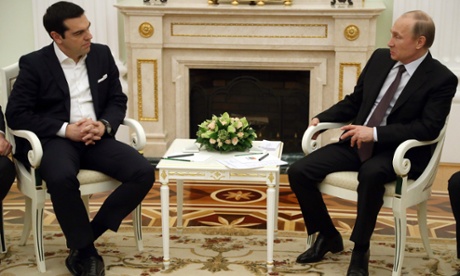
Meeting with Russian President, @PutinRF_Eng ahead of this afternoon's press conference. #Greece pic.twitter.com/iLUizVPLp2
— Alexis Tsipras (@tsipras_eu) April 8, 2015
Updated
The meeting between Tsipras and Putin is underway
The two leaders are expected to give a press conference at 15.30 Moscow time.
In the meantime, the Guardian’s Shaun Walker brings this report from the Russian capital:
Greek Prime Minister Alexis Tsipras has begun talks with Vladimir Putin in the Kremlin, the main event of a two-day trip to the Russian capital which has raised eyebrows in the EU.
The meeting in Moscow comes a day before cash-strapped Greece is due to make a major payment to the International Monetary Fund. Tsipras arrived in Moscow on Tuesday, and on Wednesday morning laid flowers in a ceremony at a World War Two monument outside the Kremlin. He was due to make a joint appearance with Putin at a press conference in the Kremlin in the afternoon, after their talks had concluded.
In Tsipras, Moscow sees a potential ally on a continent where it has few of them. The wooing of the new Greek government is part of a strategy in Moscow to seek out whatever forces may help to break the consensus in Europe that Russia’s actions in Crimea and east Ukraine require a tough, sustained response. Already, Moscow has reached out to European far right groups, including by giving a €9m loan to France’s Front National.
On the eve of his visit to Moscow, Tsipras reiterated his opposition to EU sanctions on Russia, calling them “a road to nowhere” in an interview with TASS news agency.
“I support the point of view that there is a need for a dialogue and diplomacy, we should sit down at the negotiating table and find the solutions to major problems.”
In Brussels, the visit will be watched with trepidation, for fear the Russians could make Tsipras an offer he cannot refuse.
#Russia president #Putin & #Greece PM Tsipras meet in Moscow http://t.co/F7Hl9PF2aK pic.twitter.com/FPEGmDoSMg /via @RT_com
— Yannis Koutsomitis (@YanniKouts) April 8, 2015
Bookmaker Paddy Power is offering odds of 5/4 that Greece will accept more than €1bn in a bailout from Russia in 2015.
#Greece's Tsipras says deep, long-standing ties link w/ #Russia. Says he's in Moscow to renew relationship.
— Holger Zschaepitz (@Schuldensuehner) April 8, 2015
Germany: Greece supportive of stance on Russian santions
Germany has no reason to believe Greece has changed its stance on supporting Russian sanctions, a German foreign ministry spokeswoman said.
Speaking ahead of Alexis Tsipras’ meeting with Vladimir Putin this afternoon, she said:
So far there is no reason to think in concrete terms that the position of Greece has changed.
So far Greece has supported all the decisions linked to sanctions and we hope that will continue to be the case.
In Moscow, honoring those who stood up to, and defeated fascism--a true victory of the people. #Greece pic.twitter.com/35V5OSqwBS
— Alexis Tsipras (@tsipras_eu) April 8, 2015
Aldi’s share of the market has risen to 5.3% according to market researcher Kantar Worldpanel, compared with 5.1% for Waitrose, which is owned by the John Lewis Partnership.
This from the Guardian’s Sarah Butler:
Aldi has grown rapidly in recent years as shoppers have kept a tight rein on their budgets. Having leapfrogged Waitrose, it is now closing in on the Co-op, the UK’s fifth-largest supermarket chain, which is now less than one percentage point ahead of the German chain in terms of market share.
Waitrose’s sales rose 2.9%, a relatively strong performance in a market which expanded by just 1%. But that was not enough to prevent the upmarket grocer being overtaken by Aldi, which was by far the top performer in a tough market where grocery prices fell by 2%.
Fellow discounter Lidl also saw strong growth, with sales up 12.1%, taking its market share to 3.7%. The two German grocery chains now have a combined market share of 9%, up from 5.4% only three years ago.
Supermarket sector: market share
Tesco 29.4%
Asda 17.1%
Sainsbury’s 16.4%
Morrisons 10.9%
The Co-op 6.0%
Aldi 5.3%
Waitrose 5.1%
Lidl 3.7%
First period of growth for Sainsbury's since 08/14 Asda remains worst performer of "big 4" in Kantar Worldpanel figs pic.twitter.com/gnD3poo4UY
— Sarah Butler (@whatbutlersaw) April 8, 2015
Wow. Nice work if you can get it?
Helge Lund, BG Group’s new chief executive (he joined on 9 February) is in line for up to £25m once the £47bn deal with Shell is sealed.
The Guardian’s Julia Kollewe:
@BGGroup's CEO Helge Lund will walk away with up to £25m once £47bn takeover by Shell completes (probably 2016). not bad for a year's work!
— Julia Kollewe (@JuliaKollewe) April 8, 2015
The International Monetary Fund has made €2.5bn (£1.8bn) of profit from its loans to Greece since 2010, according to the Jubilee Debt Campaign.
This is how the JDC makes its calculation:
The IMF has been charging an effective interest rate of 3.6% on its loans to Greece. This is far more than the interest rate the institution needs to meet all its costs, currently around 0.9%. If this was the actual interest rate Greece had been paying the IMF since 2010, it would have spent €2.5bn less on payments.
Out of its lending to all countries in debt crisis between 2010 and 2014 the IMF has made a total profit of €8.4bn, over a quarter of which is effectively from Greece. All of this money has been added to the Fund’s reserves, which now total €19bn. These reserves would be used to meet the costs from a country defaulting on repayments. Greece’s total debt to the IMF is currently €24bn.
Tim Jones, economist at the Jubilee Debt Campaign, said the “usurious interest” imposed by the IMF “adds to the unjust debt forced on the people of Greece”.
Here is the timetable for Alexis Tsipras’ meeting with Vladimir Putin this afternoon in Moscow. All in local time.
- 13.00 - the two leaders meet
- 14.00 - working lunch
- 15.15 - documents signed
- 15.30 - press conference
Updated
Helena Smith, the Guardian’s correspondent in Athens, brings us this update on Tsipras’ visit to Moscow.
The Greek prime minister Alexis Tsipras is accompanied by a delegation that includes veterans from World War II.
The former communist party youth leader is determined to display his leftist credentials on his trip to Moscow. Photographs this morning show him being accompanied by the Marxist energy minister Panagiotis Lafazanis, and the families of World War II veterans.
Many communists were banished to the former Soviet Union and other countries in the Communist bloc after the 1946-49 Greek civil war which followed the Nazi occupation of Greece.
Tsipras’ radical left Syriza party has traditionally had strong ties with the Russian left.
Lafazanis, who leads Syriza’s militant wing, has pushed forcefully for improved ties with Moscow.
Austria warns Greece not to get too close to Russia
Reflecting the controversial and highly political nature of Tsipras’s meeting with Putin in Moscow later today, the Austrian finance minister has fired a warning shot in Greece’s direction.
Speaking in Vienna, Hans Joerg Schelling suggested Greece should be careful in its dealings with Russia, at a time when Greece is almost out of money and trying to negotiate a deal with its eurozone partners.
The minister said:
It’s perfectly normal for talks to take place but I would urgently warn against getting closer.
We are in the middle of final negotiations for financing for Greece and I don’t believe that a good game is being played here.
Aldi overtakes Waitrose
Big moment for UK supermarkets as the German discount chain Aldi overtakes Waitrose to become Britain’s sixth largest supermarket, according to market researcher Kantar Worldpanel.
More soon.
Aldi overtakes Waitrose to become the UK's sixth largest supermarket with 5.3% market share - watch out The Co-op (6%)!
— Sarah Butler (@whatbutlersaw) April 8, 2015
Greece: we have not asked Russia for financial aid

As Alexis Tsipras begins his controversial visit to Moscow, a Greek government official has insisted the prime minister will not be seeking financial aid from Russia when he meets Putin later today.
Greece is still focused on resolving its debt crisis with its existing lenders, the official told Reuters.
We have not asked for financial aid. We want to solve our issues of debt ... within the eurozone.
The official added that the two leaders would discuss economic co-operation and bilateral investment and exports.
European parliament president Martin Schulz warned Tsipras before he travelled not to break with the EU line on sanctions imposed on Russia over its role in the Ukraine crisis.
The Greek official said:
Greece knows what to do within the EU framework but every country also has the sovereign right to look after and improve its bilateral relations.
European markets are mixed
Investors in Europe have mixed feelings this morning. The FTSE was briefly back above 7,000, but has fallen back a bit.
- FTSE 100: +0.5% at 6,995.4
- Germany’s DAX: -0.4% at 12,077.76
- France’s CAC: -0.1% at 5,143.97
- Italy’s FTSE MIB: flat at 23,708.91
- Spain’s IBEX: +0.1% at 11,738.8
More reaction is coming in on the Shell/BG Group £47bn mega deal.
Marc Kimsey, senior trader at Accendo Markets, has sent a note entitled oil m&a - we’re just getting started:
The deal between Royal Dutch Shell and BG Group will prompt sector consolidation. The decline in oil price over the past year has battered some stocks which are clearly now looking attractive.
In the last year BG shares fell 30%, shares in Tullow Oil have fallen 65%, Premier Oil down 55%, and Petrofac down 20%. By comparison sector behemoths BP and Royal Dutch Shell have only shed 10% over the same period leaving them in the position of predator rather than prey.
Richard Hunter, head of equities at Hargreaves Lansdown stockbrokers, says Shell’s move on BG is opportunistic:
Whether precipitated by the falling oil price or BG’s more recent production woes, Shell has acted opportunistically, as it previously implied it might if the occasion arose.
Already the largest FTSE 100 constituent by a considerable margin, this deal will further consolidate Shell’s position in that regard. There are clear attractions from Shell’s viewpoint, including its additional exposure to liquified natural gas, almost immediate cost synergies and, in due course, asset sales from a partial break up of BG’s operations.
The projected price being paid for BG does not quite match the company’s previous high of 1551p in March 2011, since when the shares have fallen 41%, 20% of which is in the last year alone. Nonetheless, the combined cash and shares offer will not, it would appear, dilute the cash generative abilities of the combined entity, with a substantial share buyback programme pencilled in for 2017 and beyond.
In terms of the energy sector itself, the deal could also prompt other companies who have been running the slide rule over potential targets to make their move.
FTSE opens up
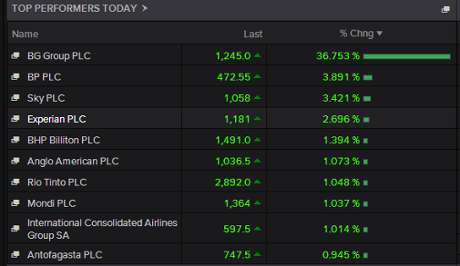
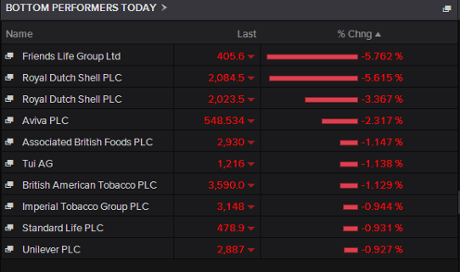
The FTSE 100 is up 0.5% at 6,998.64.
Top performers:
Bottom performers:
BG shares open up 42%
Big spike in BG shares this morning, up 42% at £13 following confirmation that Shell wants to buy the company for £47bn.
Shell shares opened down 2.9% at £21.45.
Meanwhile BP shares have opened up 4.4% at 474.85p
BG's new boss Helge Lund is expected to leave
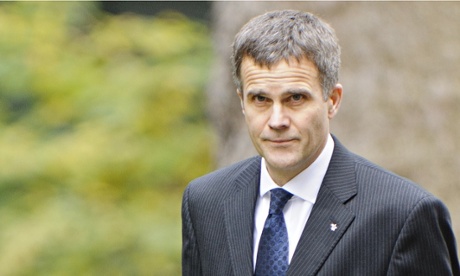
Shell boss Ben van Beurden told has told reporters that Helge Lund will “probably move along” if the deal goes ahead.
Lund only joined in February...
Looks like Helge Lund, the new heftily remunerated CEO of BG Group, will be leaving once the Shell deal is done. He didn't stay long
— Kamal Ahmed (@bbckamal) April 8, 2015
Updated
Greek PM arrives in Moscow for talks with Putin
It is also a big day for Greece, following the arrival in Moscow of prime minister Alexis Tsipras for a meeting with Vladimir Putin later today.
Arriving earlier today in Moscow ahead of tomorrow's meeting with Russian President, V. Putin. @PutinRF_Eng #Greece pic.twitter.com/HyW5FoPZ6R
— Alexis Tsipras (@tsipras_eu) April 7, 2015
The meeting comes a day before Greece must make a €450m debt repayment to the International Monetary Fund. Greek finance minister Yanis Varoufakis has vowed to meet the deadline.
We will be bringing you updates on Greece throughout the day.
Shell agrees to buy BG Group for £47bn
Good morning, and welcome to our rolling coverage of the world economy, the financial markets, the eurozone and business.
The mega deal is back. The big corporate news this morning is that oil giant Royal Dutch Shell has announced that it has agreed to buy gas group BG for £47bn.
The cash and shares deal will undoubtedly excite investors and analysts this morning as the various implications of such a major deal are absorbed.
Our story on the deal is here, and we’ll be brining you more details and reaction throughout the day.
This is what the key players had to say in this morning’s statement...
Ben van Beurden, chief executive of Shell:
Bold, strategic moves shape our industry. BG and Shell are a great fit. This transaction fits with our strategy and our read on the industry landscape around us.
BG will accelerate Shell’s financial growth strategy, particularly in deep water and liquefied natural gas: two of Shell’s growth priorities and areas where the company is already one of the industry leaders. Furthermore, the addition of BG’s competitive natural gas positions makes strategic sense, ahead of the long-term growth in demand we see for this cleaner-burning fuel.
This transaction will be a springboard for a faster rate of portfolio change, particularly in exploration and other long term plays. We will be concentrating on fewer themes, and at a larger scale, to drive profitability and balance risk, and unlock more value from the combined portfolios.
Over time, the combination will enhance our free cash flow potential, and our capacity to undertake share buybacks, where I expect to see a substantial increase in pace.
Helge Lund, chief executive of BG:
The offer from Shell delivers attractive returns to shareholders and has strong strategic logic. BG’s deep water positions and strengths in exploration, liquefaction and liquified natural gas shipping and marketing will combine well with Shell’s scale, development expertise and financial strength.
The consolidated business will be strongly placed to develop the growth projects in BG’s portfolio. The transaction will take time to complete, during which my team and I will remain committed to BG and our shareholders, and to safely delivering our 2015 business plan.
Helge Lund only joined BG as chief executive on 9 February, so he hasn’t wasted much time.
The company came under fire for offering Lund a £25m package to take the job, and was forced into an embarrassing u-turn.
After the fuss about Helge Lund's sign-on fee at BG, now seems he will receive millions of pounds for a few days at the helm. #ToughJob
— Robert Peston (@Peston) April 8, 2015













