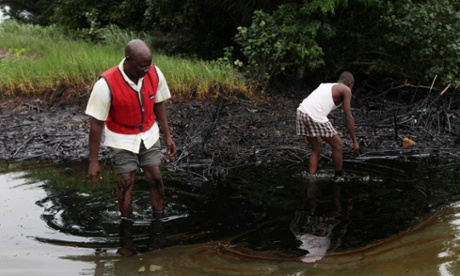
Justice has been done, it would seem, for the 15,600 farmers and fishermen who are to receive about £2,000 each as part of Shell’s £55m payout for pollution caused by two oil spills in 2008 and 2009.
While this is a significant sum in the context of the impoverishment of the Niger Delta, it will not reverse the degradation of the environment which the community is reliant on for their water, food and livelihood. The battle between this small fishing community and Shell’s Nigerian subsidiary has been lengthy, arduous and imbalanced.
Applying its dominance as an Anglo-Dutch corporation with tentacles in the Nigerian government, Shell has been able to evade responsibility for decades of environmental damage to the Niger Delta. Its ability to get away with double standards and bad practice lies in a culture of denial, obfuscation and misinformation. For example, Shell has repeatedly claimed that illegal activity in the Niger Delta in the form of sabotage and tapping into pipelines was the cause of most oil pollution.
Recent court documents, however, revealed that Shell knew for years that corrosive pipes and equipment failure were a significant risk factor, but failed to address this properly. During the legal process Shell admitted that its figures were wrong and that it had underestimated the amount of oil spilled in Bodo.
Another reason why Shell has managed to conceal its culpability is because it dominates the process of investigating and reporting on its own oil spills. Years of bad practice with regard to investigations has left communities highly distrustful of the process and outcomes.
If it were not for the resilience of the Bodo people, the support of British law firm Leigh Day, the research of Amnesty International and the persistence of civil society organisations in Nigeria, Shell’s culpability would not have been exposed.
Shell will probably do everything it can to close the book on the negligence and misinformation accompanying the Bodo spill. But the pressure on the company to be transparent with the facts and to clean up its contamination across all of the Niger Delta will intensify. Other communities are waiting in the wings to have their day in court. And there are lawyers only too well aware that the systemic failings exposed in the Bodo case are a characteristic feature of the company’s operating model.
While the compensation awarded is important to the affected communities, the wider ramifications of the Bodo case are much more significant in moving us closer to the truth and helping to bring about greater accountability in future for Shell’s actions and those of other companies operating in similar contexts. This is why Amnesty puts such a strong emphasis on access to judicial remedy for victims of corporate abuse. Not only does this provide opportunities for affected individuals and communities to gain compensation for damage done, but it also creates a deterrent to the poor practices that many companies believe they can get away with.
Kate Allen is director of Amnesty International UK. Follow her @KateAllenAI
Read more stories like this:
- Uganda’s oil: lessons on governance and the resource curse
- Live chat: how can governments improve energy infrastructure in Africa?
- Shell announces £55m payout for Nigeria oil spills
Join our community of development professionals and humanitarians. Follow@GuardianGDP on Twitter.