
I’m rescheduling videos that feature natural history museums and the like from the weekend to Mondays (“Museum Monday”) so a larger audience can learn more about the many varied roles that these institutions perform to benefit scientific research and public knowledge.
Today’s video is from the American Museum of Natural History (AMNH). It is the fourth episode in their year-long Shelf Life video series. Shelf Life is a bite-sized video exploration of some of the many natural treasures housed at the AMNH, how these specimens came to be there, the stories they tell us and how they inspire us to learn more about the natural world.
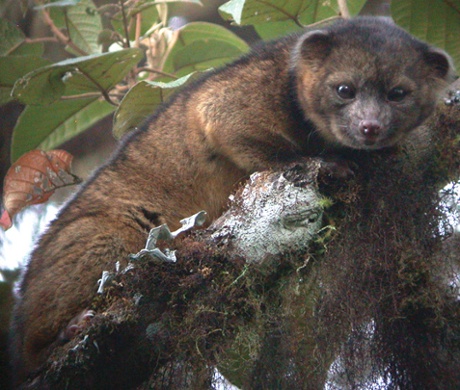
The olinguito, Bassaricyon neblina, which was formally described in 2013 (doi:10.3897/zookeys.324.5827), is the first new species of carnivore discovered in 35 years. This slender mammal, which looks like a cross between a domestic house cat and a bear, is the smallest member of the raccoon family. Olinguitos are solitary, nocturnal and strictly arboreal, prowling high-elevation cloud forests along the western side of the Andes mountains in Colombia and Ecuador. Although they are members of Carnivora, they eat fruits, nectar and insects.
This animal was not identified as a new species in the field. Instead, this new species was right under our noses for almost 90 years: it was originally collected in Ecuador in 1923. The original specimens were prepared, labeled, catalogued and placed into museum collections, where they remained, undescribed and undiscovered, awaiting the expert eye of a knowledgable specialist.
The specimens waited for 80 years.
“New species are very often found in the drawers of museum collections”, explains Nancy Simmons, curator-in-charge of the Department of Mammalogy at the AMNH.
“Basically, hiding in plain sight amongst all the other material.”
Kristopher Helgen, a raccoon expert and Curator of Mammals at the Smithsonian National Museum of Natural History, first saw the specimens in 2003, after he pulled open a drawer where the specimens were stored.
“I was working at the Chicago Field Museum, studying members of the raccoon family”, says Dr Helgen.
“I pulled open a particular drawer and I saw these red-orange pelts that were so different from any other raccoon family member that I’d ever seen. They stopped me in my tracks. I pulled open some of the boxes of skulls that went along with those skins and all of a sudden, I started to see differences in teeth and skulls and it occurred to me ... could this be a new kind of mammal that all other zoologists had missed?”
During the next ten years, Dr Helgen travelled to almost every natural history museum in the world that holds these specimens to study them more closely. He assembled a team of raccoon experts that accompanied him on an expedition to Ecuador to find the animal. Referring to the data documenting where and when the museum specimens were collected by the original expedition, Dr Helgen’s team identified a place in central Ecuador where these animals probably still live.
One of the team members, biologist Miguel Pinto, a researcher at the Pontificia Universidad Católica del Ecuador, went on a scouting trip to this location and found that their research had paid off: he saw an olinguito the day he arrived.
“Actually, it was jumping over my head”, says Mr Pinto.
Finally, after years of preparation, travel and dedicated research, Dr Helgen, team member and olingo expert Roland Kays of the North Carolina Museum of Natural Sciences and their collaborators published their formal description of this new species (doi:10.3897/zookeys.324.5827).
In this video, researcher Miguel Pinto tells the story of how a museum specimen led to the discovery of the olinguito in the wild, and Curator Nancy Simmons discusses the importance of museum holotypes:
Watch the previous video in this series.
You are invited to visit the AMNH’s dedicated Shelf Life site. The American Museum of Natural History can be found on twitter @AMNH.
Additional sources:
Kristofer M. Helgen, C. Miguel Pinto, Roland Kays, Lauren E. Helgen, Mirian T. N. Tsuchiya, Aleta Quinn, Don E. Wilson, and Jesús E. Maldonado (2013). Taxonomic revision of the olingos (Bassaricyon), with description of a new species, the Olinguito, ZooKeys, 324 1-83. doi:10.3897/zookeys.324.5827 [OA]
.. .. .. .. .. .. .. .. .. .. ..
GrrlScientist is very active on twitter @GrrlScientist and sometimes lurks on social media: facebook, G+, LinkedIn, and Pinterest.









.jpg?w=600)



