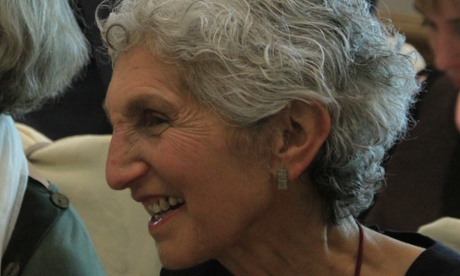
Sheila Ernst, who has died aged 73, was a pioneer of radical and feminist psychotherapy, and a leading group analyst. She worked for many years at the Women’s Therapy Centre in London and also taught at Birkbeck College, University of London.
Through her writing and clinical work, she explored the ways in which the social and political world enters into our deepest and most unconscious feelings. She steered a path between the tendency of therapy to reduce social phenomena to individual issues, and that of leftwing politics to deny the personal. Group analysis, with a more social view of the individual, offered Sheila the means of doing this, as well as chiming with her own preference for working and living collectively.
She was involved, with other analysts, in developing the practice of group analysis in Russia, Northern Ireland and Israel, visiting St Petersburg several times a year, from 2006 to 2011. She found that the legacies of authoritarian societies and the trauma of conflict surfaced in these trainee groups. Hostility, distrust and rigid attitudes were common; Sheila drew on her background in leftwing politics and her own family’s experiences, as well as her analytic skills, to enable learning to take place.
An Introduction to Groupwork (1999, co-written with Bill Barnes and Keith Hyde) was the fruit of Sheila’s experience in teaching and conducting groups in many contexts. Now a classic of the discipline, it presents complex ideas accessibly, showing how group analysis works by using the group process, and integrating individual and group perspectives.
At the Medical Foundation for the Care of Victims of Torture (now Freedom from Torture) in the mid-1990s, where recognition of social contexts and histories was essential, Sheila provided supervision to staff, who had to bear the impact of their clients’ devastating experiences. Always insistent on the importance of theories in clinical work, Sheila forged links between the Institute of Group Analysis (IGA), London, where she had qualified in 1986, and Birkbeck College, where she became a staff member in 1990, teaching as a senior tutor on the psychodynamic counselling course and setting up a pioneering master’s degree in group analysis.
Sheila was born in London to Jewish immigrant parents, Menachem and Shifra (nee Nathanson). They came to Britain from Palestine in 1930, and trained as doctors. Menachem became a psychoanalyst and Shifra a child psychotherapist, working with children from concentration camps. Both her parents had suffered from persecution; Shifra grew up in a German orphanage, having witnessed her own mother being killed in a pogrom in Odessa, and many of Menachem’s relatives were later shot by Nazis in Poland.
From this background of persecution and survival, Sheila was sent at the age of eight to the progressive boarding school Dartington, which provided an early experience of group living. She described herself as split between the Dartington “hippy” ethos and her parents’ preoccupation with achievement and fear of disaster. These different identities created enduring tensions between alternative lifestyles and the pursuit of career, but also gave Sheila an exceptional ability to engage empathetically with others’ points of view.
At Newnham College, Cambridge, from 1960 to 1963, Sheila read moral sciences and history. She entered into the social ferment of the time, joining a commune with her then husband, Bob Young, a fellow of King’s College, Cambridge, and her young children. Subsequently she lived in several collective households in London. From 1979 she lived with her long-term partner and husband, Jonathan Trustram.
In 1974 Sheila helped to create Red Therapy, a group critical of mainstream psychotherapy that aimed to democratise therapy and empower people to form their own skilled self-help groups. In her 1981 book, In Our Own Hands (co-written with Lucy Goodison) she showed, with many practical examples, how to run such groups.
From 1978 onwards, she worked at the Women’s Therapy Centre, founded in 1976 by Luise Eichenbaum and Susie Orbach. There, Sheila developed forms of individual psychoanalysis that addressed the internalised aspects of women’s oppression and disadvantage. She argued that psychological differentiation between mothers and daughters was impeded by social factors, leading to women’s fears of autonomy, achievement and others’ envy. In 1987 she co-edited Living with the Sphinx: Papers from the Women’s Therapy Centre, with Marie Maguire.
Sheila ended her life at Dignitas in Switzerland, after suffering for several years from progressive supranuclear palsy, a neurodegenerative condition. She travelled towards dying as she had lived: honestly, determinedly and engaging others in the complexities of the decision, always receptive to their feelings. In a final large group at the IGA, she encountered both respect and disagreement with her decision, as well as tributes to her inspiring and charismatic influence.
She is survived by Jonathan and their daughter, Rosie, her stepson, David, her daughters, Sarah and Emma, from her first marriage, her sister, Eva, and six grandchildren.
• Sheila Hyah Sarah Ernst, psychotherapist, born 25 July 1941; died 6 February 2015