Music has offered plenty of solace for the lovelorn this year. Taylor Swift has topped charts across the globe with her dissection of teenage entanglements. The weight of Damon Albarn’s past infidelities bear heavily on his debut solo album, Everyday Robots. Even plucky London wide boy Jamie T returned with tear-streaked missives about lovers departed.
But few artists have explored their brittle romantic endeavours with as much candour as Brooklyn-based singer-songwriter Sharon Van Etten. Her fourth album Are We There documents the intricacies of her nine-year, on-off relationship with the kind of forensic psychoanalysis most people would pay by the hour for, with track titles including I Love You But I’m Lost, Break Me and Your Love Is Killing Me.
The geography of the human heart is well-trodden terrain for Sharon Van Etten. Her mainly acoustic 2009 debut Because I Was in Love and its follow up, 2010’s Epic, concerned a relationship with an ex-partner who broke her guitar and said her music was pointless. It was the latter that caught the ear of the National’s Aaron Dessner, who went on to record her 2012 breakthrough album, Tramp – a startlingly wise account of turbulent courtship, and all the mistrust, foolishness, regret and longing that comes with it.
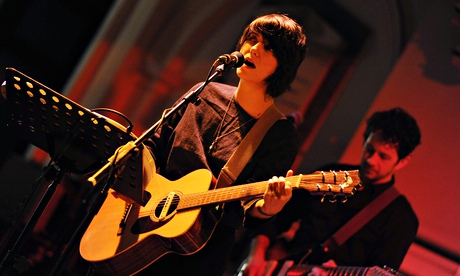
Tonight, however, she is beaming – a black-clad figure standing at a church pulpit beneath a hanging crucifix that seems quite fitting for the weight of her music. But she is playful, embracing hecklers with self-deprecating wit (“I’m so emo,” she drawls jovially in her New Jersey twang). Sometimes, she’ll shimmy blithely at her keyboard, others, playfight with her guitarist. At one point she stutters “poo” and “poop” in a juvenile manner into the microphone to soundcheck. This, it seems, is the “goofball” her friends and collaborators, War on Drugs’ Adam Granduciel and the Antlers’ Peter Silberman, have described in interviews.
It’s Thanksgiving in the US and she, in this darkened Brighton church, is a long way from home. But she’s no stranger to life on the road. While her lyrics are imbued with her emotional travails, musically she is the product of her travels. Born in New Jersey in 1981, she’s lived in Tennessee and Texas, and her songs are woven with a rich tapestry of Americana. She named her third album Tramp after two years of constant touring. That vagabond mystique rings through the country balladry of tonight’s third track, Are We There’s Tarifa, and the steely, harmonised thrum of earlier Epic track Save Yourself.
Set opener Afraid of Nothing, however, is the type of rousing torch song that her fans really cling to. Two minutes in and they are already standing in the aisles, arms aloft. Like Taking Chances after it, her songs burn with a hard-won wisdom. Nowhere is that more powerful than on Tramp track Serpents, with its kicking chorus: “You enjoy sucking on dreams, so I will fall asleep with someone other than you”. So it was a shame that song, and that album’s other gutsy guitar confessional Give Out, are absent tonight.
Instead, she leans heavily on Are We There. She produced that album herself, after becoming fearful that Tramp’s success was down to its famous guest stars – members of the National, the Walkmen and Beirut – rather than the strength of her own songwriting. She listened to Sade, Cat Power and electronic duo Glass Candy and the result was a keyboard-driven deviation from her tender battle songs. The new buoyancy is welcome: on Our Love, the closest she comes to pop balladry, the audience are dancing in the pews.
She didn’t need the musical diversification to vindicate her strength as an artist, however. When she later arrives onstage alone to sit at her piano for an encore of I Love You But I’m Lost, the audience climb over their seats to gather around her like a school assembly. “Let’s turn it into something we can change,” she coos sagely.
A toast proffered earlier in the night could easily be Sharon Van Etten’s strapline. “Here’s to learning,” she cheered. Because in all its pain and brutality, what her music offers ultimately is hope. There is defiance in her catharsis. This is a survivor’s music, not a victim’s.