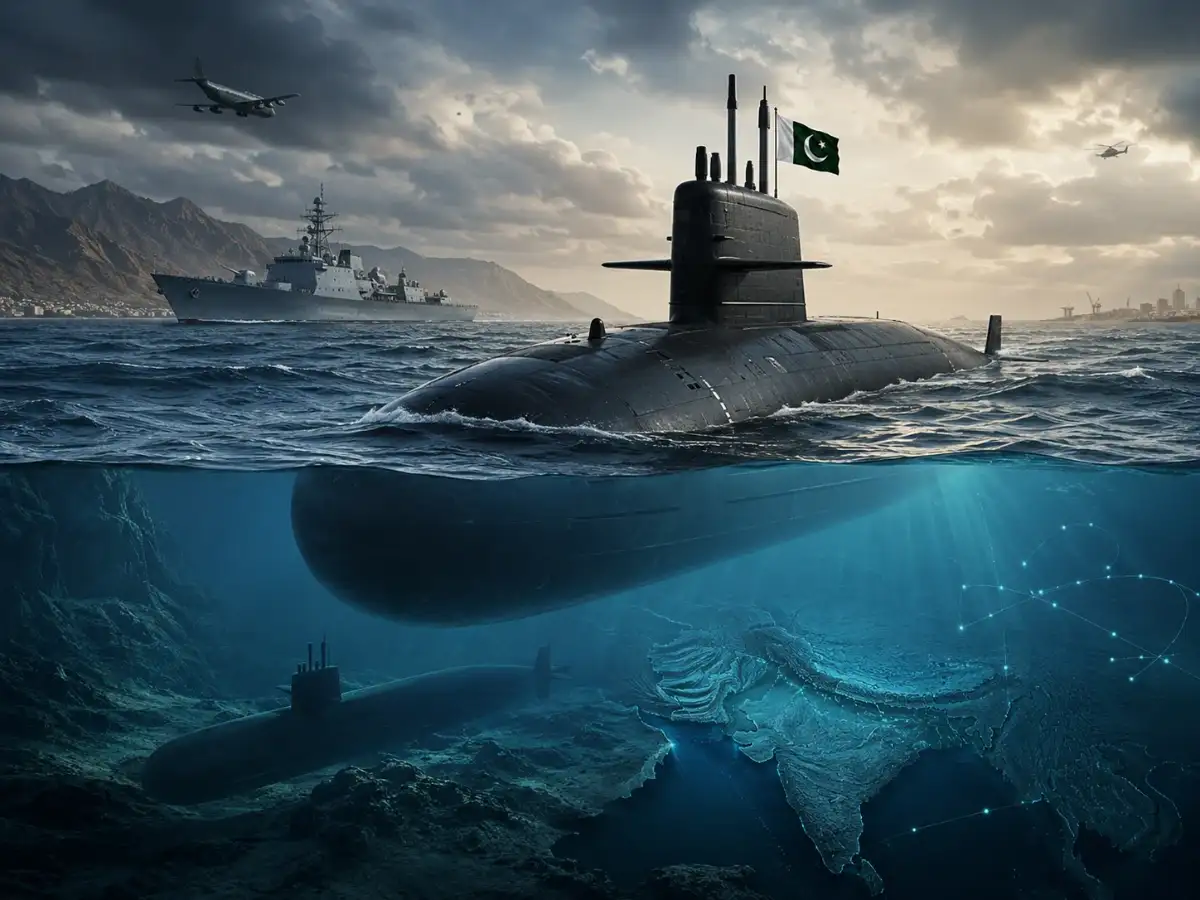
The recent arrival of Pakistan’s first Hangor-class submarine in Karachi is more than just a routine naval induction. It marks the beginning of a new phase in South Asian undersea competition, one where Pakistan is no longer limiting itself to the Arabian Sea. With reports emerging of plans for a sustained presence in the Bay of Bengal, a theatre where Pakistan has not operated since 1971, the strategic implications are widening.
These submarines, built with Chinese assistance and equipped with Air Independent Propulsion (AIP), give Islamabad a longer reach and greater stealth than ever before. For India, this is not an immediate crisis but a slow shift in the maritime balance that demands constant attention.
A new submarine fleet with extended reach
The Hangor-class submarines (Hangor is a Bangla word for shark) are based on a Chinese Type 039A derivative and represent a major leap for Pakistan’s underwater fleet. Built under a 2015 agreement, the programme involves eight submarines, with four constructed in China and four in Pakistan at Karachi Shipyard under technology transfer.
What makes these boats significant is their Air Independent Propulsion (AIP) system. Unlike conventional diesel-electric submarines that must surface or snorkel frequently, AIP-equipped submarines can remain submerged for weeks. This dramatically reduces their exposure to aircraft and surface detection systems and allows them to operate farther from home bases with greater endurance.
For Pakistan, this means its submarines are no longer strictly coastal or regional assets. They become platforms capable of sustained deployment across the Arabian Sea and potentially into the eastern Indian Ocean.
Also Read | Pak's first Hangor-class submarine arrives at Karachi Port
The Bay of Bengal threat
The most striking development is Pakistan’s signalling of a possible sustained naval presence in the Bay of Bengal, a region it has not operated in since the 1971 war when another Pakistani submarine also named Hangor sank India's INS Khukri. The messaging, including remarks made during escort operations in Colombo by Pakistani naval official, reflects a deliberate attempt to expand maritime geography rather than just upgrade hardware.
In practical terms, such a move would require more than just submarines. It would depend on access, logistics and diplomatic space. Reports of warming ties with Bangladesh, including renewed naval contacts, port visits and expanded military exchanges, provide Pakistan with at least a theoretical opening. Even limited access to ports like Chattogram would significantly improve operational reach for long-endurance submarine patrols.
However, this does not automatically translate into a permanent deployment. At present, it is more accurate to view this as intent signalling rather than established basing rights. Still, in naval strategy, intent often matters almost as much as capability because it forces adversaries to plan for worst-case scenarios.
What this changes for India’s eastern maritime theatre
For India, the Bay of Bengal has traditionally been a relatively secure water space dominated by its own navy and protected by geography. The potential entry of Pakistani submarines into this region introduces a psychological and operational shift.
The main concern is not that Pakistan could match India’s overall naval presence, but that even a small number of stealthy submarines operating at long range could complicate India’s maritime awareness. AIP-equipped submarines can loiter quietly in chokepoints, track shipping routes or force naval planners to divert anti-submarine warfare (ASW) assets to wider patrol patterns. This matters because India’s eastern seaboard is closely tied to critical infrastructure, naval bases and sea lines of communication. Even limited submarine activity in this region would require expanded surveillance and faster response cycles.
India’s submarine gap and counter-response
India currently operates around sixteen conventional submarines along with nuclear-powered ballistic missile submarines under the Arihant-class. Its conventional fleet includes Kalvari, Sindhughosh and Shishumar-class boats, though several older submarines are being phased out. The key challenge India faces is not numerical inferiority but a capability transition gap. Unlike Pakistan’s new Hangor-class submarines, India currently does not have an operational Air Independent Propulsion (AIP) submarine in service. The Kalvari-class submarines are expected to receive indigenous DRDO-developed AIP systems, with the first likely becoming operational around the end of 2026 or shortly after.
India’s broader response is structured around three layers. The first is surveillance dominance through long-range maritime patrol aircraft like the P-8I, along with helicopter-based anti-submarine warfare platforms. The second is underwater awareness through sonar networks and coordinated surface fleet operations. The third is fleet modernisation through Project 75(India), a Rs 70,000 crore initiative to construct six advanced, diesel-electric attack submarines for the Indian Navy, and future indigenous submarine programmes.
However, these efforts are still in transition. The gap between induction timelines means Pakistan’s new submarines could enter operational service months earlier than India’s corresponding upgrades fully mature.
The China factor and regional naval competition
The Hangor programme also reflects a deeper structural shift in the region: the increasing integration of Chinese naval technology into Pakistan’s fleet. This extends beyond hardware into training, sensors and combat systems, effectively creating interoperability between Chinese and Pakistani undersea warfare doctrines.
This development adds complexity for India because it is no longer dealing with a purely bilateral naval competition. Instead, it is facing a layered scenario where Pakistan’s submarines benefit from Chinese design evolution and potentially operational support ecosystems. In parallel, the Indian Ocean is becoming more crowded with submarine activity from multiple powers, further raising the importance of detection networks and maritime domain awareness.
Can Pakistan sustain a Bay of Bengal presence?
Even if Pakistan successfully inducts all eight Hangor-class submarines, maintaining a continuous presence in the Bay of Bengal remains a logistical and operational challenge. Submarines require resupply, maintenance cycles and secure communication links, all of which become more complex at extended ranges. At best, Pakistan could aim for periodic deployments or symbolic patrols rather than continuous presence. But even intermittent operations would carry strategic messaging value, especially if linked to diplomatic openings in Bangladesh.
India’s strategic cushion remains strong
Despite the concerns, India retains significant structural advantages. It has a larger submarine fleet, nuclear-powered deterrent capability and a far more extensive anti-submarine warfare (ASW) network across the Indian Ocean. Its maritime surveillance infrastructure is also deeper and more integrated.
The key challenge is timing rather than balance. Pakistan’s Hangor-class submarines are entering service now, while India’s full AIP capability and next-generation submarine programmes will take several more years to mature though the first submarine equipped with an indigenous AIP system is scheduled to be completed by the end of 2026. This creates a temporary phase of adjustment rather than a long-term shift in dominance.
The induction of the Hangor-class submarines represents a clear upgrade in Pakistan’s underwater warfare capability and an attempt to extend its operational imagination beyond the Arabian Sea. The talk of a Bay of Bengal presence adds a new layer of strategic signalling that India cannot ignore, even if its practical execution remains uncertain. For India, the challenge is not a grave threat but a pacing issue. The response is already underway through surveillance networks, submarine modernisation and AIP integration.