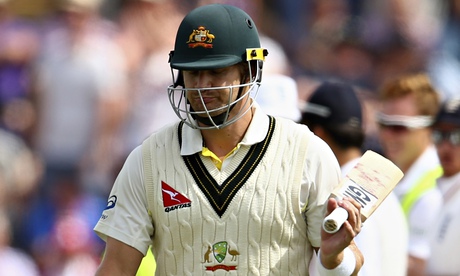
As Shane Watson walked out to face Stuart Broad shortly after lunch, he had to pass close to Jimmy Anderson, and, this being the friendly series (as some want it) or not (as do others), it would nonetheless almost have been a dereliction of duty for England’s senior bowler not to have greeted him with: “Good luck in your last Test innings, Watto.” Maybe England should have formed a guard of honour and clapped him in, for does not the new ICC diktat deal with sendings-off but make no mention of sarcastic welcomes?
Watto has been a fine player for Australia, something that has made him their highest earner, with a reputed A$4m-a-year contract. But he is struggling, under pressure for his place from Mitchell Marsh and retaining it for this first Test on reputation rather than performance. In the first innings, though, when he had made 30, Broad had pinned him on the crease, the ball thundering into the massive magnet that is his front pad. He reviewed the lbw decision – of course he did – and, as happens more often than not, it was in vain. Now, in this second innings, Australia were struggling for survival, and Watson’s career was on the line.
He made 19 unspectacular runs, trying so hard to play straight rather than around his front pad as the downfall of the lbw laureate so often suggests. Alastair Cook set three slips and a gully. But, for good measure, there were three close fielders on the drive, one on the off and two to leg, one of them almost standing on the cut strip. If you want to get the ball away, Cook was saying, you are going to have to hit across the line. Just once Anderson was belted back down the ground to the boundary, too straight and firm for anyone to stop and Ben Stokes was pulled dismissively to square leg for a second four. It all looked a struggle, a voice in his head telling him to play straight, keep the pad out of the way. After 57 previous deliveries, came the inevitable.
Mark Wood, already a star in this new England team, slanted one into him, the bat came around his pad as he looked to angle the ball away and it thudded into it. The appeal was wholehearted and vociferous, the response of Marais Erasmus almost preordained, and with it Watson’s reaction.
In the media centre, the universal plea came for him to review it, maybe for the last time in his Test career. The advice from the non-striker, Mitchell Johnson, may well have been not to bother but such was the situation that he had little option, even if it might have been for old times sake. So he did, grinning sheepishly as he did so. Maybe he could put DRS after his name. In the press box, arms went up gleefully. Then came the drama: the bowler had not overstepped, and nor did the batsman feather the ball on to his pad. Finally, trial by the automated decision review system: red light was followed by another, and then the orange umpire’s call. The ball would have been taking a big chunk out of a chocolate leg stump and Watson turned to trudge resignedly from the field, lbw for the 29th time. “Cheerio, cheerio, cheerio,” chanted the crowd. Someone posted a picture on Twitter of a Hawk-Eye screen grab captioned “Shane Watson’s passport photograph”: genius. Perhaps if the decision is taken to end his career he will review that as well.
The opprobrium heaped on Cardiff before the match had begun was largely unwarranted and, if the pitch has been slower than some might like, it suited the home side and the first three innings were scored at four runs per over or more: it has been an enthralling match and supported to the full. Before play, the crowds had filled the coffee shops near the castle and the crocodile of spectators wound through the gardens and along the path by the Taff to the Swalec Stadium.
Most press boxes these days have excellent views but as much atmosphere as the moon, so while it is easy to watch the match it is difficult to feel it. But go down one floor from this one and there is an open terrace from which to watch and it lends a different perspective. There is a hum between deliveries, gathering noise as the bowler runs in and there was an explosion of sound as five Australia wickets fell in the half-hour either side of lunch.
For most of the first hour, though, there were mostly gasps, as the new ball darted and jagged past probing blades without finding the edge. A wicket seemed likely every ball but never came. In the third over, Chris Rogers got a thick edge to Anderson and the ball flew to the left of Joe Root at third slip but, whereas England’s catching had been exceptional otherwise, he could only parry this so that Rogers escaped. Those at third slip on both teams have been standing closer than normal, the slips tending to be en échelon rather than in an arc, and this was no exception. But this was the new ball, which will always go through a little quicker and come faster from the bat: he may have been too close. Root lay prone as the crowd groaned: was it going to be this sort of a day?
Broad bowled magnificently, as he had done throughout the match. This is a bowler who sometimes slumbers only to wake and deliver devastating spells; but that was not the case here, hitting the splice more than anyone and always challenging. He has never bowled better.
Somehow Rogers and David Warner, a pair of left-handers, had survived until Broad went round the wicket to the former, moved one away and Ian Bell took the catch at bootlace height, low enough for the batsman to delay his walk back while the umpires checked the legitimacy. There was no doubt and up went the first real roar of the day.