ALL-ROUNDERDOM IS A DIFFERENT ART NOW
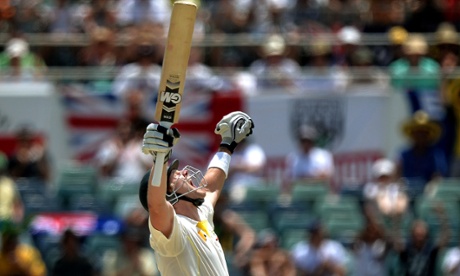
Farewell, then, Watto. You will be missed. Certainly, for those who have followed closely over the past few years, it might take a little while to get used to the idea that an Ashes summer can be said to have begun without daffodils, birdsong and the sound sound of leather on Shane Watson’s front pad. Instead, after 59 Tests, 10 years and – surprisingly, given his talent – only four hundreds, Watson has retired from Test cricket.
As ever, he leaves with a tale of trapped potential, congealed energy, a half-glimpsed notion of the colossus who might have been. Not to mention a degree of genuine affection towards the departing silhouette of this thrillingly gifted, vast Victorian armoire of a cricketer, a man who always seemed to be struggling with the weight of his own slightly ponderous talent.
Cricketers tend to age in different ways. Some become crabby and stringy. Some thicken out and slow down. Others, like Ian Bell during his doldrums earlier this summer, remain exactly the same in every way apart from some indiscernible slackening. Watson simply became more endearingly confused, a cricketer for whom every dismissal from the crease appears to be an incomprehensible injustice. Stricken, face a mask of confusion, off he trudges once again, utterly baffled as how on earth – how? – anything like this could possibly have happened.
The most interesting thing about Watson’s departure from the longest form is probably the wider sense of endings. This is a cricketer who, emerging simultaneously with Michael Clarke, had seemed likely at one time to become the final piece, the final upgrade of that brilliant Aussie team of the Waugh-Warne-McGrath years. The team with everything now also had a young blond, powerful fast-bowling all-rounder in the offing. “There’s genuine excitement value in what Watson could bring to Australian cricket during the next decade or more,” Cricinfo wrote on his first call-up in January 2002 to the one-day squad. “He might well be the authentic all-rounder that the country has craved for years.”
And so he was. A bit. In patches. Watson’s bowling never really progressed beyond third/fourth seamer status, able to block up an end and, when the ball swung, take useful wickets. Perhaps this was because he so obviously hated doing it, or at least he did later in his career as his prodigious frame became a burden to be tended and soothed and generally lugged about. His batting could be brilliantly dismissive. The hundred at the Oval on the last Ashes tour but one – 176 out of 289-4 – was a thrilling thing, as was his laughably dominant 83 not out to win the Melbourne Test the same year.
The main thing though, about his final head-shaking exit as a Test player, is the lack of all-rounders in his wake. If Watson never established himself as an unarguably top drawer Test all-rounder, he was at least one of the last to emerge at a time when there were still genuine hopes that such a thing was still a shared aim, a high watermark of the sport, a species there was no real reason to believe would ever die out.
The sport has of course changed dramatically in those the years, let alone the 30 since the golden era of the über-all-rounders. There are different skills, different codes to be learnt. The best definition of genuine Test all-rounderdom, a player who bats in the top six and would also be selected separately as a front-line bowler, is probably no longer tenable.
But all the same, just look at the state of that list. Currently the top ICC-ranked all-rounder in world cricket in both Tests and one-dayers is Shakib Al Hasan. This is not to disparage Shakib, who is clearly a fine cricketer, and who has barely had a chance to prove himself outside Bangladesh. But when his main achievement here is to stay ahead of Ravichandran Ashwin, Vernon Philander and Stuart Broad, the world’s greatest, most obviously, terrified lower-order batsman, then clearly something is up.
Looking down the list Moeen Ali, currently at No6 and arguably the only genuine all-rounder on it, could expect to climb higher. Plus of course if Ben Stokes bowls like he has at times, and bats like he has at others, he could yet yet become a genuine all-rounder in the classic sense. Mitch Marsh bowled and batted well at times in the Ashes series. Otherwise, welcome to a world where Dale Steyn is rated the ninth best all-rounder in the world, and where things aren’t much better in ODIs, with a gaggle of spin-bowling batsmen elevated to special playing status, and where James Faulkner perhaps stands out as a man who could develop enough with both hands to attain genuine all-round status.
It is easy to come to certain rather obvious conclusions about the difference between now and the grand old days of the alpha male all-round superstar (oh my Kapil Dev, my Clive Rice). Certainly being an all-rounder now simply means a different thing, something perhaps just as complex and with a similarly high standard of hard work and skill refinement. Basically to be an all-rounder now is to play in more than one format to international grade. So AB De Villiers, Joe Root, Trent Boult, Mitch Starc – perhaps Shakib too – are the world’s best all-rounders because they play every code to an A-list standard. The demands of the sport have simply diversified. If there was once a chance a player like Starc might spend his development years honing his batting to front-line Test standard, these days the need to learn to bowl for three different games is now likely to take precedence. Watson himself managed this feat, playing T20, Test and ODI cricket at the highest level, and with considerable skill as a batsman and back-up bowler.
Meanwhile the truth is all-rounders have been a dwindling species generally in the 21st century, with Jacques Kallis in effect providing a one-man act of misdirection. Behind his giant statistical feats of orthodox all-rounderdom the breed has waned thin. Even Kallis was perhaps a slightly odd genuine all-rounder, a batting superstar and occasionally very quick seam and swing bowler whose bald stats put him up there with Garry Sobers, even as his lack of truly memorable match-winning feats of derring-do leave a slight emotional void. On paper a place in any all-time XI beckons for the last of the great all-rounders. In practice The Spin would take Imran Khan, Richard Hadlee and the pre-endgame Beefy every time.
And yet to pine for the old all-rounders is, of course, to pine for a lost world that may not come again, the parallax errors of a different era, and indeed a world that may not really have existed quite as vividly in the first place. However you look at it the superstars of the 1980s – Imran, Kapil Dev, Hadlee, Rice, Botham – were a freakish coincidence in themselves, a clutch of convergent talents not seen before or since.
In fact, look a little closer and it’s hard to make a case that all of these players satisfied, most of the time, the basic requirements of genuine Test all-rounderdom. Botham remains the only player to be awarded a peak score (OK the rankings are meaningless, but still …) of more than 800 points for both batting and bowling, recognition of the fact that during his all-too-brief pomp he produced all-round performances that have perhaps not been bettered.
Outside of that the players we tend to call genuine Test all-rounders have often been brilliant bowlers who had some prolific spells with the bat: Hadlee, Wasim Akram, Kapil Dev, Shaun Pollock, Andrew Flintoff. The list of players who have for a significant period of time had the numbers and the impact to qualify as a genuine stand-alone frontline players in both bowling and batting is tiny: Sobers, Kallis, Imran Khan, Keith Miller, Botham Mk1. Australia have been searching for a batting-bowling successor to Miller for generations. England thrashed about desperately in search of another Botham. Maybe this is something of a chimera in any case. Maybe classic all-rounders are just incredibly scarce. Certainly the all-round rat pack of the 1980s were also the most fun, colourful buccaneering things around at the time, and rightly enthroned as mega-stars of the day. Cricket could be a little grey, a little long form back in the days when no one thought much of England opening the batting in a World Cup final with Mike Brearley and Geoff Boycott, when T20-style colour and glitz and fizz were only ever glimpsed in snatches.
The list of Test all-rounders may look particularly thin at the moment. But look deeper and it seems safe to say the range of skills required to play all kinds of international cricket has never been so diverse. That in a sense all players are all-rounders now, or at least strive to be. And that Watson’s success has been to straddle each of these worlds, at times, as one of the first truly modern multi-format semi-rounders.