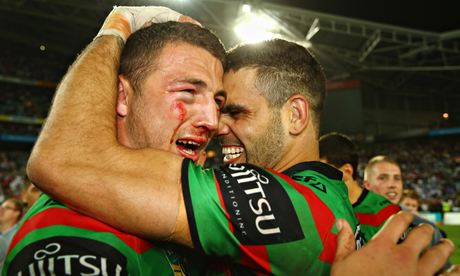
It has been an unforgettable week for Shane Richardson, the Australian who spent a few years in England launching Gateshead Thunder and then as chief executive of Hull FC. He now fills the same position at South Sydney and will be returning north with the Rabbitohs next February for the World Club Challenge, after the Pride of the League ended a wait of 43 years for a Premiership in last Sunday’s epic Grand Final.
But even now “Richo” is not entirely happy. “I look at the state of international rugby league and it just makes me angry,” he told The Observer on Friday evening, Sydney time, before heading out for his club’s end-of-season Red and Green Ball.
“I know from the years I’ve spent in the game, and the contacts I’ve made in business, and the places I’ve been around the world, that there’s a potential to do so much more. Why do players like Sam Burgess think they have to go to rugby union to play on a global stage? It’s time we did something about it.”
It was Richardson who struck a sobering tone last week when sections of the Sydney league media were suggesting that Burgess will inevitably return to Souths after the 2015 union World Cup, provided a salary cap exemption is activated for high-profile players. “I don’t think there are any guarantees because I think Sam will be a champion in rugby [union],” he said, after Burgess’s awe-inspiring display of courage in the Rabbitohs’ Grand Final victory over Canterbury. “Then the profile he gets over in England, as well as the money, will be massive. What we’ve got to do as a game is create more big occasions, nationally and internationally, so that our players receive the platform and the profile they deserve.
“That’s what makes me angry, mate. You’re not telling me that other sporting codes have got athletes to beat Greg Inglis, Jarryd Hayne, Sam Tomkins or the Burgess boys. You can guarantee there will be more where they came from, too – that’s just because of the quality of the game, and the way it nurtures these guys to take the breath away. But for pretty much its whole history rugby league has relied on its players to rescue the people who run it from stuffing it up.”
Richardson would concede that his fellow Australians have been among the worst offenders, with the scale and profile of the NRL, and the State of Origin series, leading to a Sydney-centric view which denigrates international rugby. England’s inability to offer a convincing challenge to the Kangaroos for the majority of the past four decades has not helped, either.
But now he reckons there are plenty of like-minded big thinkers at the big clubs. There is evidence of that in the enthusiasm of Brisbane Broncos and the St George-Illawarra Dragons to travel with Souths early next year for an expanded World Club Series against St Helens, Warrington and Wigan on three consecutive nights.
“But that’s been down to us as clubs to work out,” he says. “People like Simon Moran at Warrington and Russell Crowe at Souths can see the potential for the game of things like the World Club Series or the World Nines.
“Why can’t we take that sort of thing to new countries? It’s the same reason we’ve got people in America having to find illegal internet feeds to watch the Grand Final. I know the great people I met on a trip to the Czech Republic a couple of years ago, who love their rugby league, were in the same situation last weekend.
“The world’s changed so much with the internet and social media, and that gives a huge chance for league to expand on the back of the enthusiasm that hits people when they see the game. They just get bitten.
“Look what’s happening this weekend. The Kangaroos are in Papua New Guinea, where they go every year to be fair, but you’ve got Greece playing the Czechs in Athens, Fiji are playing Lebanon here in Sydney next week, there’s a European Championship coming up, which should be very competitive, and there are domestic competitions up and running from Ukraine to Canada.
“That’s what I mean about potential. I’m just not sure the International Federation that we’ve got is delivering on that at the moment. We’re constantly cowered rather than getting out there and telling the world.”