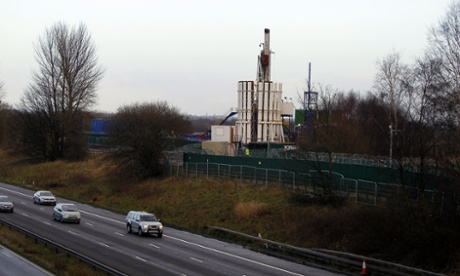
Politicians have overhyped fracking’s potential and the prospect of shale gas making Britain self-sufficient in gas again is far-fetched, according to government-funded researchers.
The UK became a net importer gas in 2004 as North Sea production declined, and the coalition has heavily promoted shale gas on the grounds of energy security and economic growth. David Cameron says the UK is “going out all for shale”.
But a new report by academics at the Imperial College-based UK Energy Research Centre (UKERC) says significant shale gas production in the UK is unlikely to get underway until next decade and will not reproduce the American ‘shale revolution’ that has put the US on course to energy self-sufficiency.
Jim Watson, an author of the report and professor of energy policy at the University of Sussex, said that industry and politicians had “overhyped” the impact shale will have on prices and energy security.
“Looking at the evidence base, it’s very hard to support some of the statements made both by industry and some politicians that it’s going to bring down prices, strengthen energy security or create jobs through cheaper energy any time soon. It may have an impact. But a lot depends on how fast shale develops,” he said.
The authors are unambiguous that shale gas will not reduce energy prices or reduce the UK’s reliance on gas imports, which are mostly supplied by Norway and Qatar today.
“Any talk of shale gas making the UK self-sufficient again, let alone allowing significant exports, is far-fetched,” says the report, The UK’s Global Gas Challenge. It also cautioned against “a blind belief that a future UK shale gas revolution will solve all our problems”.
A second report by UKERC warns that by 2025, the time any such shale gas industry is up and running in the UK, global gas consumption must have peaked and begin rapidly tailing off to avoid dangerous levels of global warming.
With the development of widespread technology to capture and store the carbon emissions from those gas plants, that deadline moves back to 2035.
But carbon capture and storage (CCS) technology is so far largely unproven at scale and the world’s first major CCS power plant only switched on last month. UKERC’s report says “whether CCS will actually be commercialised or not is currently far from certain”, though Watson says recent developments in North America mean he is more optimistic than two years ago.
The report, A Bridge to a Low-Carbon Future? Modelling the Long-Term Global Potential of Natural Gas, suggests gas’s role as a quick fix to cut carbon emissions – gas emits significantly less CO2 than coal when burned – could be short-lived.
Gas has been hailed by some advocates as a ‘bridge’ or ‘transition’ fuel as economies move to renewable energy and nuclear power to reduce greenhouse gas emissions and tackle climate change.
If CCS doesn’t take off, to keep temperature rises under 2C as governments have agreed to do, the report’s modelling showed “gas consumption peaked in 2025 and declined terminally thereafter: the role that gas can play as a transition fuel was thus substantially reduced”.
However, despite the short window of opportunity, the authors say the amount of coal that could be displaced by gas is significant in terms of cutting emissions.
Dr Christophe McGlade of UCL, who led the modelling work, said: “Gas could play an important role in tackling climate change over the next 10 to 20 years.”
Watson added: “In those countries which a have a lot of coal in their energy systems, China being the prime example, gas has a role to play with or without CCS.” He said ensuring gas consumption peaked and declined rapidly in 2025 or 2035 would “require significant policy intervention” from governments.
Gas consumption in the UK has already peaked, and development of UK shale gas has been slower than expected. Hydraulic fracturing to extract shale gas will not resume until 2015, the first exploratory fracking in the country since 2011.