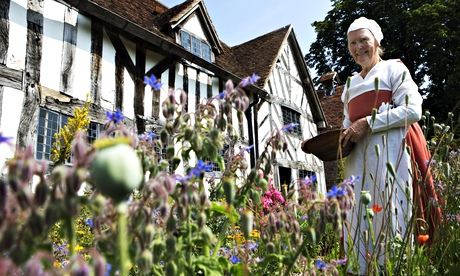
It’s Wolf Hall’s world now, and we just live in it. Which is excellent. I am all for this, especially if we maintain a gateway into a parallel universe where we can still access modern medicine, cleaning products and meals whose recipes don’t begin “First catch your sheep’s head”. And if we could keep watching briskly efficient documentaries like Shakespeare’s Mother: The Secret Life of a Tudor Woman (BBC4), presented by historian and broadcaster Michael Wood, that would be great too.
Although I suppose in that case the life a) wouldn’t be so secret and b) watching it as well as living it might cause some kind of event horizon that would bring the whole thing crashing down and leave Mark Rylance, Damian Lewis and assorted other stars of British stage and screen unexpectedly unemployed. (Is anyone else waiting for Benedict Cumberbatch to pop up as Tudorbethan Sherlock, solve the mystery of the princes in the tower and turn the whole thing into a crazy counterfactual that can only be put right by Matt Smith strapping the whole thing to the Tardis and pulling it back through a wormhole?)
BUT. Let us return our attention now to Mary Arden, born around 1535 into an old Warwickshire farming family and just in time to live through all the social, political and religious upheavals Henry VIII’s penis had precipitated. I simplify slightly. By the time Mary died, her country had been ruled by five different monarchs and undergone four changes of official religion. Good times.
Despite all this history going on she somehow found time to learn to read, do arithmetic and (maybe) to write, before marrying glovemaker John Shakespeare and having eight children of her own. The third of these was – dum-dum-DAHHH – William Shakespeare himself! Though they didn’t know about the “himself” or the exclamation point yet.
They moved to Stratford where John eventually rose to become mayor before getting into wool, trouble and bankruptcy, which forced William to leave school instead of going to university. At 18 he got 26-year-old Anne Hathaway pregnant and they – and the twins that shortly followed – were all under his parents’ one roof. Fortunately she was soon miscast, but lucratively so, in Tom Hooper’s film adaptation of Les Miserables and … no, I jest of course. I just couldn’t resist.
The family became a target for anti-Catholic harassment and things didn’t begin to look up until the late 1580s, when William started making good with his plays in London. By the time Mary died in 1608 she was comfortable once more. Or at least as comfortable as any woman who had borne eight children under Tudorbethan conditions could have ever expected to be.
If there wasn’t actually very much about Mary Arden herself in the programme, you could choose to call this a failure of titling rather than programme-making. It was another way of looking at an era that currently has us more than ever in its thrall, and it mapped the personal and political topography very well. Which is not to say there isn’t still, therefore, space for a proper look at Mary Arden – or perhaps, a proper look at why we cannot get a proper look at Shakespeare’s mother, or wife, or daughters, or most of the women who did not end up as queens or crowned mistresses of kings. What and who gets left out of history could surely be as compelling as another trip round the figures we all know by now quite well. Miranda Richardson and Glenda Jackson could share the voiceover as Elizabeth I and break both acting and TIME ITSELF.
Over on Channel 5 was the opening episode of Britain’s Biggest Primary School, the product of six months’ filming of the 1,100 seven-to-11-year-olds and 160 staff in the 38 classrooms at Gascoigne primary school in Barking. The first episode, however, focused mainly on 10-year-old Lee and his teachers’ attempts to deal with the behavioural problems he has had since his mother died suddenly last year. Which is to say that while dealing with all the concerns of their other 1,099 charges, they are also trying to help a child deal with an unbearable grief.
“But,” says Lee, wrestling with the advice his beloved Miss Murphy tries to give him in one of their chats, “I’ll never see her again.” As your heart broke, anger too flooded out. Where are the services to help him and his teachers with this? Why is his suffering being aggravated by borderline homelessness and relocation miles away from the school that is giving him so much? Why do we put up with a set of systems that compounds instead of alleviating terrible suffering? When is the general election? Will things be any different then?