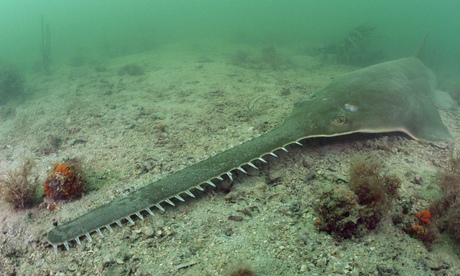
If sawfish weren’t already strange enough, we have now learned that they can reproduce themselves independently of the mechanism of sex. This is known in captive animals, but very rare in the wild. Why should the sawfish resort to such measures? Scientists who conducted the new study at Stony Brook University, New York, believe the animal may be responding to threat – the possibility of species demise. By such extreme inbreeding, the sawfish may save its future – although at the expense of genetic diversity.
Parthenogenesis may sound like the title of a bad sci-fi blockbuster, but it is a phenomenon not uncommon in captive animals, which respond to confinement by doing away with the usual necessities of conjugation. It occurs in bees, starfish, crustaceans and reptiles. More “complicated” animals also exhibit the ability. In 2008, a female shark in an Hungarian aquarium gave birth to a pup without having had contact with a male shark. Birds, too, can reproduce parthenogenetically, but the phenomenon is restricted mainly to domesticated chickens, turkeys and pigeons. There are no naturally occurring instances among mammals – although rabbits, who one would imagine hardly need it, have been artificially induced to reproduce thus.
Among humans, stem-cell technology is bringing parthenogenesis ever closer. In 2007, the International Stem Cell Corporation declared that it had created human stem cells from unfertilised human eggs using parthenogenetic methods.
Such techniques may avoid genetically inherited disorders. But they propose a plaintive notion, these sexless unions. They speak to a dystopian world, evocative of the science fiction of Margaret Atwood. Charlotte Perkins Gilman’s 1915 novel, Herland, foresaw a female society that reproduced entirely through parthenogenesis, partly as a response to then-fashionable theories of eugenics. A recent scientific study, which appeared, with obvious timing, in the British Medical Journal at Christmas 2013, noted an increasing number of women claiming to have given birth without having had sex. It recorded 45 women who had reported virgin pregnancy without the aid of reproductive technology. This was explained by cultural factors – often the religious beliefs of the people involved.
The same paper noted that parthenogenesis has also appeared in popular culture, from Spielberg’s Jurassic Park – in which it was a key factor in the propagation of the dino-park – to a 2008 Doctor Who episode, Partners in Crime, in which the Doctor investigates a miracle weight-loss pill being tested in London by Adipose Industries, and discovers blobby aliens reproducing themselves using human fat. In our increasingly solo lives, it seems possible that we may well end up resorting to parthenogenetic procedures. But I’m guessing that most Homo sapiens lucky enough to be given the choice will continue to opt for the traditional method.