Everyone was enjoying sex all the time in the 18th century, to judge by its art. The century of the American and French revolutions was also a time of open-minded, unstuffy attitudes to love and desire. News that a 1766 edition of a popular sex manual called Aristotle's Masterpiece is to be auctioned next week in Edinburgh is incitement enough for us to explore some Enlightenment erotica.
The most important thing about Aristotle's Masterpiece, first published in the 1680s, was its advice that women needed to experience sexual pleasure as part of the reproductive process. This argument for equality in bed chimes with images of the boudoir as a female domain in Rococo art. William Hogarth's satirical depiction of an aristocratic bedroom from his series of paintings Marriage à la Mode shows a countess at her toilette surrounded by flunkeys (including a eunuch singing opera) while her lover suggests they meet later at a masked ball. Her bed is a pink curtained place of pleasure.
What Hogarth laughs at, French Rococo artists indulge. Antoine Watteau's intimate painting of a woman naked in her bedroom is based on a sketch of one of his friends. But the most daring nude in 18th-century art is surely François Boucher's portrait of Marie-Louise O'Murphy lying on her stomach on a divan. Mademoiselle O'Murphy, daughter of an Irish emigre and mistress of Louis XV, shows the artist her buttocks in a self-consciously sexy pose.
Not that love needed a velvet-draped boudoir. A clump of bushes would do, as Hogarth illustrates in his paintings Before and After. Country pleasures start with kisses and end in exhaustion.
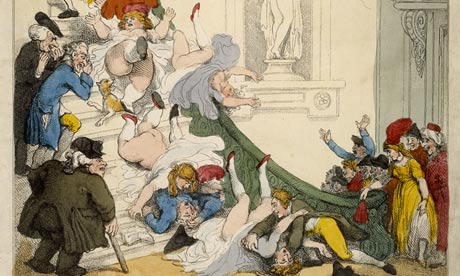
It seems that sex could be found anywhere in an age that celebrated quick thrills. In the Regency cartoonist Thomas Rowlandson's picture The Exhibition Stare-Case, "connoisseurs" are examining the underwear of women who have fallen down the spiral staircase at the Royal Academy (today, the same staircase serves the Courtauld Gallery).
Rowlandson drew his saucy scene in the early 1800s, when louche attitudes still flourished, but by the Victorian age artists – at least in Britain – would be a lot more respectable, religious, and vague. The famous pre-Raphaelite painting The Awakening Conscience shows a mistress seeing the light about her sinful life. A century earlier, this trite painting would have seemed just as absurd and funny as it does today.