Squeamish readers might want to close this book after its initial pages yet find themselves compelled to keep reading. That repulsion/ attraction to the gruesome is an instinct that anthropologist and historian Frances Larson captures in this meticulously researched account of severed heads and skulls in literature, art, science, religion, warfare and crime. From Hamlet’s graveyard encounter with Yorick’s skull, and the extraordinary journey of Oliver Cromwell’s head, to Damien Hirst’s With Dead Head, and contemporary cryonics, it’s a subject that moves people “to turn away or to look a little closer”, explains Larson, “and to reflect on the limits of their humanity”.
Objects and the stories they tell permeate Larson’s work, and she has a talent for exploring the topic: her first book, An Infinity of Things, was a biography of Henry Wellcome, a voracious collect of medical artefacts, and she co-authored Knowing Things, a book on the history of the Pitt Rivers Museum, home of Oxford University’s archaeological and anthropological collections. It was at this museum, surrounded by “shrunken heads”, that the idea for Severed developed.
Throughout the book Larson intelligently explores the point at which a person becomes an object, an inanimate thing, and also considers states of emotional and psychological detachment that cause people to dehumanise and objectify others, and how a “sense of social detachment can turn a person into an object before they are even dead”. She grapples with notions of civilisation and savagery around the world as she traces the histories of both head-hunters and the head-hunted, how “usually the people who take heads see themselves as inherently different from the people whose heads they take”.
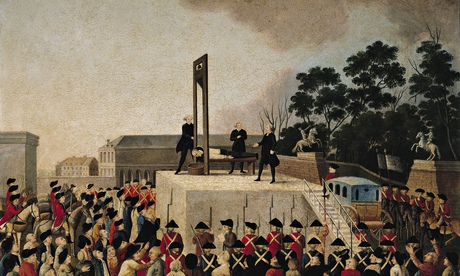
Both victims and voyeurs of violence throughout the ages fill the pages, from the first execution by guillotine in Paris, 1792, to those who pressed their faces against glass cases in museums to view severed heads, to videos of decapitations circulating online. Although the timeframe covered mainly predates jihadist beheadings, Severed has horribly timely insight to shed.
Severed is published by Granta (£9.99). Click here to buy it for £6.99