KYOTO -- More than 10 months have passed since the fatal arson attack on a Kyoto Animation Co. studio shocked anime fans around the world. On Wednesday, the Kyoto prefectural police arrested 42-year-old suspect Shinji Aoba, who was at one point on the verge of death from serious burns he sustained over his entire body at the crime scene.
Investigation of the murder case -- which involved 36 fatalities, the most ever in the Heisei era (1989-2019) -- began with a number of unusual measures.
Aoba was arrested at 7:18 a.m. on Wednesday. Investigators from the prefectural police came to a Kyoto hospital where Aoba was hospitalized, and read the arrest warrant to him as he lay in bed. Aoba responded calmly, "That's correct," according to police.
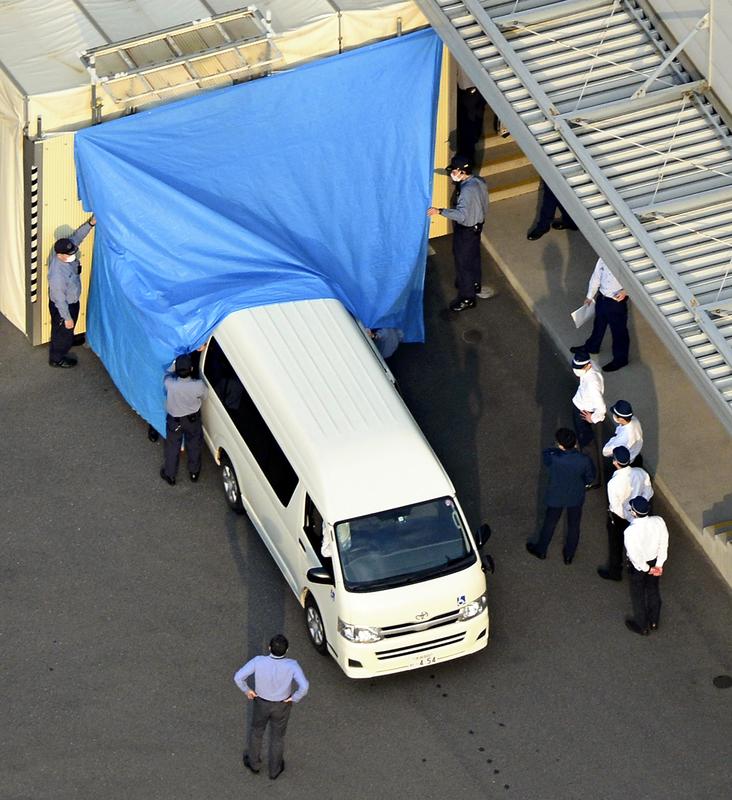
At about 7:40 a.m., Aoba was taken on a stretcher through the hospital entrance, which was covered with blue sheets, to a welfare van prepared by the police. The van carrying him was sandwiched between police cars on the way and arrived at Fushimi Police Station about five kilometers away at 8:06 a.m.
When he was taken out of the van, Aoba was wearing a blue gown and a white mask. With his body fastened to the stretcher by a belt, the suspect kept looking at the assembled reporters as he entered the station. Aoba's fingers were deformed, and the skin on his face and hands was mottled with red and white, showing vivid marks of serious burns. According to the police, he was not put in handcuffs due to the burns.
Aoba was questioned on a stretcher at the police station. According to the police, he said, "I thought using gasoline could kill a lot of people." He even signed a statement of his confession. After that, a prosecutor from the Kyoto District Public Prosecutors Office came to the police station and completed the process of sending the case to prosecutors.
Aoba was again taken to the welfare van and moved to the Kyoto District Court. Courts usually hold detention hearings to determine whether a suspect needs to remain in custody during an investigation. On that day, the judge apparently heard arguments from Aoba's side and then judged whether the prosecutors' request was appropriate.
The district court decided to detain him for 10 days from Wednesday, after which the van carrying Aoba left the court shortly after 4 p.m. He then arrived at the Osaka Detention House about 1-1/2 hour later.
The Kyoto prefectural police decided to arrest him based on opinions from several doctors who said Aoba would be able to withstand detention, and due to concerns over the deterioration of Aoba's memory.
Prefectural police officers were to visit the detention house from Thursday to conduct questioning. Aoba was to have his temperature checked beforehand to see if he has a fever. The hours of questioning were also to be limited.
"It is unprecedented for a suspect requiring assistance to be arrested. If questioning is conducted [of someone] in an unstable physical condition, doubts will arise about the voluntary nature of the suspect's confession," said Megumi Wada, a lawyer at Center for Criminal Defense of the Japan Federation of Bar Associations.
Collecting evidence is another challenge. Aoba stopped by a gas station and other places before attacking the studio, but it will likely be difficult for him to be present for police's on-site investigations.
Under the Code of Criminal Procedure, suspects can meet with lawyers without the presence of police officers, under the right of access to a lawyer. Aoba's lawyers have not yet been appointed, but it is unclear whether he will be able to communicate with them.
"There may be unexpected situations occurring in the future. This is a serious case that killed 36 people, so careful investigation is required for a fair trial," Wada said.
Read more from The Japan News at https://japannews.yomiuri.co.jp/