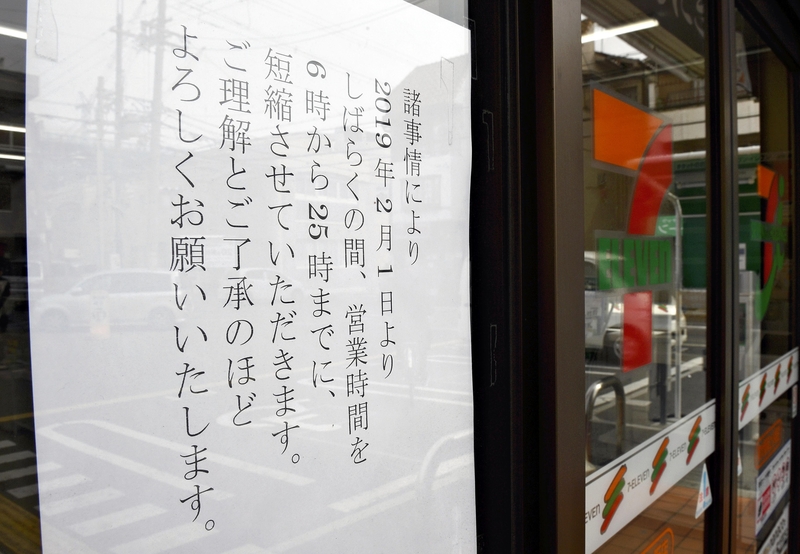
Seven-Eleven Japan Co. and one of its franchisees are facing off after the outlet owner quit operating around the clock due to difficulties in recruiting part-timers.
Nowadays shoppers also use convenience stores to pay utility fees, and the existence of such outlets plays a part in crime prevention, making them function as bases for life infrastructure in local communities. The latest confrontation between franchiser and franchisee will likely stir up a debate.
Starting this month, a Seven-Eleven outlet in the Minamikamikosaka district in Higashiosaka, Osaka Prefecture, reduced its business hours to 19 hours a day -- opening from 6 a.m. to 1 a.m. The decision was made because the franchisee was unable to recruit part-time employees, so he decided that it would be difficult to keep the store open around the clock.
Following the move, the franchise owner was then reportedly requested by the chain's headquarters to pay about 17 million yen because of breach of contract, but the franchisee insists on the need to shorten the shop's operation time. When it gets difficult to recruit employees, franchisees could be forced to work on their their days off to cover staff shortages, resulting in long working hours.
In response, Seven-Eleven Japan released a statement on Wednesday in which the franchise chain's headquarters said, "Seven-Eleven stores have not only been in the business of selling merchandise, but have also been operating as social infrastructure." The statement also said that the company "will support the store so that it will be able to continue 24-hour operations," expressing the intention to continue talks with the franchise owner in Higashiosaka.
Most operators in the convenience store industry basically keep their shops open 24 hours a day, seven days a week. Out of the about 50,000 combined outlets of the three major chain convenience store operators in Japan -- Seven-Eleven, FamilyMart Co. and Lawson, Inc. -- stores that open on reduced hours account for only 3 percent to 5 percent. Many of them are located in such places as train stations and office buildings, which are closed during the night.
Convenience stores also function as basic infrastructure where shoppers use ATM services and pay utility fees. Many convenience stores have made agreements with local authorities to serve, among other purposes, as bases for providing support to people stranded at times of disaster.
In addition, store management is also designed based on around-the-clock operations, as merchandise delivery and cleaning, for instance, are mainly conducted late at night when there are fewer customers.
There is also a high demand for 24-hour operations among consumers. Lawson once reduced opening hours at some of its outlets on a trial basis, but it generated a negative impact on the number of both daytime and nighttime customers, as well as on sales.
However, severe labor shortages have prompted some operators in the distribution and restaurant industries to reduce opening hours. Royal Host Co. ended 24-hour operations at its all outlets in 2017.
A similar trend has appeared in the convenience store industry. Hokkaido-based Secoma Co., which operates Seicomart stores, keeps only about 20 percent of its outlets open around the clock.
In South Korea, which surpasses Japan in the number of convenience stores per capita, it became illegal in 2014 to force franchisees to have their shops open 24 hours.
Lawson has set up an employment agency and dispatches staff to its outlets. Convenience store operators have introduced self-checkout machines in an effort to reduce manpower, or have been working on measures to realize unmanned operations in some of their outlets.
However, an industry source said, "It will still take some time to drastically improve the labor shortage situation."
"It is a too heavy burden for franchise owners to undertake a role to operate [their stores as bases for] basic living infrastructure," said distribution analyst Hiroaki Watanabe. "It is time for companies as well as the central government to step up getting involved with measures to work toward improving labor shortages."
Read more from The Japan News at https://japannews.yomiuri.co.jp/