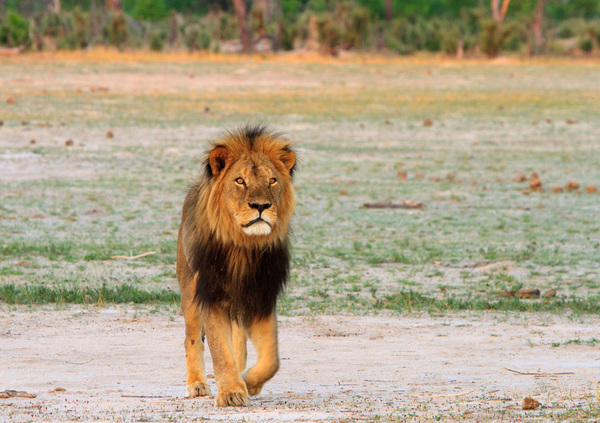
A new book offers new details from the most revealing account yet of the killing in July 2015 of a prized lion in Zimbabwe by a Minnesota trophy hunter.
Biologist Andrew Loveridge's "Lion Hearted: The Life and Death of Cecil & the Future of Africa's Iconic Cats" says Walter Palmer, of Eden Prairie, Minn., was perched in a tree stand downwind from an elephant carcass that had been dragged into place before the meal-seeking lion was wounded with one shot from the Minnesotan's compound bow and then finished off nearly a half-day later with another arrow.
Loveridge, who had studied Cecil for his last eight years on behalf of Oxford University, described in his book the ideal circumstances that made the animal "an easy lion (for Palmer) to hunt _ a park lion, well-fed and habituated to people."
Palmer's guide and an assistant moved the elephant carcass about 1,000 feet "to a suitable location," and the stand and hunting blind were built for Palmer to use, the book says. Baiting lions with food is specifically outlawed in Zimbabwe.
"The big cat sniffed the clearing," the book says. "The draw of the elephant meat overcame the lion's caution, and he approached the carcass. He settled down to feed, tearing at the tough, dry meat with scissor-like teeth. He fed for a few minutes, oblivious to the hunter taking up the tension on his bow."
Cecil's death provoked international outrage over big-game hunting, and Palmer was vilified in protests and in social media. The tumult forced him to close his Bloomington dental practice for several weeks in 2015.
Palmer was never charged with a crime for Cecil's death and said in an interview with the Star Tribune two months after the hunt that the kill was legal, and that he and the others in his guided hunting party had no clue that the lion was the revered 13-year-old with the distinctive coal-black mane.
Also, the excerpt did not include whether Palmer knew what was being set up on his behalf by the guide, who was paid $50,000.
A court in Zimbabwe dropped charges against the guide who helped Palmer track and kill Cecil, ruling that the expedition leader didn't do anything wrong in the killing of the lion on a neighboring farm just outside its protected Hwange National Park.
The Oxpeckers Center for Investigative Environmental Journalism, Africa's first journalistic investigation unit focusing on environmental issues, reported in the wake of Cecil's death that hunting outfits relied on baiting lions out of Hwange to satisfy their clients.
"Due to the scarcity of lions outside the national park, private hunting operators with properties adjacent to Hwange have resorted to the widespread use of baiting to lure the animals on to their properties to be sold off and shot," the South African-based center quoted one researcher as saying soon after Cecil was killed. "There is just a railway line to separate the park from the private land, so baiting them out of the national park is very easy. Because they move in prides, entire lion families can be lured out to sure death in a single baiting operation."
"Lion Hearted," scheduled for release in April, is based on is based on Loveridge's interviews with people involved in the hunt, statements made by those involved, and analysis of the location data collected via satellite from the GPS collar that Cecil wore at the time he died.
Palmer, his legal adviser Joe Friedberg and a media representative did not respond to requests for comment.
Among the book's other highlights:
_ After Cecil was first wounded, members of the hunting party could "hear (the lion) struggling to breathe," and Palmer was instructed to "finish the lion off." Cecil most likely was killed 10 to 12 hours after being wounded.
_ Cecil's GPS collar was taken off his neck at some point and never recovered. One of the guides admitted removing the collar in a moment of panic and hung it on a tree near where Cecil was killed.
The excerpts of "Lion Hearted" were reported by Wildlife Watch, an investigative reporting project between National Geographic Society and National Geographic Partners focusing on wildlife crime and exploitation.