Sports reporters tend to cherish the moments when they got there first. That time when, shoe‑horned into some wind-blown press box you turn a glazed and bloodshot eye towards the pitch and find yourself gripped suddenly by some vision of the future: the infant superstar, the world champ in mufti, the man-child sporting genius emerging ready-made from his urban dustbin, nostrils flaring, a scowl of destiny across his brow.
Of course, this doesn’t happen very often, if ever. Most of the time the future presents itself and you just happen to be looking the other way. For example, I was in Innsbruck in June 2008 for Spain versus Russia, the moment the greatest international football team of the modern age began a run of 19 tournament matches that brought three trophies and a legend of glorious soft-touch collectivism. Not bad, this Spain team I wrote. One thing, though. They need to drop this Xavi chap. Too much passing. Slows things down. Yup, Xavi. The greatest midfielder of his era, who would define a champion style like no other player in history. He’s your problem. Just get it forward. Hit Fernando. Yes, well, demand it, son.
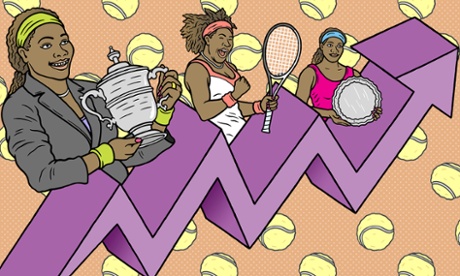
I mention this here because of the news this week about Serena Williams, who has retained the world No1 ranking, nudging up past Martina Hingis into fourth on the all-time list of longest No1s, while also turning up at the WTA finals in Singapore despite a chronic knee injury and thus helping to ensure that she ends the year ahead of perennial Serena-lite Maria Sharapova at the age of 33.
At moments such as these, you see, my thoughts turn to Pat Cash – Come on Pat! Up here! Ladies and gentlemen, Pat Cash! – who seven years ago wrote what is surely one of the great wrong calls of modern sporting history, a newspaper column in which he dismissed Williams as both “a lost cause” and “deluded”, a player with “a limited attention span”, lacking the “fortitude” and “application” to get back to winning tennis tournaments. To be fair, Cash had some evidence to support his views at the time and made his case with erroneous lucidity.
But the fact remains there has always been a part of tennis that has wanted Serena to fail: to turn out to be in some way a mistake, a lacuna, an oversight. As long ago as the 2005 Australian Open she was being forced to deny she was finished (a point she reinforced by winning the tournament). And two years later there was Cash, consigning to the dustbin of history – and he’s not angry here, just a little sad – one of his sport’s all-time great champion athletes, a washed up 25-year-old who would before long be eclipsed by the combined grand slam might of Ana Ivanovic and Nicole Vaidisova.
Since when – despite being so deluded and finished – Serena has won 11 grand slam singles titles and two Olympic gold medals. She didn’t just defeat Sharapova in the final of that Australian Open two weeks later, she annihilated her in an hour, chucked her racket in the air, did a lap of honour, high-fived the crowd and with a very genuine sense of eloquent and unmawkish affection, devoted the win to her murdered sister, Yetunde. So not, it seems, actually finished after all then.
Indeed one of the brilliant things about The Cash Declaration is that in attempting to list everything wrong with Serena it has instead turned out to be a perfect distillation of so many things that are right. Yes: she remains a serial comeback artist. But more than this, and as Cash captures so well, her success has come despite a vague, often unspoken, often spoken, sense of broader hostility. Not just the talk over the years of not taking tennis seriously enough by missing tournaments – as Pete Sampras and Andre Agassi did too at times – but beyond this the suggestion that her particular brand of on-court greatness counts a little less, as though to win this way – to be stronger, more athletic, more thrillingly competitive – is in some way cheating, a shortcut, a get-out.
Which is, of course, a basic misunderstanding of how sport works. Serena may not be built along the lines of the wonderfully dainty Martina Hingis, who played a set of tennis as though delivering a crisp, punitive lecture on geometry and basic physics to some hulking sixth form reprobate. She may not have the soft touch of Agneska Radwanska, who interprets the sport as a selection of beautiful little precision engineered moments, a bar room brawl that can still be won with a series of brilliantly timed sarcastic remarks. But nobody ever bludgeoned their way to 18 grand slams, just as power itself isn’t a gift but a craft, a product of timing and practice and technique. The Williams serve is a refined knockout blow. That famous forehand is a stately, beautifully orthodox thing of rotation and extension, and pure mechanical grace.
And this is the best thing about Serena: the comprehensive confounding of expectations. Here she comes: ditzy, a flake but somehow also supremely hard‑nosed, the girl who couldn’t concentrate but who is now the oldest WTA No1 of all time. Not to mention a career gadfly, with her avaricious outside interests; who is, it turns out, only the second-best-paid female tennis player behind Sharapova, who has remained top of the money charts through the last decade of being regularly swatted off court and who is even now hawking about her wretched sweet shop empire with apparent impunity.
There is, of course, talk now of a final reckoning-up in the months to come. That knee isn’t getting any easier and it seems all but impossible, entering the 20th year of her Cash-doomed, fortitude-free professional career that Williams will claim the four grand slams she needs to equal Steffi Graf in the open era.
And yet she remains a remarkable and indeed inspirational athlete. For now it might just be best – Hi, tennis! – to keep those oddly muted and conditional farewells on hold a little longer.