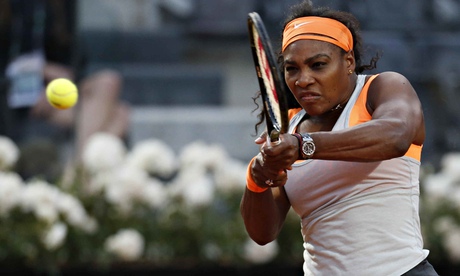
To lose one draw card halfway through a tournament is unfortunate but, when Serena Williams, the defending champion, joined Andy Murray in packing her bags on Thursday, a sense of slowly unravelling chaos took hold of the Rome Masters.
While the Scot offered fatigue as an excuse – understandable from a personal point of view before the French Open after a gruelling clay-court run, but buttering few parsnips with the fans or the organisers – Williams at least could point to an injury to her right elbow when announcing she could not fulfil her third-round match against her compatriot Christina McHale.
“It wasn’t an easy decision,” she said. “I talked with my coach and he was like: ‘It wouldn’t be very smart for you to play.’ I said: ‘I hate quitting,’ and he said: ‘This is not about quitting, this is about making the best decision.’”
Murray and Williams have well-founded expectations of making strong runs in Paris, so it is not unreasonable they prioritise those ambitions.
“It’s smart that I learned from things in the past,” Williams said, referring to previous withdrawals ahead of slams. “If I continue to play it can really hurt my chances, not only for Roland Garros but maybe also for Wimbledon.” The American added that her elbow began hurting in Madrid last week. “I wasn’t serving my best,” she said. “When you’re injured you don’t have that much confidence.”
It was not a great day for the family as Simona Halep walloped her sister Venus 6-2, 6-1. Halep meets her fellow Romanian Alexandra Dulgheru, who put out the Russian Ekaterina Makarova in two sets. Maria Sharapova advanced smoothly past the Serbian qualifier Bojana Jovanovski and, in the absence of Serena, may assume favouritism for the title.
Much has happened to Stan Wawrinka since he beat Rafael Nadal in the final of the 2014 Australian Open, a breakthrough slam victory that was supposed to propel the Swiss at least into the outer orbit of his compatriot Roger Federer. It has not quite worked out that way.
Wawrinka, one of the game’s enigmatic figures, celebrated wholeheartedly then struggled for consistency when the euphoria faded, winning a further 37 of 54 matches that year, although he arrived in Rome this week with a respectable 18-6 log and two titles in the bag.
However, an acrimonious split with his wife of six years, Ilham, last month looks to have been a sufficient distraction to blunt his focus, and he lost distractedly when trying to defend his Monte Carlo title.
Now, after 16 months of enhanced celebrity, a switch of name from Stanislas to Stan, as well as a few highs and desperate lows, the quiet man of tennis plays Nadal again, in the quarter-finals on Friday. It is unlikely to be dull.
Wawrinka, seeded eighth, dropped a set in his opening match against Juan Mónaco but restored equilibrium in the third round, beating the talented young Austrian Dominic Thiem 7-6 (6-3), 6-4 without fuss on a heaving Court Pietrangeli in an hour and 37 minutes. He struck nine aces, winning 90% of his first serves and grabbed the only break that came his way.
Nadal, after injuries, illness and his own downturn in form, looks to have rediscovered much of his clay-court mojo at the right time. In draining heat earlier, he took an hour and 19 minutes to beat John Isner 6-4, 6-4 in pursuit of his eighth title here.
Nadal has had problems against Isner in the past, notably in the first round at Roland Garros in 2011, when, after taking the first set, he dropped the next two before grinding out a tricky win. On Thursday Nadal struck first again, breaking in the fifth game to snap a run of 86 successful service games for the American – and the Spaniard was the last to break him, in the fourth game of the third set in Monte Carlo last month.
Isner has few problems holding serve from his 6ft 10in launchpad, and arrived in Rome at the top of the aces board, with 134 free points in nine clay outings this season. But he struggles to break opponents, which is a mystery to admirers who despair of the repeated tie-breaks he has to fight through.
Nadal saved him the agony in the first set, despite double-faulting with three set points in the bag, and took the lead on a sweltering day after 35 minutes with an unreachable crosscourt forehand. He did not want a protracted war with the marathon man of tennis.
Of players involved in more than 20 tiebreakers this year, Isner has played most but won only 12 of 28 – so his potency in quick deciders is not what it was. It cannot be easy being John Isner. When he failed to handle a difficult volley in the ninth game of the second set, giving Nadal the break again, life looked decidedly glum for Big John.