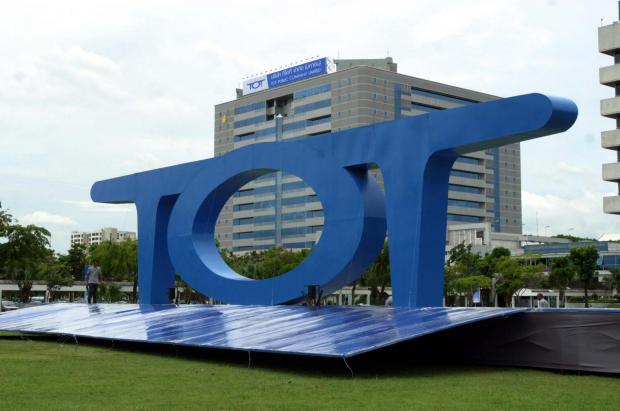
The State Enterprise Policy Office (Sepo) will propose to the new government a plan to merge TOT Plc with CAT Telecom, a move deemed essential to helping the two state telecom firms turn the corner.
After the merger plan wins cabinet approval, Sepo will still need to monitor the consolidated entity's operating performance to see if efficiency is improved and usage of duplicate resources such as telecom networks is reduced before an exit from rehabilitation is considered, said Sepo director-general Prapas Kong-Ied.
TOT holds the 470MHz, 2100MHz and 2300MHz spectra, while CAT has the 850MHz band.
TOT and CAT are among the five financially ailing state enterprises that are required by the State Enterprise Policy Commission to rehabilitate their business. The others are flag carrier Thai Airways International Plc, the State Railway of Thailand and the Bangkok Mass Transit Authority.
Earlier, two state enterprises -- the Small and Medium Enterprise Development Bank of Thailand (SME D Bank) and Islamic Bank of Thailand (IBank) -- exited from rehabilitation plans after they managed to significantly lower bad loans and swing back to profit.
Mr Prapas said a new law on state enterprise supervision and management, enforced from May 23, will help enhance efficiency in supervising state enterprises.
According to the act, which is aimed at enhancing the efficiency and transparency of state enterprises, all enterprises are required to conduct a five-year development plan as an investment guideline and adopt innovation and corporate governance.
Sepo will need to propose over 20 organic laws under the act for state enterprise supervision and management, Mr Prapas said.
He said the outgoing government's policy is to front-load any investment projects that are ready to boost the country's economy later this year.
Sepo has informed all state enterprises, particularly Airports of Thailand Plc and the state railway, about the front-loading policy.
Thailand's economy grew by just 2.8% in the first quarter of the year, the lowest reading since the end of 2014, largely due to a drop in exports and public investment.