Conventional wisdom says Terence Rattigan was a victim of the repressiveness of the 1950s. My view is that this master of oblique understatement wrote best within formal restrictions. The point is confirmed by this production of Rattigan's famous 1954 double-bill using the dramatist's more explicit, later text without noticeable gain.
Both plays are set in a Bournemouth private hotel filled with genteel sadness; and, in the second play, Table Number Seven, we witness the exposure of a bogus major. In the original his offence was interfering with women, whereas here it is male importuning. But Rattigan's discreet metaphor was more powerful than his subsequent candour; and it is significant a modern audience tends to laugh at such almighty pother about a relatively minor sexual offence.
I suspect audiences in the 50s knew what Rattigan was on about. His indirect approach was also consistent with his talent for subtext. There's a marvellous moment in Sarah Frankcom's revival when Alexandra Mathie as the hotel proprietress admits to a hopeless love with a forced cheerfulness that reveals a fractured heart. And there is something uplifting about the climax when the hotel residents rebel against the odious Mrs Railton-Bell's planned expulsion of the fake major: it remains a victory for decency and tolerance and is here movingly confirmed by the shy, complicit smiles exchanged between Nigel Cooke as the persecuted survivor and Clare Holman as his mousy ally.
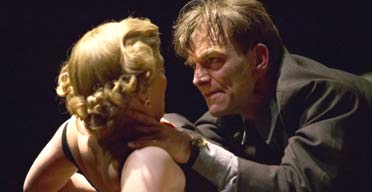
Cooke and Holman also appear to good effect in the first piece, Table By The Window, playing a leftwing journalist and his upper-class ex-wife who has tracked him down to darkest Bournemouth. What strikes one now is how uncannily the play anticipates Look Back In Anger in its combination of the sex and class war and its portrait of marriage as a violent battleground.
Even if Rattigan lacked Osborne's incandescent prose, he created a rich gallery of minor characters, here excellently embodied by Janet Henfrey as the hotel's resident dragon, Ian Barritt as a Chekhovian schoolmaster and Ann Firbank as an impoverished widow. The evening reminds one just how much the British theatre lost by its sacrifice of Rattigan on the altar of the Royal Court revolution.
· Until May 13. Box office: 0161-833 9833.