Power struggles often play out in Senegal’s political arena, both within a party and between rival parties. To summarise British foreign minister Lord Palmerston’s argument in 1848:
In politics, there are no permanent enemies, no permanent friends, only permanent interests.
The situation at the top of Senegal’s executive branch is no exception.
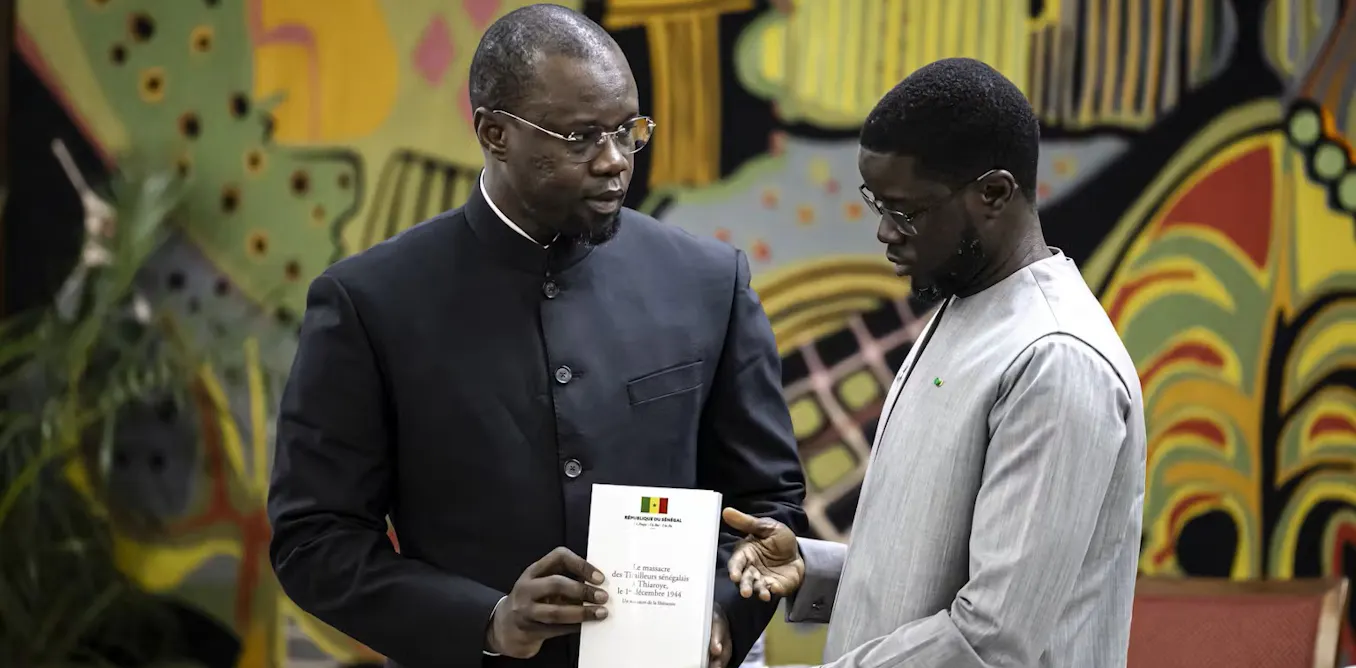
The Sonko-Diomaye duo, formed by president Bassirou Diomaye Faye and his prime minister Ousmane Sonko, used to speak with one voice. Today, the alliance that oversaw the fall of former president Macky Sall is plagued by deep internal divisions. These disagreements culminated on 22 May 2026 with the president’s announcement that he’d dismissed the prime minister and dissolved the government.
A political rally held by Sonko in November 2025 already showed signs of a fracture. In an interview six months later Faye removed all doubt. The president confirmed there were disagreements with his prime minister. He denounced the “excessive personalisation” of power around Sonko.
I am a political scientist whose doctoral research focuses on the recent transformations of Senegal’s political system. It examines the rise of the ruling party, Pastef, and the sociopolitical realignments observed between 2021 and 2024, in a period of political instability. I analyse how this anti-establishment party succeeded in upending the traditional sociopolitical order.
In my view, their split is a worrying sign of potential political turmoil ahead for the country, which is also battling an economic crisis.
The myth of unity
This unprecedented duo was forged when opposition leader Sonko’s candidacy to run for president against Sall was invalidated in January 2024. Sonko, the founder of Pastef, backed the party’s less well-known secretary-general, Faye, in securing the elections. In turn Faye backed Sonko to become prime minister.
Initially their relationship was built on political alignment. One handled the management of the state apparatus, the other ensured strong political legitimacy during the first months of their rule.
However, Pastef’s 2025 rally revealed the limits of the two-headed illusion championed by Sonko. As he predicted at the time, the event marked the beginning of a “post-November 8 era”, a turning point for the future of the partnership.
Read more: Bassirou Diomaye Faye: from prison runner-up to president of Senegal
But the relationship between the two men soon led to deadlock. First, they disagreed over who should head the ruling coalition. Then came clashes over differing visions of power. Finally, disputes emerged over political alliances.
The once unifying Wolof slogan “Sonko mooy Diomaye” (Sonko is Diomaye) was Pastef’s survival strategy under Sall. That slogan has faded and is giving way to the likes of “Sonko is Sonko” and “Ousmane is Sonko”. The work of Senegalese journalist Sidy Diop supports this view. Diop shows that:
The proclaimed unity is over. It is giving way to a duality that is now visible, almost accepted, where roles are being redefined and ambitions are becoming clearer.
However, from the perspective of the theory of domination and symbolic reproduction, Sonko built what could be called a “proxy capital” (borrowed influence). Their symbolic fusion created a unique shared identity – “partisan habitus” – in which Pastef supporters no longer perceived two distinct figures, but a single political force.
Rivalry between the two leaders was inevitable, despite the “complementarity” that initially defined their entry into executive power. Senegal’s political system demands a clear hierarchy. The president’s authority is not shared.
The powers of the president of the republic and the prime minister are defined by Senegal’s constitution, in articles 42 through 52. This already created a kind of “soft rivalry”.
Faye tends to adopt a restrained posture, acting as a guarantor of proper functioning of institutions. Sonko, on the other hand, maintains a style of mobilisation and disruption. As French sociologist Pierre Bourdieu argues, institutional structures dictate individual actions, language, and posture. Not the other way round.
The office of the presidency imposes a “sovereign habitus” that naturally differs from the habitus or mindset of the prime minister and party leader. In line with the principle of separation between the functions of head of state and party politics, Faye resigned from all leadership positions in Pastef, including secretary-general. By law, however, Sonko was allowed to retain his leadership positions in the party. This further fuelled their stand-off.
The boundary between the two men is mostly invisible but very real. It lies in the transition from the street-level slogan “Diomaye is Sonko” to institutional communication where the image of the president comes first, as protocol demands.
Sonko brought Faye to power. But Faye now holds discretionary authority, including the power to appoint officials. This has created a political polarisation between factions of the party that support Faye or Sonko.
The limits of dual leadership
In physics, when two bodies of unequal weight occupy the same space, the heavier one compresses the lighter. Power is not static, just as human nature is not.
Through upward influence, Sonko draws his strength from his charisma, and strong grip on the party. He has given Faye popular legitimacy. In return, the president’s executive orders and state decisions have translated the party’s “vision” into Senegalese law.
It soon became a tricky situation: if Sonko took up too much space, his influence would spill over into Faye’s institutional territory. The president may appear to be under his tutelage. If Faye isolated himself too much, he would lose his source of legitimacy, which is Sonko. They became locked in a system of mutual dependence and self-destruction as power shifted between the president’s office and the prime minister’s.
By mimicking each other’s desires, they become mirror image antagonists. The more they resembled each other, the deeper their divergence grew. Each saw in the other a mirror of his own ambition. Ultimately both actors want the same things: power, the presidency, leadership. After being sacked by Diomaye, Sonko quickly became speaker of parliament, rejoining the opposition battle.
The myth of a gentleman’s agreement
What has unfolded at the top of Senegal’s leadership is a stark reminder that in politics, a “gentlemen’s agreement” is a myth that best serves idealists. It is the return of the “number two” syndrome. The presumptive heir apparent, initially loyal and competent, climbs the ranks and turns against his leader when the latter takes all the limelight.
Read more: Senegal’s crisis: why debt restructuring may be the least bad option
The dominant player, meanwhile, in his quest to secure future elections, turns a loyal ally into an enemy. This creates a further cycle of mutual paranoia that looks set to signal a renewed period of social and political turmoil.
This article was originally published on The Conversation. Read the original article.