WASHINGTON _ Senate Republicans on Thursday unveiled a sweeping plan to roll back the Affordable Care Act, including a drastic reduction in federal health care spending that threatens to leave millions more Americans uninsured.
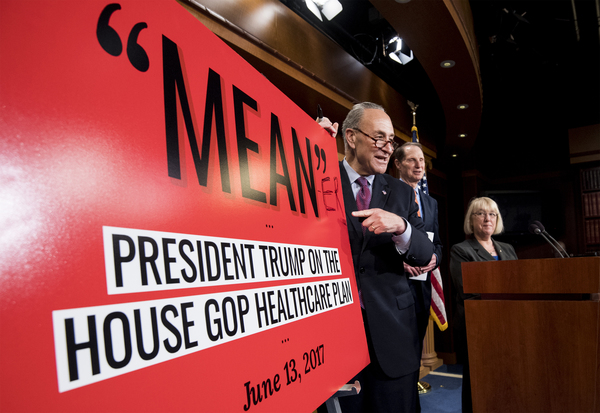
The legislative outline, which Senate Majority Leader Mitch McConnell's team wrote largely behind closed doors, hews closely to the Obamacare repeal bill passed last month by House Republicans, but includes important differences. The House version was first celebrated by President Donald Trump in a White House Rose Garden ceremony, though he later criticized the bill as "mean."
The Senate measure, which could come to a vote as soon as next week, offers more generous premium subsidies for some low-income buyers of insurance compared to the House version, but it also dramatically cuts federal funding to Medicaid, a move that will likely force states to make deep cuts in their health care programs for the poor.
McConnell hopes to call a vote on the measure next week, all but daring Republican holdouts to oppose it and prolong what has already been a painstaking process to advance their promise to do away with Obamacare.
"We've been in the backseat of Thelma and Louise's convertible for quite a while, and we're getting pretty close to the canyon. It's time for us to get out of the damn car," said Republican Sen. Pat Roberts of Kansas.
Trump said Wednesday night, during a campaign-style rally in Cedar Rapids, Iowa, that he had told senators to "add some money to it" to produce a health care bill with "heart."
Based on comments from senators leading up to the release of the bill, it may not match that "heart" standard.
Like the House effort, the Senate bill appears likely to produce major losses in insurance coverage as hundreds of billions of dollars in federal health care assistance to low- and moderate-income Americans are cut over the next decade.
An independent analysis of the Senate legislation from the nonpartisan Congressional Budget Office is expected in the next several days.
The centerpiece of the Senate bill will be a series of major reductions in federal aid for poor Americans who rely on the government Medicaid program and consumers who currently qualify for federal subsidies to help them buy private health insurance through the Obamacare marketplace.
An expansion of Medicaid benefits currently offered under Obamacare would be phased out beginning in 2020 and shut down completely by 2023, senators said.
To date, 31 states have expanded Medicaid eligibility since 2014, helping to drive a historic reduction in the number of uninsured Americans _ including many of those now struggling with opiate addiction.
Over the last four years, the share of people without coverage in the U.S. has been cut in half, data show.
Conservatives want a swift end to the Medicaid expansion, but centrist senators and those from states that expanded coverage, particularly in the economically hard-hit Rust Belt, prefer a slower wind-down.
"I think we have to do it in a very measured fashion," said North Carolina Republican Sen. Thom Tillis, whose state has not expanded Medicaid but is considering such a move. "That's going to create controversy with some people on our side who want to do it sooner."
The Senate bill would cap future federal aid to states for Medicaid, fundamentally transforming a safety-net health insurance program that now covers about 70 million poor Americans. Such a cap will likely require states to either scale back insurance coverage or cut services, according to independent analyses from the nonpartisan Congressional Budget Office. The agency estimated there would be 23 million more Americans without insurance in the first decade under the House bill.
Separately, the Senate bill restructures a system of subsidies that help Americans pay for private insurance on the Obamacare marketplaces.
These tax credits, which about 8 million Americans receive, lower the cost of insurance plans that consumers can buy on HealthCare.gov, Covered California and other insurance marketplaces.
Under Obamacare, the amount of assistance available is linked to how much people earn and where they live, with larger subsidies for lower-income consumers and residents of regions with very high insurance costs.
Republicans, though, have been split over how exactly to undo this system, mindful that they will probably be jacking up costs for many consumers.
Many Republican senators are also concerned about further destabilizing insurance markets that have already been buffeted by uncertainty about the Trump administration's commitment to keeping the markets afloat.
While the House bill linked the credits primarily to consumers' age, with older Americans receiving bigger subsidies than young consumers, Senate Republicans say they plan to keep the income-based structure, while dialing back aid for middle-income consumers.
Libertarian-leaning Sen. Rand Paul of Kentucky, whose vote may be tough for McConnell to get, warned that may end up costing more than Obamacare.
"There's a great danger, from the point of view of somebody who thought we were repealing Obamacare, that we're going to actually be replacing Obamacare with Obamacare," Paul said Wednesday.
After spending seven years promising to repeal President Barack Obama's signature health care law _ and winning elections in part on that promise _ the political dilemma for Republicans is apparent.
The law has grown in popularity and many more Americans are insured, making the new safety net difficult to unravel.
With all Democrats opposed, McConnell can afford to lose just two Republican senators from his 52-seat majority and still pass the bill with Vice President Mike Pence breaking a tie.
But GOP senators are mindful that failure may not be an option now that Republicans have the majority in Congress and control of the White House.
If Senate Republicans approve the bill, even by a narrow vote, it would give their repeal effort momentum, and likely enable the House and Senate to resolve their legislative differences and send a bill to Trump's desk to sign into law.