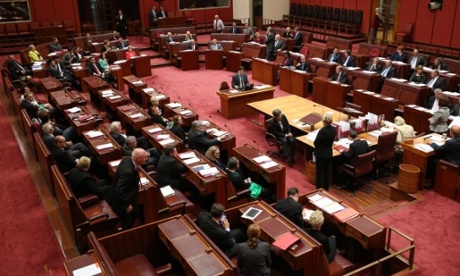
Good night great peoples
Well kids, I reckon that will do us for today. You’ve been magnificent as always.
Let’s wrap today, Wednesday.
- Higher education fell over.
- Tony Abbott attempted to sell a different message on the upcoming budget, which would be frugal and almost boring but also magical, in that it would boost the effort to return Commonwealth finances to almost balance. (This message didn’t really stack up, so I’m not sure that worked out very well.)
- The metadata debate continued in the House of Representatives. Some Labor MPs were sounding decidely lukewarm on the proposal. Behind the scenes, negotiations continued on an amendment that will require warranted access to journalists’ metadata. The prime minister sent a strong signal that he’s unlikely to agree to what the industry is calling for. He noted his own lack of concern about metadata, thirty years ago, when he was a journalist, (*before there was metadata.)

It was to be glass half full day. You bet you are. You bet I am.
Thanks for your company. Let’s do it all again tomorrow.
Mr Bowers of course can’t resist the opportunities opened by #BrickLeyonhjelm and private ownership of animals once thought to be wild.
Hello there, Trevor.

Bowers is not alone, of course.
@murpharoo So, I've adopted a wildlife as the good Senator suggests. #auspol pic.twitter.com/CPqVJ0c5Xk
— DameBaileyWoof OAM (@MissBaileyWoof) March 18, 2015
RUOK PVO
Guardian Australia media columnist Amanda Meade has a fun little story concerning an interview the prime minister did at the weekend with Sky News, on Saturday afternoon, at a time when only deeply sad people like me were actually watching. It was always pretty odd, and Amanda has the back story.
On Saturday the PM agreed to a pre-recorded interview with Paul Kelly and sat down for a rare face-to-face with him and his colleague from the Oz, Greg Sheridan. Peter Van Onselen was nowhere to be seen. He tweeted his annoyance on Saturday: a pic of the Sky set with Abbott facing Kelly and Sheridan and the words “Tony Abbott in the hosts chair!”
Behind the scenes at Sky tempers were running even hotter. The pre-recorded interview was slated to be broadcast during Australian Agenda on Sunday morning but PVO told Sky producers he would not introduce it, even threatening to resign. Eventually it was aired late on Saturday afternoon – in a graveyard timeslot.
We asked PVO what had happened and he was candid: “The PM didn’t want me to interview him and I am not going to look like an idiot and throw to an interview that I haven’t been part of when I am the host of the show.” He added: “They organised it for the day before and I wasn’t invited.”
Updated
My news editor has sent this through from the news wire AAP.
The Liberal Democrat senator David Leyonhjelm wants to allow private ownership of native wildlife, to prevent species becoming extinct. The senator does not believe taxpayers can effectively save native wildlife through national parks, citing Australia’s 11% extinction record. He argues they have disappeared because they were owned by everyone but belonged to no one. As a result there was no incentive for anyone to keep them safe from predators.
Leyonhjelm questioned the logic of allowing people to own animals that can kill native wildlife, but not allowing people to protect the prey. “Just as dogs and cats are in no danger of dying out, the same will be true if native animals are privately owned,” he said.
(I hardly know where to start with this. Adopt a kangaroo and put it in your yard. Go on. I dare you.)
Quite early on I flagged the government would be in 457 visa territory today. Then I got swamped. My colleague Shalailah Medhora has filed a story. “The Coalition will adopt or consider all of the recommendations of an independent review into 457s, including criminalising fraudulent behaviour and relaxing the requirements for English language proficiency. But the government said it would examine further the role of labour market testing, which the review recommended scrapping.”
Interesting that the government isn’t looking to scrap labour market testing – at least not yet. It would be a highly contentious move at a couple of levels – it would buy a big brawl with the trade union movement – and it would make it very hard to achieve bipartisan agreement with the ALP on free trade deals, including the China deal.
Labor has told the government it will not offer bipartisan support for a pact that “sells out” Australian workers. Labor’s trade spokeswoman Penny Wong, late last year.
Among other matters we will closely examine labour provisions to ensure Australian workers aren’t sold out. On 14 October Mr Abbott committed to retain labour market testing requirements for temporary migration. Labor will hold the prime minister to that commitment in the context of the China FTA.
My colleague Lenore Taylor has written an excellent analysis on today’s budget ‘conversation’. She suggests the prime minister, having to reposition on the budget, is attempting to put lipstick on a pig. Voters, however, might just see the pig, Lenore thinks.
Sticking relentlessly with the substance, there is still no word from the ‘warrants regime for journalists’ amendment bunker. We still haven’t seen the wording, and can’t predict the landing point right now.
While we are in faux geriatric mode, or to be more precise, the prime minister is in faux geriatric mode – I did fail to maximise a ‘back in the olde days’ observation from the press conference at lunchtime.
Let me attempt to correct that now. One of the prime minister’s feels concerning the issue of whether or not journalism is a special case when it comes to the looming metadata package related to his days as a member of the fourth estate.
It went along the lines of I’m alright Jack.
Tony Abbott:
In the days when I was a journalist there were no metadata protections for journalists. If any agency including the RSPCA or the local council had wanted to they could have just gone and got it on authorisations. I was perfectly comfortable (with that) as a journalist.
Pure speculation on my part this, but I’m pretty confident that the prime minister didn’t give a moment’s thought to his metadata – thirty years ago. Pre-digital. When people communicated in long hand. I’m prepared to put a lazy twenty bucks on the contention that Abbott would have had no idea what metadata even was. (Actually, not much has changed. Abbott still writes his speeches in long hand.)
Let the memes begin.
Further questions have been placed on the notice paper.
My eyes. My eyes.


Shadow agriculture minister Joel Fitzgibbon to agriculture minister Barnaby Joyce.
Q: Will the minister now give a full and frank account of his meeting with the secretary on October 27 last year in which the changes to his Hansard were clearly raised?
(Nope. he won’t.)
The government lobs a Dorothy Dixer: Labor is hopeless when it comes to unauthorised boat arrivals.
Labor then tracks round to the sacking Dr Paul Grimes. What happened to destroy the working relationship between the agriculture minister Barnaby Joyce and his departmental head? Why has all the blame been attributed to Grimes?
Tony Abbott:
Madam Speaker, I’d like to quote from the statement that was issued when Dr Grimes left and it says, ‘I would like to acknowledge the long-standing contribution of Dr Grimes to public administration in this country at the Commonwealth, state and territory levels.’
There we are. Madam Speaker, as for everything else, it’s been dealt with in previous answers to this House.
(Couple of things here. Dr Grimes didn’t leave. He was sacked by the prime minister. And the question has been asked for three days, but not yet answered.)
Labor is back to the hospitals.
Q: In his last budget the prime minister cut more than $50bn from hospitals across Australia, including the equivalent of a $729m cut to hospitals in the northern NSW region. How many doctors and nurses will be sacked at the Tweed hospital, Lismore hospital and Ballina hospital because of the prime minister’s cuts in his last budget – and how many more will be sacked because of the further cuts the prime minister will make in his next budget?
Health minister Sussan Ley takes the question.
Thank you, Madam Speaker. I’m delighted to take a question from the member for Richmond about health and hospitals funding – and what she says is complete rubbish.
Ley does what the government always does when it is asked these sorts of questions. It talks about the funding trajectory over the forward estimates, and omits the cut which is proposed to come after the forward estimates.
Shorten is back now on cuts to hospital funding foreshadowed in last year’s budget. The Fixer, in his capacity as manager of government business, objects to the question on the basis that it is predicated on an assertion.
Manager of opposition business, Tony Burke, begs to differ.
I’m careful not to use a prop but what’s being claimed to be an assertion is in fact a budget paper.
Hai.

Hai.

Apparently the mayor of Geelong is in the gallery today. Hai Darryn.
Labor wants to know why Joe Hockey is sitting on a review from the Grants Commission until after the NSW state election. This report concerns the future distribution of GST.
Hockey says the Grants Commission report would have no impact on the NSW election. Absolutely none. The treasurer says he’ll give the review to the states before he meets them in April. Hockey says he’ll take the opportunity of the question to launch some pro-Baird election advertising.
Hockey:
The biggest threat to the prosperity of NSW is not the GST appropriation, the biggest threat to the prosperity of NSW is the threat of Labor being elected two Saturdays time.
Shorten, to Tony Abbott.
Q: The prime minister has today promised the budget will be in broad balance within five years. The last budget cut the rate of pension increase, it imposed a new GP tax and hit students with $100,000 degrees. Will the prime minister confirm that the same cuts and chaos of the last budget will be front and centre in the next budget or, put simply, prime minister, are these ideas in or out?
Tony Abbott:
Madam Speaker I might respectfully say to the leader of the opposition what would you do?
The prime minister wants to brandish p17 of the IGR again. He really really wants to.
Madam Speaker doesn’t like props.
Madam Speaker:
I said we will not have props from either side.
Tony Abbott:
Madam Speaker, my eyesight means I’ve got to hold it up. I need long arms, Madam Speaker, in order to be able to see it.
Madam Speaker:
Yeah, well, I can always lend him a pair of glasses.
Tony Abbott:
Thank you (putting on glasses). OK, Madam Speaker, is that better?
Labor’s Jenny Macklin.
Q: Will the treasurer rule out limiting the annual carer supplement to only one payment per carer as recommended in the government’s Commission of Audit?
Joe Hockey says he’s not playing the rule in rule out game. It’s a well worn path, used by everyone, including the Coalition in opposition, Hockey says candidly, before reverting to bluster.
The problem we found was we were always right, unlike the Labor party which so far is proving absolutely wrong.
Hockey says rather than being cute, how about a conversation with Bill Shorten.
I really hope that she has already spoken to the leader of the opposition about that cut to single mothers initiated by the leader of the opposition – 67,000 single mothers taken off a single-mothers’ pension and put on to Newstart – and it was initiated by the leader of the opposition.
I would suggest to the honourable member she start a conversation with her own leader rather than asking us question that certainly have no foundations.
Bob Katter has asked a question about Indonesia. I confess I could not understand the question at all. The foreign minister Julie Bishop uses the opportunity to say things are good enough with Jakarta – the bilateral relationship is now post-boats, post-Snowden, post-live cattle. Concerning the fate of the two men on death row:
Australia opposes the death penalty, both at home and abroad, and we have made respectful submissions and I thank the Labor party for their support. We’ve made very respectful submissions to Indonesia, indeed I note that Indonesia also opposes the death penalty for its citizens when they face death row in other countries abroad.
So we’re not asking of Indonesia or the Indonesian president anything that Indonesia does not ask and receive from other countries.
We are a trusted and reliable trading partner, we will continue to be so and, yes, there will be challenges in the relationship as there are with any relationships but Australia is determined to ensure that this is a strong relationship that endures.
Labor is back on the budget. Given the prime minister’s renewed preoccupation with surpluses ..
Q: Will the prime minister rule out abolishing Family Tax Benefit part B in his next budget as recommended in the government’s commission of audit or does the prime minister still think that Australian families are leaners?
Tony Abbott reaches for Greece.
We were heading to Greek levels of debt and deficit. That’s where we were going. Greek levels of debt and deficit.
(We aren’t, by the way, in case you are interested.)
Julie Bishop, rarely, is not smiling. Possibly because she’d trying to get a rise out of her opposite number, Tanya Plibersek.
Bishop is unhappy that Plibersek has not read her press releases.
‘We urge the Abbott government to do more to help Vanuatu immediately. Labor believes serious consideration should be given to deploying Australian expert medical assistance teams.’ That’s what (Plibersek) said yesterday.
That’s what I announced on Sunday. On Sunday, an Australian medical assistance team landed in Port Villa. On Sunday. You’ve got to give it to her, she’s good. Two days after they were in Port Villa we’ve been criticised for not sending a medical team.
I know it’s hard to slip anything past this deputy leader of the opposition but reading press releases from last Sunday would be a good start.
Labor approaches The Fixer with another ‘what horrors does the higher education future hold’ question. The Fixer believes no horrors at all, citing the support of the vice chancellry of the nation.
All you needed was a bank account that had been inactive for three years and Bill Shorten would trouser the money. Madam Speaker, isn’t it so typical of the Labor party? They look at your money, they envy it, they grab it and then they make you go through six months of bureaucracy to get back what’s always been yours. That’s the Labor Party.
This is the prime minister, on the inactive bank accounts. And Bill Shorten’s trousers.
Question time
It being 2pm. The Labor leader Bill Shorten points to statements from the government signalling an intention to bring the higher education package back.
Q: Prime minister, doesn’t this show that the same cuts and chaos in his last budget will be front and centre of the next budget?
Abbott says thanks for asking but no. This will be a frugal and responsible budget.
Madam Speaker, what we said was we would get back to a strong and sustainable surplus as soon as possible. As soon as possible.
And we will.
Politics this lunchtime
Crikey, it’s almost question time. Better sprint with the lunchtime summary.
Today, Wednesday, at the hour of sambo and green smoothie:
- Higher education has hit the senate fence.
- Tony Abbott says he intends to produce an almost boring budget, but never mind, the budget emergency is over now because those savings measures are still stuck in the feral senate, sure, but they don’t matter anymore. The prime minister has page 17 of the IGR to prove his claims. ‘See, we are almost sort of back in balance’ [Fine print: briefly, before sliding into permanent deficit.]
- The metadata debate is underway now in the House of Representatives. There’s still no sign of an amendment which would require agencies to get warrants before accessing journalists’ metadata; and the prime minister doesn’t like the contestable warrants that the media companies say they want.
Situation [broadly] normal. [No fineprint.]
Page 17, I tell you. Page 17.

I’ve already posted this once, but it bears posting once again.
The line that the prime minister contends makes the case that the budget is almost back in balance actually projects that the budget will never be in surplus.
Take it away, IGR.
The scenario ‘currently legislated’ shows a set of projections on the basis of laws currently passed by parliament. Under this scenario, the underlying cash balance is projected to remain in deficit, deteriorating to almost 6% of GDP by 2054‑55. Net debt is projected to reach almost 60% of GDP ($2,609bn in today’s dollars) by the end of the projection period.
Abbott’s signal on contestable warrants just then was quite clear. He’s not keen.
This puts Labor in an interesting position. Everyone currently haggling over this proposed journalist’s amendment in the metadata package knows that the media companies want contestable warrants, and will shout loudly if they are not forthcoming. The MEAA actually wants more than contestable warrants, it wants a full exemption for journalists.
If Abbott’s public statement is a reliable guide (and we all know, sadly, that’s an ‘if’, given emphatic statements can change quite rapidly in the current political climate) – then Labor faces a tough choice. Does it deliver less than what the media companies want to preserve the hallowed ‘bipartisanship on national security’ – or does it stand Abbott up and risk sinking the package.
Surely the prime minister couldn’t be playing politics here, daring Labor to break ranks? That would never happen would it? We’ve never seen that kind of brinkmanship in politics have we?
Dangerous game though, that.
Updated
No contestable warrant process, thanks very much .. shhh .. don't tell Rupert et al
Q: Could you give an update on the negotiations over the amendment for metadata regarding journalists, why won’t you allow the warrant process to be contestable? And isn’t it the case that you can go after sources by targeting their metadata?
Tony Abbott:
What I’m not going to do is give a running commentary on what are constructive and collegial discussions between the government and the opposition – and again I say if the opposition was as constructive on economic security as it has by and large been on national security our country would be in much better shape.
On the metadata retention legislation, what we are proposing is a level of protection for journalists’ metadata which simply doesn’t exist now. There is no special protection for journalists’ metadata right now, so we are proposing much greater protection for journalists’ metadata than is currently the case, that is ever been the case, but I think there’s a misunderstanding about the warrant process.
I’ve never practiced as a lawyer but my understanding is that where the police or security agencies want a warrant, they go before the relevant judicial officer, they make a case, the officer considers the case and says yes or no to the activity for which a warrant is proposed.
These things are never contested. A contested warrant is more like a court case and if you had to have a court case to access metadata, well, the whole process would absolutely gum up.
Updated
My colleagues are still at it.
Q: On that map you showed us isn’t it true that when you look at it at no stage do you reach a surplus in the next 40 years?
Tony Abbott:
We get very close to balance, well within 1% of GDP, we get very close to balance in 2020.
Q: If you’re saying we’re getting very close to a balanced budget essentially within five years why is it then the case that you’re saying that there’ll be few structural changes in this budget?
Abbott:
There will be significant changes to child-care, which will be factored into this year’s budget. There will be significant changes for small business including a small business tax cut which will be factored into this budget, so this is a budget that will involve structural change, but they will be much less drastic, structural changes than the ones that were in last year’s budget – and again I say this is a government which has very substantially addressed the budgetary situation that we inherited.
And yes you can look at this and say that this glass is half empty but you won’t mind if I look at you and say that the glass is half full.
Murphy joined by fellow budget magic maths obsessives in the prime minister's courtyard
First question.
Q: How do you get a surplus in five years by producing a dull budget in May?
(Given my obsessions this morning I’d call that a very good question.) The prime minister has the chart on page 17 out. He’s pointing at the chart. See here, here’s the chart. It shows the glass is not half empty but half full.
Q: The IGR chart that you cited there shows the budget balance heading south again from 2020. When you described the budget, coming budget, as dull and routine what’s your response to people who may fear that that means you’re easing up and resting on your laurels rather than doing more on structural reform?
Tony Abbott:
Well, this budget certainly will be much less exciting than last year’s budget because the task this year is at least 50% reduced from this task last year, so inevitably it will be a much less exhilarating budget for those who are budget devotees and structural reform enthusiasts – but nevertheless this will be a budget that is prudent, frugal, responsible, but there’ll be something in it for families, a better child-care deal in particular, and there’ll be much in it for small business, particularly the tax cut that small business is yearning for, because we want to unleash the creativity of our small business people and the best way to do that is for the dead hand of government to rest less heavily upon them.
The prime minister has appeared in his courtyard for a press conference. He’s flanked by Josh Frydenberg, the assistant treasurer.

The purpose of this press conference is Bill Shorten’s cash grab. You just can’t trust people like Bill Shorten with your money. (This is about unclaimed monies in inactive bank accounts. Obviously the PM feels not enough attention has been paid to this issue today.)
Updated
Melissa Parke rounds out her contribution by saying that the process of trying to make a bad bill better has not worked. It’s still a bad bill.
She doesn’t say it explicitly, but the clear implication (for this listener at least) is she’s reserving her rights. Parke abstained on – or was absent from the chamber – for a previous national security measure which criminalised the reporting of special intelligence operations. She was the only Labor MP to break ranks.
Less than a full house this morning.


Labor’s Melissa Parke is speaking now. Parke is a long time critic of this proposal. The member for Fremantle thanks the shadow attorney-general and the shadow communications minister for their consultative approach. Then she proceeds to take apart the substance of the bill apart. Metadata, Parke says, is not a shell of your communications. It is a window on your life, your politics, your sexual preferences, your health outlook. The government can’t keep saying in the same breath that metadata is nothing at all, and a vital tool for agencies in meeting national security challenges, Parke says.
Paul Fletcher says the primary purpose of the current bill is to standardise how long private communictions data is to be held – the bill requires that it be held for two years. (Fletcher is kind of right here, but the bill also specifies what data should be collected and held. Not all companies collect identical records. So the regime will in fact impose new requirements on some telcos and ISPs.)
In some ways, the scope is narrowing.
This is Paul Fletcher again, pointing out that this bill has safeguards that don’t currently exist.
Liberal Paul Fletcher, who is parliamentary secretary to the minister for communications, is next cab off the rank in the debate. Fletcher cites his professional history in the telecommunications industry.
There are no new powers to access metadata granted by this bill.
Wilkie suspects this regime will simply push criminals and terrorists to the dark web – leaving the rest of the law abiding population to be surveilled by intelligence agencies and police. This is a remarkable and unprecedented expansion of state power, the MP says.
Wilkie points out that he was on the intelligence committee during the last parliament, and the last JPCIS wasn’t at all sure that a mandatory scheme was the way to go. He says the current committee has gone inside the tent. When secrets are shared with you, it’s intoxicating. Wilkie says parliament’s job is not to rubber stamp requests from the agencies, parliament’s job is to make careful judgments on the merits of the request.
I don’t mean to sound overly dramatic, but (this) is a step towards a police state.
I will certainly oppose this bill, and I will call on a future parliament to wind it back.
I flagged a bit earlier that Tasmanian MP Andrew Wilkie was a no vote. He’s up for his contribution on metadata now. He’s telling the chamber that if we decided to summarily execute every single shoplifter then we’d quickly see an end to shoplifting. But of course that would be a ludicrous proposal, he says. Wilkie says we struggle to hold that sense of proportionality when it comes to national security. We keep redrawing the line, and if you keep redrawing the line, when and how does that stop?
We are already on a slippery slope and we don’t know where the slope is going to take us.
One of the Labor MPs who spoke out yesterday in a lengthy caucus debate about the metadata laws – Michelle Rowland – has just made her contribution on the package in the chamber.
Rowland in her speech has raised concerns about the costs of the scheme, the two year retention period, and the fact she hasn’t yet seen the proposed amendment that will create a warrants scheme for journalists private communications data.
She’s also not sure who a journalist is when we all self publish all the time. The definitional question, Rowland thinks, is ..
.. no trivial matter.
If you haven’t followed the metadata debate closely, and you need someone to step you through the issues, do check out this video from my colleagues, Paul Farrell and Bill Code.
(PS: Can the naughty person who nicked Paul’s computer bring it back please? No questions asked.)
Yes, there have been some modest reductions coming up in Australia’s aid budget
A question from the Australian news wire service, AAP.
Q: One in 10 people in Vietnam live in extreme poverty on $US1.25 a day or less. Mr Abbott, was it embarrassing for you to explain to the prime minister of Vietnam that Australia is cutting its aid budget by $11 billion overall and, Mr Tan Dung, are you concerned about the potential impact of aid cuts on your people?
The Australian prime minister wants to start.
Tony Abbott:
If I could go first. Look, obviously it is important for all countries to ensure that their domestic economic house is in order because if you don’t have your domestic economic house in order, it is very difficult to be a good friend and neighbour abroad.
Yes, there have been some modest reductions coming up in Australia’s aid budget but our aid budget has been growing very strongly in recent years and we think it is important to pause it and scale it back a bit before it then starts to grow again in a few years time.
Obviously, as part of a modest reduction in the overall aid budget, we will be focusing the aid that we give on our region and Vietnam is very much a strong, respected and increasingly important part of our region.
The Vietnamese PM declines the opportunity to comment.
The first question is from a Vietnamese journalist, who makes a veiled reference to tensions in the South China sea.
Tony Abbott:
Australia and Vietnam have a strong shared interest in the continued peace and stability of our region. We have both prospered in peace over the last 40 years because of the stability that our region has enjoyed.
Anything which disturbs that stability is something that we would mutually deplore and mutually work to ensure didn’t happen. We both support freedom of navigation by air and by sea in the South China Sea. We both deplore any unilateral change to the status quo. We both think that disputes should be resolved peacefully and in accordance with international law.
I probably should repeat what I have said in Tokyo and Seoul and in Beijing, that the countries of Asia will all advance together or none of us will advance at all. We all have a very strong vested interest permanent interest in maintaining the peace and stability of our region.
A joint press conference is now underway between Tony Abbott and the Vietnamese PM. We are deep in impenetrable diplomatic formulations at this time.
Nguyen Tan Dung:
Building upon the ongoing good relations, we agreed and affirm that the development of Vietnam Australian relations – we want to push and deepen further these relations and take the comprehensive relations to the next level. Accordingly we agreed to release a statement on the strengthening of the comprehensive partnership and accordingly, we agreed to improve further the comprehensive partnership between the two countries and task the two foreign ministries to develop an action plan for 2015-2017 to implement the projects for the two countries interests, for peace, stability, cooperation and common development of the region.
The prime minister reminded us on 3AW this morning that he is the politician in the family, not his wife Margie, who is quoted somewhat whimsically in The Australian Women’s Weekly today – offering a forumlation along the lines of, if it all ended tomorrow, I wouldn’t be crying buckets of tears.

Mrs Abbott is not the politician, that’s true. But she is called very regularly to serve in the frontline, as all political spouses are. Here she is this morning.
The Greens deputy leader Adam Bandt is unhappy, meanwhile, that the government’s metadata proposal departs from the basic principle that police and intelligence agencies should routinely get warrants before intruding on the privacy of the citizenry.
Bandt is also unhappy that the chamber has not yet seen the amendment that would create a new warrant regime for journalists. He wants to know why a major legislative debate is underway without a crucial element of detail.
Adam Bandt:
Where’s the amendment? No amendment has been circulated.
By the by, we have a visitor in the House today, the Vietnamese prime minister Nguyen Tan Dung.

Not that numbers matter in this House, the Tasmanian independent (and former intelligence analyst) Andrew Wilkie says he’ll be opposing the metadata bill.
When a data retention scheme was first proposed a few years ago it was on the basis that it would only be for national security purposes, but already we’ve seen the justification for the scheme expand to other forms of crime. This is just the sort of incrementalism which makes such reform especially problematic.
I also question this bill’s usefulness on national security. History teaches us that the most competent terrorists are innovative and will know to use offshore communications services. They already rely heavily on computers that can no longer be reached via the conventional internet, and that large amount of web content that is not indexed by standard search engines.
I’m going to stop driving myself and you all slowly crazy with my obsessive nit picking on the budget for a bit – the metadata debate is back on in the House of Representatives.
I’ve made some inquiries about where the amendment concerning journalists and warrants is currently up to. I’m told that it is currently transiting between the prime minister’s office and Bill Shorten’s office. Speaking in the debate now is Labor’s Andrew Leigh.
So just to square the surplus here (you see what I did there, right?) – the prime minister said this morning on 2SM:
If you look at the Intergenerational report it showed that on the measures that this parliament has already passed, on the measures that we have already managed to get through the Senate we get back to broad budget balance within about five years and beyond that Labor’s debt and deficit is halved under the measures that this government has already put in place.
I’ve checked. He said balance, not surplus, so that’s my error. The graph on page 17 bears that out.
But what the prime minister neglects to dwell on in great detail is the broad balance (which isn’t quite balance anyway) trends inexorably to deficit, not to surplus.
If the government wants to trend to surplus then we are back in losers territory.
Updated
Sorry for the brief break in transmission – I’ve had to make some calls in an effort to get clarity on what the prime minister is actually saying about the budget both yesterday and this morning.
A government spokesman is directing me to page 17 of the IGR. Page 17 contains a graph which illustrates the three budget repeair scenarios – proposed policy, legislated policy, and previous policy.
The prime minister is apparently referencing the fact that the “legislated” line on the graph on page 17 skirts budget balance before trending down to a deficit of 6% of GDP.
All good then? Clear as ...
Updated
Before you go, your wife Margie says she wouldn’t be heartbroken if you lost the prime ministership. Mitchell is speaking of an interview Margie Abbott has done with the Australian Women’s Weekly – out today – in which she appears quite relaxed about returning to normal life.
Tony Abbott:
Margie’s not the politician, I am.
Updated
Let’s sprint back to the IGR while Mitchell is on an ad break.
- The scenario ‘currently legislated’ shows a set of projections on the basis of laws currently passed by parliament. Under this scenario, the underlying cash balance is projected to remain in deficit, deteriorating to almost 6% of GDP by 2054‑55. Net debt is projected to reach almost 60% of GDP ($2,609bn in today’s dollars) by the end of the projection period.
(Broadly is perhaps the operative word here. Perhaps I’m confused – it is entirely possible I’m confused, confusion can occur sometimes when filing live for many hours at a time – or perhaps the prime minister means what’s already been done plus the dull things in the budget that we don’t yet know about equals a surplus in five years.)
Updated
Neil Mitchell opens with the prime minister on the budget.
Abbott is in reassurance mode for the looming May statement. We did a lot of very good work last year. Because we did the heavy lifting last year there’s less to do this year, he says. The prime minister says the budget will be frugal, prudent and responsible. This budget is not going to involve anything like the restructuring we saw last year, the prime minister says.
When it comes to savings people, will find it pretty dull.
Surplus in five years, Mitchell asks – with no changes? How does that work? On the measures that have been successfully put through this parliament, the IGR says we get back to broad balance in five years, the prime minister says.
If you are reading in Melbourne, the prime minister is coming up in a minute or two on 3AW. I’ll cover that live.
Updated
In terms of Abbott’s fresh declaration, a couple of points of background and context that may be helpful. It’s March. That means the government right now is deep in pre-budget preparations. This sitting fortnight is the last time the parliament sits before the May budget.
David Crowe has an interesting take on the pre-budget prep in the Australian this morning. Crowe says there are deepening concerns in treasury “that ministers are running out of time to finalise huge decisions on the May 12 budget, sparking fears of a lack of clarity about the strategic direction”. This is a nice way of saying the process is in deep drift – possibly because it is not actually possible to do what the prime minister says he can do, which is return the budget to surplus without creating losers. There will be losers if that’s the fiscal trajectory.
It’s interesting too that Abbott is returning to a message about budget repair. Julie Bishop has been edging out on the budget, Malcolm Turnbull has been on the budget – because the true believers of the Liberal party are worried that the Abbott government has comprehensively botched its chance to deliver smaller government. What to do in this space, and who is best placed to do it, is a critical part of the internal discussion the Liberal party is having with itself right now.
Updated
This man never fails us. Surplus in five years? No probs.
@murpharoo Hello! Not sure what the #brickparliament budget is, but the magic budget fairy with wand is available. pic.twitter.com/9arjTKBWuP
— The Matt Hatter (@MattGlassDarkly) March 17, 2015
Apart from the moving forward from education, Bill Shorten’s many thought crimes, magic maths and onion fancying – we expect an announcement today on 475 visas, yet another “repeal day”, more debate on the metadata package, and an appearance by the treasury before a parliamentary committee.
On metadata, Labor was given an amendment by the government late yesterday dealing with a new warrant regime for journalist’s communications records. Presumably details of that will emerge during the course of the day. The legal profession is on the march too. The Law Institute of Victoria is also concerned about client privilege and privacy. If journalists can have warrants, why not us?
LIV president, Katie Miller
In many cases it is very important to keep confidential and protect even the fact that a lawyer is in contact with particular people. Any mass retention of communications data between lawyers and their clients could threaten the necessary trust between lawyers and their clients, allow an issue of sensitivity to be inferred or revealed, and undermine the ability of lawyers to advocate on behalf of their clients. The bill must be amended so that a warrant is required to access lawyers’ telecommunications data.
Updated
Good morning all and welcome to the Wednesday after the Senate fully fixed the Abbott government’s higher education package for the second time.

Never fear. Our favourite sometime fixer, sometime unicorn, education minister Christopher Pyne, is vowing to look through last night’s rejection and bring back deregulation in the winter sitting of parliament.
Pyne:
We will ... bring back the higher education reform package for the parliament to consider. We will not give up. This reform is too important … Great reform takes time.
(I’m almost certain that’s the exact same formulation he used after the first defeat but who knows, corners can be turned in politics. Pyne, like me, is a teen of the 1980s, a Journey man from way back. Don’t stop believing.)
As we go live this morning, the foreign minister Julie Bishop is on Radio National and the prime minister is on Sydney radio. Bishop is backing in a speech she made last night about radicalisation. Tony Abbott is talking about a Labor “smash and grab raid” on inactive superannuation accounts.
Tony Abbott:
Typical of the Labor party, it takes your money and then subjects you to mountains of paperwork to get your money back. Yet another Labor mess is being fixed up by this government, Grant.
The host on 2SM (that would be Grant) wants to know how the prime minister can be flagging fresh budget cuts when he can’t get the last budget through the Senate. Abbott is sticking by this notion that he floated yesterday that there’s a natural return to budget balance in five years – which is perplexing given a future surplus scenario only happens if the government persists with budget measures which it has already turfed. Very magic, that maths. (As I said to Politics Live readers yesterday, don’t leave your desks, here comes another round of cuts.)
Abbott:
Well Grant, we’ve made a lot more progress than people think.
Abbott says despite this great progress and the great gradually returning surplus – he won’t hit households in May. Grant on 2SM doesn’t want to mention Greece and great exploding debts, but he will, sorrowfully.
Tony Abbott:
Things are better, and getting better all the time under this government.
Grant then moves on to whether we should be telling cyclone countries to change their way of building. The prime minister doesn’t think you can wave a magic wand on that one, Grant.
Grant wants to know whether things have settled down in Canberra. The prime minister acknowledges there has been a bit of tremor, but now everyone is now completely focused on Bill Shorten’s cash grab.
Q: Why did you eat that onion, Tony?
Abbott:
I enjoy onions.
Don’t we all.
I enjoy your comments too, which is why the thread is now wide open for your business. Get into it. A long day is way better with company. You can also chat to me and to the man with the camera on the Twits – I’m @murpharoo, he’s @mpbowers
[Note to readers: this post contains a correction from the original. The original post said the prime minister had flagged a return to surplus in five years. Abbott told 2SM “we get back to broad budget balance within about five years.” My error, apols.]
Updated