WASHINGTON _ The Senate overwhelmingly approved a defense appropriations bill Thursday that contains a provision intended to help thousands of California National Guard soldiers and veterans facing repayment demands for enlistment bonuses.
The final version of the bill, which already has passed the House, was approved 92-7 and now moves to President Barack Obama's desk for his signature.
The bill directs the Pentagon to set up a review board to fast-track an assessment of the estimated 9,700 California Guard soldiers who received bonuses in error. Most of the improper payments ranged from $15,000 to $50,000 each.
The board would then recommend which soldiers should have their debts fully or partially waived, and which ones should be required to repay some or all of their enlistment bonuses. It sets a deadline to complete the work by next July.
The bill largely tracks instructions that Secretary of Defense Ashton Carter announced on Oct. 26, days after the Los Angeles Times first reported the repayment program.
On Wednesday, Peter Levine, the Pentagon official appointed by Carter to head the review, told a House Armed Services Committee hearing that he expected 90 percent of the debts to be effectively forgiven at the outset.
The legislation and the Pentagon action thus will bring to an end the California Guard's controversial five-year effort to recoup all the enlistment bonuses, which were given in error over more than a decade to help the Pentagon fill enlistment quotas for the wars in Iraq and Afghanistan.
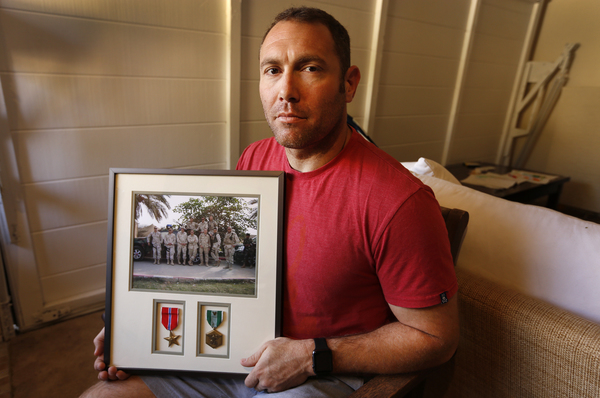
Many of the soldiers who received repayment demands served in combat, and some returned with severe injuries.
Although the bill leaves discretion with the Defense secretary, it says "recoupment is unwarranted" unless the review determines "by a preponderance of the evidence" that the soldier "knew or reasonably should have known that the member was ineligible for the bonus pay."
By placing the burden on the Pentagon to contact each soldier and prove he or she was ineligible, the compromise provision is likely to result in forgiveness of the bonus debts for most of the 9,700 soldiers ordered to repay some or all of their reenlistment incentive payments from 2004 to 2015, according to lawmakers.
Because of Pentagon concerns about setting a precedent that would invite soldiers from other states with similar debts to seek relief, the provision applies only to California Guard soldiers.
It remains unclear how the Pentagon will handle soldiers who were ordered to repay their bonuses because they left the Guard before they had completed their enlistment terms.
Soldiers who received $15,000 bonuses were required in many cases to remain in the Army for six years. Those who left early became ineligible for the bonus, requiring them to repay the money, according to California Guard officials.
Other soldiers received bonuses offered for accepting particular jobs in the military, such as medics, translators and other assignments. If they changed assignments before their enlistment expired, they also technically voided their bonus, officials said.
"The intent is not to recoup from soldiers that did not know what was going on," Maj. Gen David Baldwin, the California Guard commander, told the House Armed Services Committee hearing Wednesday.
Baldwin added that soldiers who were ordered to change jobs during their enlistments should be able to keep their bonuses, while those who did so on their on initiative should have to repay them.
Even some members of Congress who favored waiving debts in most cases said this week that soldiers who went AWOL or failed to finish their required service time should have their bonuses recouped.
At the House hearing, Rep. Jackie Speier, D-Calif., said she had heard of "medical professionals" who received as much as $80,000 in bonuses and student loan repayments to join the Army but left before completing their six-year enlistments.
"We should claw back every single dime" of their payments, she said.
The small number of soldiers who have been convicted or pleaded guilty to fraudulently accepting a bonus will also have their cases reviewed, but the chances that they will have their debts waived is slim, Levine, the Pentagon's top official for personnel, told the House hearing.
"We will provide an avenue for everybody" in the California Guard with a debt to seek forgiveness, he said. "For those who have already been convicted of fraud, that may be a narrow avenue."
If the Pentagon forgives a soldier's debts, it would have to inform credit agencies to correct any downgrades of credit scores that could affect applications for car loans, mortgages and other debts.
The provision on the California Guard repayments was included in the $619 billion compromise National Defense Authorization Act. It passed the House last week by a veto-proof 375-34 margin.
The bill authorizes $523.7 billion for base defense spending. It also authorizes $67.8 billion for war-related Overseas Contingency Operations.