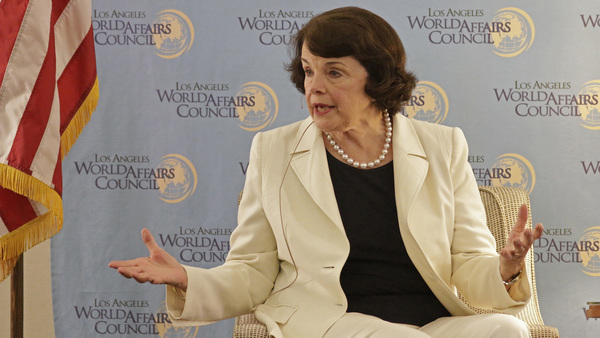
A few words about President Donald Trump from Sen. Dianne Feinstein over the summer personified her well-worn reputation as a measured veteran elected official. And they'll also surely be the centerpieces of Democratic campaigns attempting to unseat her.
It was a boilerplate political event at the Commonwealth Club in San Francisco on Aug. 29. Feinstein, D-Calif., outlined her views on immigration, the threat of North Korea and the president's response to white nationalist protests in Charlottesville, Va., while answering friendly questions from confidante and former Rep. Ellen Tauscher, a Democrat.
There were some angry members of the crowd who called for Trump's impeachment. Amid the 70-minute discussion, she said two things that lit a fire under liberals already frustrated by her measured approach.
Each comment has already been shorthanded by rivals: Feinstein thinks Trump can be a good president! And she asked Americans to be patient with Trump!
There's more to the story.
Fifty-five minutes into the conversation, Feinstein was asked when Republican leaders would turn against Trump and either pursue impeachment or urge him to resign. She replied with these 121 words. Her critics have boiled that statement down to six.
"Well, um, I'd really rather not comment. However, I think you all know impeachment and the House brings the impeachment and then the Senate sits as a court and votes. At the end there is a trial in front of the Senate. I've kind of been there done that. It's not the greatest thing in the world. That's for sure."
"Look, this man is going to be president, most likely for the rest of this term. I just hope he has the ability to learn, and to change. And if he does, he can be a good president. And that's my hope. I have my own personal feelings about it."
"Yeah, I understand how you feel," Feinstein responded. "I understand how you feel."
Later, she was asked why the Democratic message seemed muted compared with all the airtime Trump gets. This was just after the flooding in Houston. Feinstein urged the crowd to give Trump latitude in his early tenure. But that call for "patience" was followed by words marked by skepticism.
"This man is president of the United States. That's unlike any other job out there, by far, has enormous powers. And I think what's happened is that he has shown several holes in himself. And I think the press has picked this up and really sees what's been happening, and following it very closely. I was listening to his comments in Texas and generally the press wouldn't run comments at an emergency _ they didn't in the big earthquake or the fire, the president came out and that wasn't really run. But this is his first big American emergency and I think, I think we have to have some patience. I do," Feinstein said.
"I mean, it's eight months into the tenure of the presidency and it's buffeted by being rent asunder. It really is," she went on. "And we'll have to see if he can forget himself and his feeling about himself enough to be able to really have the kind of empathy and the kind of direction that this country needs. And if it doesn't happen, there are things that could happen that I don't think it'd be responsible for me to begin to speak about here."
Feinstein's Democratic rivals _ notably state Senate leader Kevin de Leon _ seized upon Feinstein's remarks to argue the senator had grown out of touch with the state she has represented in the U.S. Senate for a quarter century.
"It is the responsibility of Congress to hold him accountable _ especially Democrats, not be complicit in his reckless behavior," De Leon said before announcing in October that he was challenging her re-election.
Another critic jumped in Thursday. Alison Hartson, the leader of a group aimed at getting money out of politics, said "Dianne Feinstein isn't doing it at all."
Feinstein's allies point out that while the longtime senator is no liberal flame-thrower, she has spoken out against Trump on the issues most important to her, such as gun control. They also note, as the senator alluded to, Feinstein probably feels constrained by her role, both on a Senate committee investigating Russian interference in the presidential election, and potentially judging an impeachment trial were one to happen.