Amid the increasingly serious global shortage of semiconductors, automakers have been forced to reduce their output or postpone the release of new models. The repercussions are being felt amid a wide range of products, including home appliances, computers and telecommunication devices.
As if preying on companies' fears, counterfeit semiconductors have appeared on the market.
-- Risk of catching fire
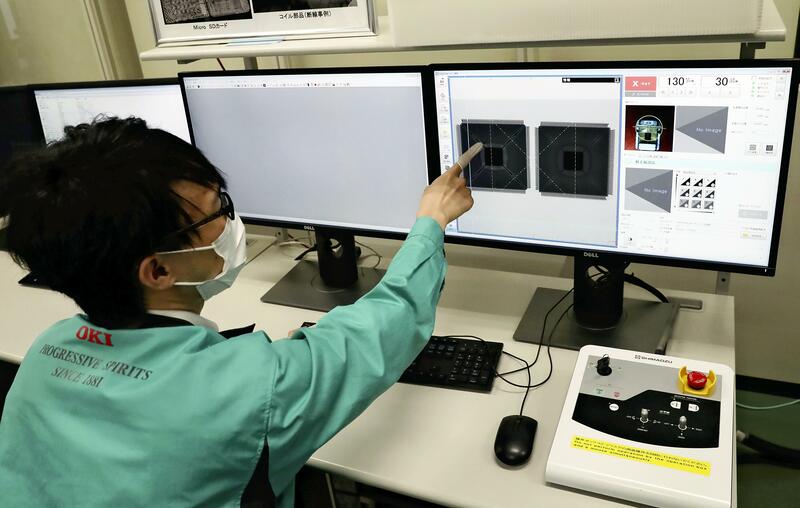
Oki Engineering Co., based in Nerima Ward, Tokyo, launched a service in early June to check whether semiconductors are genuine. It now receives inquiries every month about whether client companies can trust certain products.
Semiconductors have been brought to the firm, mainly by electronic machinery makers, sometimes numbering in the thousands in just one batch.
Oki Engineering staff pick up the semiconductors, which measure one to three millimeters on each side, using sucker-like devices exclusively for this purpose and closely examine them under a microscope.
They confirm whether there are suspicious elements in the corporate logos and serial numbers on the surface, and also check circuit patterns inside them with X-ray machines, comparing them with legitimate semiconductors.
About 30% of the semiconductors they have checked have proved to be of poor quality. They included old models deemed to have been produced more than 10 years ago, and secondhand ones that were likely removed from discarded home appliances.
According to Oki Engineering, a sizable number of the faulty products were counterfeit. For example, some had proper casings but were empty inside, while others used major manufacturers' logos without permission.
Counterfeit or poor-quality semiconductor chips are not a new phenomenon, but the problem rapidly became pronounced as the semiconductor shortage intensified.
The semiconductors in question are believed to mainly come from China, South Korea and Southeast Asia, and they are mainly traded on the internet. In many cases, they are bought and delivered by trading companies that received orders for semiconductors from client manufacturers but were unable to procure proper ones.
Problematic semiconductors are directly installed in such consumer products as drive recorders in cars, facial massagers and electronic cigarettes. After being sold, some of these products have failed to work from the outset.
There are also rare situations in which problematic chips could cause products to catch fire.
-- Race to obtain goods
Large electronics stores in Tokyo feature many signs these days telling customers that they will have to wait for the delivery of such products as telephones, cameras and printers. Unable to procure semiconductors, makers have reduced their output of such products, hence the delays.
In early August, Honda Motor Co. suspended the production of fully assembled cars at its Suzuka Factory in Mie Prefecture for five days. Nissan Motor Co. postponed the release of its new electric vehicle Ariya from the middle of this year to winter 2021.
In China, where consumer spending recovered early among major economies, newly made cars are in short supply because of the shortage of semiconductors. As a result, the number of cars sold there in June fell 12.4% from a year ago.
Reduced output of cars and home appliances also affects material manufacturing industries, such as steelmakers and nonferrous metal makers.
In a composite index (CI) of business conditions in May, which the Cabinet Office announced on July 7, the coinciding index indicating the current economic situation fell 2.6 points to 92.7, the first decline in three months. The CI is calculated with a base of 100 in 2015.
Demand for semiconductors has grown rapidly, in tandem with the spread of teleworking amid the novel coronavirus crisis. Since autumn last year, new car sales in North America and other major markets have rapidly recovered.
As a result, companies in a wide range of business sectors are waging a fierce battle to obtain semiconductors.
In March this year, a fire occurred in Naka Factory in Ibaraki Prefecture of Renesas Electronics Corp., a major semiconductor manufacturer, and it took about fourth months for the factory to fully resume operations. This further exacerbated the shortage of semiconductor products at home and abroad.
Even if a manufacturer aims to increase its output, it takes about a year from deciding on the construction of a new factory to starting production. There are several hundred manufacturing processes involved in making semiconductors, and it takes several months from receiving an order to delivery.
Kazuhiro Sugiyama, a consultant with Omdia Japan, said: "Some major semiconductor manufacturers are fully booked with orders through 2022, and they have little room to increase output. It seems the shortage will be resolved only in or after autumn 2022."
-- Enclosure by U.S., China
Semiconductors have been called "industry's rice," likening them to the staple food of Japan, because they are core parts of a wide range of products. Many countries, especially the United States and China, have been strengthening their efforts to keep semiconductor-related companies and technologies for themselves.
In December 2020, China enacted a law to control imports and introduced restrictions on exports of semiconductor products related to cyber-security. Similarly in 2010, when tensions rose between Japan and China over the Senkaku Islands, Beijing started restricting exports of rare earths toward Japan.
There are fears that China will heighten diplomatic pressure by using the supply of semiconductors for leverage.
To cope with this possibility, the U.S. government shifted to a policy of increasing domestic production of semiconductors. In June this year, it announced a plan to provide at least 50 billion dollars (about 5.5 trillion yen) in aid for production and research into such products.
Intel Corp. of the United States and Taiwan Semiconductor Manufacturing Co. (TSMC), among other companies, will invest the equivalent of trillions of yen for this purpose in Arizona.
European countries, Taiwan and South Korea have announced one after another aid measures for companies that produce or develop technologies inside the bloc or nations, seeking to avoid excessive reliance on imports of semiconductors.
The Yomiuri Shimbun
An employee of Oki Engineering Co. checks whether semiconductor chips are genuine in Nerima Ward, Tokyo, on July 14.
Read more from The Japan News at https://japannews.yomiuri.co.jp/