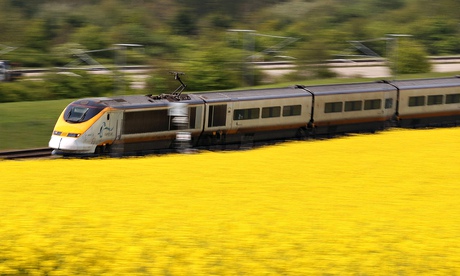
Will Hutton is quite right about the long-term impact of this government’s policy of selling off the country’s assets (“Eurostar, kerching! But is it really so smart to sell off our best assets?”, Comment). They are trying to make a short-term dent in a persistent deficit to persuade the electorate that they are to be trusted with the economy.
After five years of despair inflicted on the poorest and most vulnerable, savage cuts to essential public services and a wilful pretence that asking the richest to contribute more in times of crisis would destroy our recovery, it is only the world reduction in the price of oil that is allowing the pretext that the economy is doing well due to their good management.
Far from it. Double the cuts that Labour intended have not shortened the prospects of an earlier balanced economy than Labour’s honest prediction of 10 years.
When Labour was in power, its good management got millions back to work in properly paid jobs, financed huge improvements in public services, not to mention the activities of our armed forces, finished repaying the postwar Marshall aid loan and paid off a large chunk of the national debt.
Had it not been for the latter, Alistair Darling would not have been able to prevent the collapse of the banking sector. He also had the good sense to prop up the car and building industries.
When he left office, the country still had its AAA rating and growth was already recovering. George Osborne’s simplistic ideas on how to get out of debt only threw the economy into reverse. And selling off our assets as if it is something for which he is to be congratulated is unfortunately typical of his economic ignorance.
Gloria Brown
Builth Wells
Powys
Will Hutton attacks the UK for selling off its old infrastructure. He could equally blame the City and government for our failure to invest enough in the new energy, transport and water systems needed for “smarter growth”.
Surely the inequalities in London and the wider south-east cannot be resolved without appropriating land on the edges? This means rethinking the sanctity of the green belt. We could then plough the uplift in land values back into new housing that all can afford, and build a greener economy.
The slogan should be “posterity not austerity”. The models are not just KfW and the Sparkasse in Germany, but also Caisse des Depots in France, Kommuninvest in Sweden and BNG in the Netherlands.
Dr Nicholas Falk
Director, London Office
URBED (Urbanism Environment Design)
London WC1
These assets are held by the country, are owned by the country, and their disposal should surely be agreed upon by the people of the country through our representatives?
What happens when we run out of assets?
Some disposals have had a positive effect. However, the ridiculous state that we have reached with power companies and water, creation of false markets and the need for us to run around like headless chickens checking the price all the time are failures on a massive degree. Why do other countries see state ownership as a necessity? They certainly seem to think owning our utilities is a useful thing.
Karen Hirst
Alnwick
Northumberland