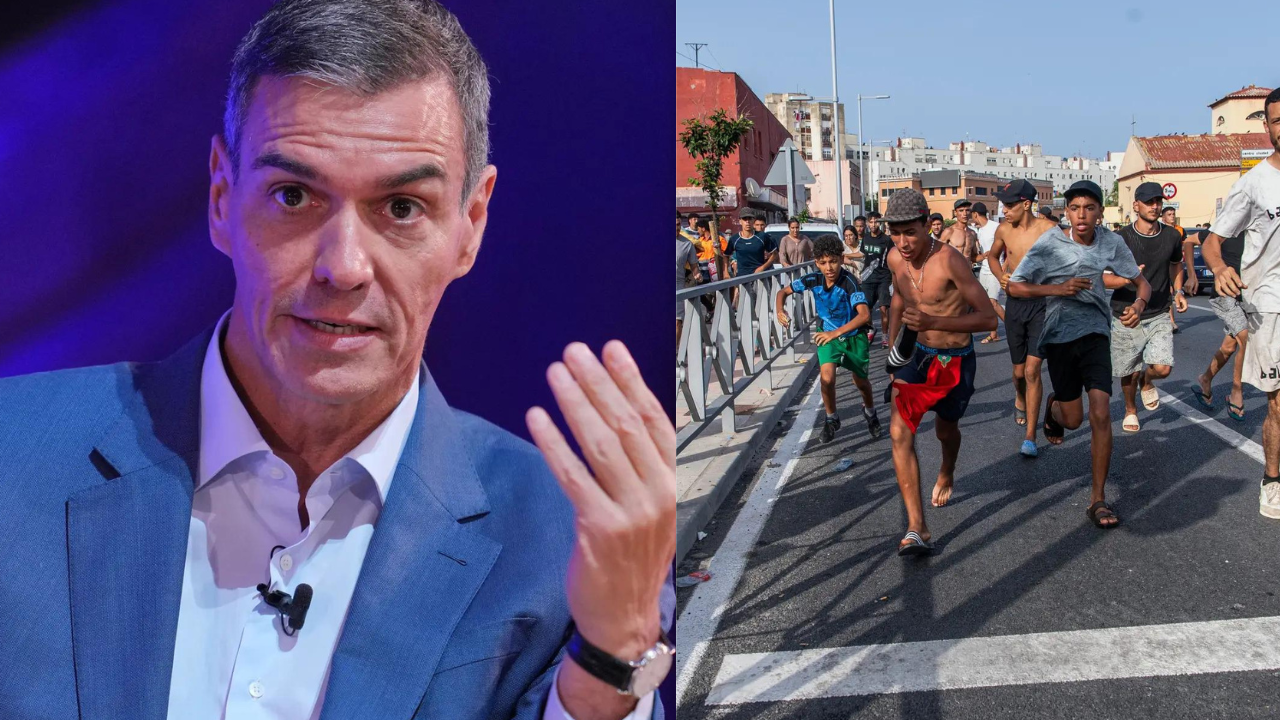
Spain's prime minister Pedro Sánchez on Saturday criticised the response of some European Union member states to this week's mass influx of illegal migrants into the Spanish enclave of Ceuta, calling their approach "selfish, polarising and unlawful."
Get breaking news anytime, anywhere. Download the TOI app now!
“The European Union cannot afford this kind of selfish, polarizing and unlawful reaction,” Sánchez wrote in a letter addressed to European Council president Antonio Costa, European Commission President Ursula von der Leyen and Irish leader Micheal Martin, as cited by Bloomberg.
Sánchez said the response of some European governments to the situation was "not only contrary to European law, humanitarian law, and the principles of solidarity that bind us together."
It was "also contrary to Europe's long-term interests and to the most basic common sense," he wrote, expressing his "serious concern" over reactions he said were "driven by prejudice, fake news, ignorance, or political interest."
His remarks came after several European leaders threatened to impose border checks and, if necessary, suspend Spain's participation in the Schengen Area, the bloc's passport-free travel zone.
European leaders reiterated their stance on Saturday in a separate letter to European Council President António Costa, European Commission President Ursula von der Leyen and Irish Prime Minister Micheál Martin, calling for an extraordinary meeting of EU interior ministers to discuss an "immediate and coordinated European response."
"We cannot allow uncontrolled mass crossings, the instrumentalization of migration or other hybrid threats to create the perception that illegal entry into the European Union is possible," the letter, signed by 22 EU leaders including Denmark's Mette Frederiksen, Italy's Giorgia Meloni and Germany's Friedrich Merz, said. France did not sign the letter, which was posted by Frederiksen on X.
Irish Prime Minister Micheál Martin said Ireland will convene a meeting of the EU Justice and Home Affairs Council on Aug. 4 to discuss the situation in Ceuta.
Spain has deployed its armed forces to the North African enclave of Ceuta after tens of thousands of migrants crossed into the territory from neighbouring Morocco in one of the largest border breaches in recent years. According to Spain's Interior Ministry, more than 49,000 people entered Ceuta in the past 24 hours, overwhelming local authorities, straining reception centres and reigniting debate over migration, border security and Madrid's ties with Morocco.
Spanish newspaper El País reported that 67 people died during the crossings, as thousands scaled border fences or swam to Ceuta from Morocco. In response, Spain on Saturday installed a 500-metre (1,640-foot) sea barrier along the Ceuta-Morocco border, as cited by news agency AP.
Ceuta is a Spanish autonomous city on the northern coast of Africa, situated on a six-mile-long peninsula bordering Morocco, across the Strait of Gibraltar from mainland Spain. Along with Melilla, another Spanish enclave further east, it forms the European Union's only land border with Africa.
Although Ceuta has been under Spanish control since 1580, Morocco does not recognise Spain's sovereignty over either enclave and considers them occupied territories.