Ever since Ponce de León landed in Florida in search of the mythic fountain of youth, the dream of limitless life has captivated the mind of mankind. Especially in Florida, where the ancients of the frigid northern wastes of the United States still emigrate en masse, on or about their sell-by dates, in hopes of retarding or halting the relentless depredations of time and gravity.
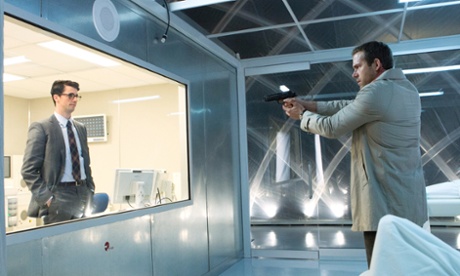
But as Matthew Goode tells an ageing Ben Kingsley in Self/Less: “Immortality has some side effects.” He’s not kidding. The immensely wealthy Damian (Kingsley) is invited – for a cool quarter-billion-dollar fee – to participate in a highly secret process whereby his entire consciousness will be decanted from his increasingly decrepit body and into the handsome, wrinkle-free form of Ryan Reynolds, thus ensuring a new lease on life.
It doesn’t work out the way Damian hopes it will, of course, because it never does. What looks like the gift of life appears from another angle more like the curse of immortality, as he finds out all too soon, when he realizes that the body he has inherited – and where exactly did it come from anyway? – still has errant memories, urges and feelings of its own.
He might have saved himself the trouble if he’d taken the time to see John Frankenheimer’s terrifying 1966 thriller Seconds, to which Self/Less bears more than a passing resemblance. In that movie, an elderly and existentially exhausted New York businessman, played by John Randolph (himself lately resurrected from the career-death of the McCarthy-era Hollywood blacklist), is recruited for rejuvenation by a secretive organization run by a sinister but twinkly Will Geer (another blacklistee). He wakes up – after a corpse resembling his own turns up in a hotel fire – as Rock Hudson, in all his bare-chested, Doris Day-era splendor, living an idyllic life as a sculptor in a bohemian beachside community in California. His idyll is short-lived, however, when it becomes plain that all the things Randolph was running away from still linger within his reupholstered Hudsonian form; indeed, they are his essence – he is in flight from himself. The meaning of the title becomes evident in the final moments, as Randolph/Hudson learns, horribly and finally, that he can never return for “Thirds”.
In every movie in which it turns up, immortality is a stone drag, a bummer, a curse. Think of the credit sequence of Matt Groening’s Futurama: in the foreground, Fry, frozen and unchanging in his suspension chamber; outside the window, civilizations rise and fall, aliens invade, everything is bombed back to the Stone Age and humankind must rebuild itself from the rubble again and again as 10,000 years are burned away before us in a matter of moments. Now, if Fry were awake and conscious for all of that, imagine how depressed he would feel.
Because depression seems to be the common complaint of all those who achieve eternal life. Look at all the Draculas we’ve come to know and love: Max Schreck in Murnau’s Nosferatu (or Klaus Kinski in Werner Herzog’s remake); Bela Lugosi, Christopher Lee, Gary Oldman, all of whom have stalked the nocturnal earth since the middle ages, doomed to feast upon the blood of others until the end of time. And none of them look too cheery about it, carrying in their wake a sulphurous whiff of hollow-eyed misery at the cruelty of their fates.
The logic of vampirism dictates that you remain in the state you were when throat-bitten. Thus we get the horrifying pubescent vampire of Kathryn Bigelow’s southwestern horror-noir Near Dark, played by Joshua John Miller (whose dad Jason starred in The Exorcist), trapped forever as an annoying and ill-disciplined pre-teen blood-guzzler. Or the 11-year-old vampiress Eli in Let the Right One In, who has outlived her protector and procurer of blood, and now needs a replacement. In the movie’s crushingly poignant final moments it dawns upon us that her rescuer, the 11-year-old Oskar, will in time become that same elderly man, seeking victims for his charge to drain and drink, changing from suitor to protector to father and grandfather, while Eli remains eternally prepubescent.
And if you get bits chopped off you or sustain gruesome physical injuries of one kind or another, as happens on a fairly regular basis in the Blade trilogy, you won’t die of your wounds; you’ll just stay that way as all the other vampires laugh at you.

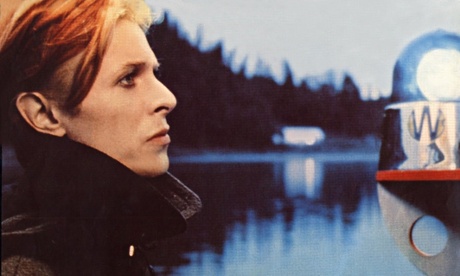
One way or another, you will pay for immortality. Dorian Gray paid. Jorge Luis Borges’ The Immortal paid. The Flying Dutchman paid. And Thomas Jerome Newton, the titular Man Who Fell to Earth, must also pay, as he watches everyone around him age and pass away. Candy Clark’s beauty erodes as she becomes increasingly drunken and raddled, Rip Torn and Bernie Casey lose their hair or watch it go grey, then white. And meanwhile Newton remains unchanged, Low-era 1976 David Bowie forever, drunk in front of his bank of TVs until the end of time (I picture him in front of a laptop somewhere in New Mexico today, with 50 windows open). How he must wish he could share in the fate of Scary Monsters-era 1981 David Bowie in Tony Scott’s The Hunger: to age centuries and rot to a pile of dust in a matter of minutes. How all of these vampires and eternal-lifers must pine for a go on the Logan’s Run roundabout, an unavoidable appointment – death disguised as “renewal” – signaled at one’s 30th birthday by a blinking jewel embedded in the palm of every human.
There are some get-out-of-eternal-life cards available in special circumstances. Adrian Pasdar’s newly bitten vampire cowboy in Near Dark regains his humanity with an infusion of blood from his virginal, pure-hearted little sister. The Half-Elves of The Lord of the Rings can choose mortality or immortality, while full Elves have no such choice, building up centuries of sorrow in their hearts as the millennia roll past them.
But usually it’s a rotten trick on the one desiring to live forever, along the lines of those mishaps that occur with the Genie’s three wishes, or the unintended consequences of the Butterfly Effect or King Midas’s curse. Only rarely does it work out to the benefit of the seeker after eternal life, as in Cocoon, set among the contemporary aged transplantees of Ponce de León’s Florida, and a rare movie that takes an optimistic, unquestioning (and ultimately uninteresting) view on the life everlasting.
There is some controversy as to whether Ponce really came to Florida in search of the fountain of youth. It’s been argued that “vida”, meaning life, was in fact a typo for “viña”, as in fountain of wine. That’s more like it, a spring at which to drown the sorrows of decrepitude and old age, and which, if you drink enough from it, could also mercy-kill you – the very opposite of the fountain of life or youth, and, frankly, a much finer and nobler thing to seek for and pine after than the miserable curse of immortality. Long live death!