A Newcastle company is enabling autonomous drones that use artificial intelligence to fly new and more ambitious routes while boosting safety.
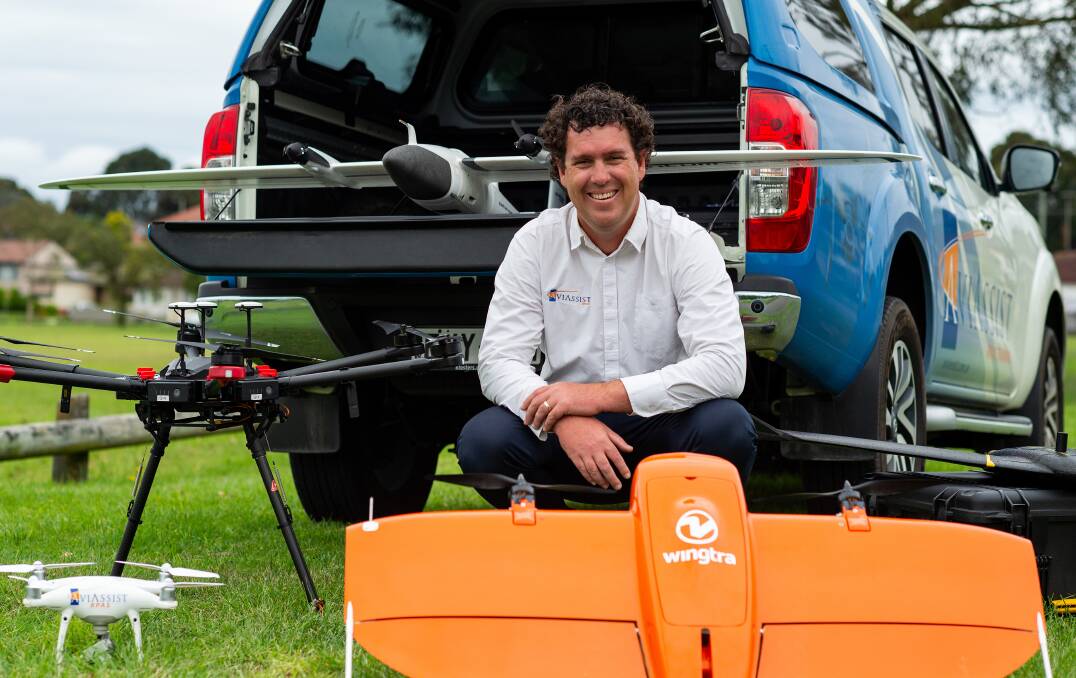
Aviassist, based in Mayfield East, is working with US drone manufacturer Skydio to advance the use of autonomous flight technology in Australia's business sector.
The global market for commercial drones is reportedly estimated to grow from $6.5 billion to $35 billion in the next five years.
With Chinese-made drones considered a national security risk, Skydio is rising high. The company, co-founded by former MIT and Google unmanned aircraft scientists, is now valued at more than $1 billion.
The California-based company, which has customers that include the US Army, Drug Enforcement Administration and residential roof inspectors, visited Aviassist in Newcastle on Tuesday.
The company's CEO Adam Bry joined Aviassist managing director Ross Anderson to observe a drone fly around the Mayfield warehouse, while the pilot operated from Melbourne.
The display involved the Skydio 2 drone - which sells for about $4500, plus a $4000 annual software fee.
Mr Anderson said the point was to show that drones could be flown safely with a pilot based elsewhere.
"Traditionally, if you're going to fly a drone you have to be with it. We've removed that barrier, so you can fly drones from anywhere in the world," Mr Anderson said.
He gave the example of a drone being used for security or stocktake purposes at a warehouse.
"Instead of needing to have a person present to fly the drone, you'd have a drone sitting on a stand and an operator could log in and fly it from anywhere."
Mr Anderson said this could not be done easily due to "big barriers with licensing and available technology".
But the drone sector is growing fast and regulation is catching up. The technology has become crucial for the military and emergency services, along with business. In a key development, the use of artificial intelligence for autonomous drone flying is now emerging in Australia.
Mr Anderson said Skydio drones can "figure out how to get back to their stand without any human pilot at the controls".
"It's machine learning. The drone visually scans the environment it is operating in and remembers where things are."
Skydio solutions engineer James Finch said the drones use "computer vision, which is a branch of AI [artificial intelligence]".
"It allows the drone to create a 3D map of the world around it to detect obstacles, risks and hazards and act accordingly on its own.
"If you were to fly the drone towards an obstacle, the drone will detect and understand that and avoid it autonomously."
The drone is essentially thinking on its own.
"The pilot still has his hands on the controls as per regulations, but the drone is flying itself and capturing this data autonomously."
Skydio drones are built to meet numerous challenges.
"Our biggest one is safety, which we tackle with autonomous flight and AI. We seek to make a scalable product, so anyone can fly these drones with any experience level and you don't require too much training."
Mr Finch said the AI navigation system included numerous cameras that ensure the drones can "navigate the world safely".
Aviassist is involved with Skydio because the Newcastle company has a non-profit research and development arm that enables businesses to legally fly drones to improve their operations.
It conducts test flights of new drone-flying scenarios under approved procedures, then seeks approval from CASA [Civil Aviation Safety Authority] before giving the concept away to industry.
Flying drones over mining vehicles - while avoiding people and buildings - is an example of one such approved concept.
"You can't normally do that legally. We did it, proved it, then released that to industry," Mr Anderson said.
The prospect of drones being used regularly to fly the likes of coffee and pizza to customers is also close to becoming reality.
Drone delivery company Wing - a subsidiary of Google's parent company Alphabet - is now flying products to customers from the roof of a Queensland shopping centre. The Wing drones can carry a cargo of a few kilograms. It has flown items such as coffee and snacks to customers in surrounding suburbs.
"There's not widespread drones like in The Jetsons yet, but it's certainly on the way," Mr Anderson said.