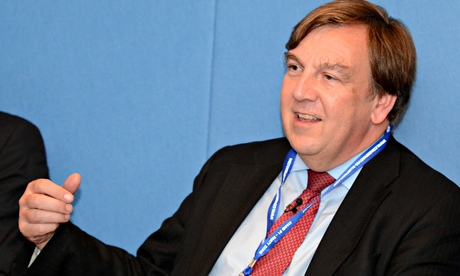
The days of funding the BBC via a licence fee could be numbered, according to John Whittingdale, chair of the Commons culture select committee.
Whittingdale’s committee is carrying out an inquiry into the future of the BBC. Speaking at a Guardian fringe event at the Conservative party conference in Birmingham, the Conservative MP said it was “getting steadily harder to sustain the licence fee” as the best way to continue funding the corporation.
Though a Guardian poll ahead of the conference season showed that 83% of respondents agreed that the fee was the best way to fund the corporation – and the BBC’s own research also shows that the licence fee remains the top choice for funding – Whittingdale said “ a lot of people” wanted his committee’s inquiry to consider alternatives to the licence fee, including replacing some of the fee with a subscription model.
Ahead of the BBC’s charter renewal in 2016, the group of MPs is looking at alternative models being used in countries such as Denmark, Holland and Germany, where a payment for broadcasting is included in household taxes. The Dutch system, where the government makes a direct grant to public service broadcasting, was also “quite attractive”, said Whittingdale, though it was introduced with guarantees of ringfenced funding which ministers then cut by 30%. From 2010-2012, broadcasters in the Netherlands faced cuts of €127m.
Whittingdale said the BBC, just like any other public service, should have to make economies. He described the existing funding system as “highly regressive”, adding that it is “deeply unfair” that people who can’t pay the licence fee end up in prison.
On 8 September, culture minister Sajid Javid announced a review of whether failing to pay the licence fee should remain a criminal offence. Decriminalisation, which is backed by all three main parties, could potentially cost the BBC as much as £200m a year.
The culture select committee review is due to be published at the end of this year, “once I can get the committee members to agree.” said Whittingdale. As well as funding, it will also consider the role of the BBC Trust. Whittingdale said evidence to the committee showed that few people think the existing trust is fit for purpose or has worked well.
Other panellists defended the licence fee. John McVay, chief executive of PACT, said a BBC funded by subscription could threaten the delicate ecology of the UK broadcasting system, by making the corporation more of a threat to commercial broadcasters. “If they [BBC staff] are charged to get money and bonuses, they’ll aggressively go after pay TV revenues,” he said. Adam Minns, executive director of the Commercial Broadcasters Association, said he didn’t want to see BBC funding being top-sliced or salami-sliced, but he did call for greater consultation by the corporation with the rest of the broadcasting sector.
RadioCentre chief executive Siobhan Kenny said 78% of Radio 1 listeners want the BBC to produce content that is different from commercial output, yet had little awareness of the public service output required by the BBC Trust, leading her to question whether the BBC Trust has sufficient teeth to hold all BBC services to account. “We should give the trust more power and separate it out,” she said.
But the debate over both public funding and regulation rumbles on. James Heath, BBC director of policy, said the present funding meets crucial tests “fairly effectively” in that it is universal and provides both value for money and independence from government, but said he was “open” to discussion if there was a better system than the licence fee.
Meanwhile Peter Salmon, director of England at the BBC, said the licence fee has given the corporation continuity and the ability to plan. “I spend time with broadcasters in Europe who have a mix of funding models and they don’t know from one month to another what they have to work with,” he said. “The detrimental impact of these mixed models has led to a degree of chaos and confusion in those territories.
“The licence fee has stood the test of time and means government keeps its hands off broadcasters,” he added, “so be careful what you wish for.”
Whitttingdale said some issues with the present BBC funding could be easily solved – particularly those that had arisen because of the advances in technology since the fee was last set. He said it was “plainly a nonsense” that it is necessary to buy a licence to watch live streamed television content but not to watch catchup television. “That needs to be brought up-to-date,” he admitted.
This conference fringe debate was designed and produced by the Guardian to a brief agreed by partners PACT, COBA and RadioCentre. All content is editorially independent.
Read more from the Guardian Big Ideas at the 2014 party conferences.