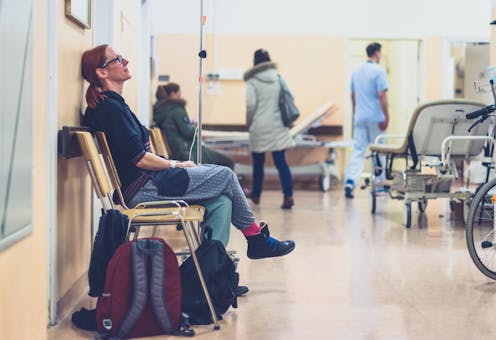
It’s 8 p.m. on a week night. You haven’t been feeling well all day and now you’re even worse. You’ve got a low-grade temperature, you feel nauseous and you’re coughing a lot. You call your family doctor and get a recorded message telling you the office is now closed until tomorrow and if it’s an emergency you should either go to a walk-in clinic, call Telehealth Ontario or go to an emergency department.
By now, all of the walk-in clinics near you are closed and when you’ve called Telehealth in the past you’ve usually been told to go to the nearest emergency room (ER) so that’s where you head. Eventually, you see me, an ER doctor.
After I’ve examined you, done a few routine blood tests and taken a chest X-ray it turns out that you’ve got a viral infection and you should be feeling better in about a week. However, there were a few abnormalities in your blood work. Nothing very serious but they should be followed up.
Read more: How to solve Canada's wait time problem
I decide that it’s easiest if I call your family doctor and leave a message letting her know about these abnormalities and what I would recommend. However, when the call goes through, it turns out that your doctor’s voice mail doesn’t accept after-hours messages. So, I need to spend extra time writing out my thoughts and giving you the paper to take to your doctor when you can get an appointment.
Where is this happening? In Ontario since Sept. 20, 2019, when the College of Physicians and Surgeons of Ontario (CPSO) passed a new policy about Availability and Coverage.
The CPSO is the body that licenses doctors and is supposed to protect the interests of patients. Each province has its equivalent. The new CPSO policy does not require doctors to accept after-hours messages, stating only that they “must inform patients of when and where to access appropriate care outside of regular office hours.”
You need continuity of care
The draft policy proposed by the CPSO back in December 2018 was much stronger. Office telephones had to accept after-hours messages. Doctors were required to have “a plan in place to co-ordinate care for their patients outside of regular operating hours,” and make “a reasonable attempt to minimize… the inappropriate utilization of emergency rooms or walk-in clinics.”
I recognize that co-ordinating care in every circumstance is not possible, nor is avoiding the use of emergency departments. For example, in small rural communities, general practitioners often close their offices and then go to work in the emergency department. So leaving a message for patients to go to the emergency is perfectly appropriate.
The new policy is the antithesis of protecting patients because it does not promote continuity of care. Continuity of care has been widely recognized as one of the keystones of good medical care.
Continuity ideally means being seen by the same person who you have built up a relationship with over many years; someone who knows you well and can determine when a problem is serious and needs quick follow-up.
The ideal is not always possible, but at a minimum, patients should be able to get in touch with someone who has access to their medical records. A colleague of their regular doctor, who can easily communicate with that doctor the next day or as soon as is necessary. That’s not something that happens in either walk-in clinics or emergency departments.
Hallway medicine getting worse
June 2019 was the worst month since records started to be kept in 2008 for “hallway medicine,” or overcrowding, in Ontario’s hospitals. And the flu season is now on its way, which will put more pressure upon hospital emergency departments.
Having doctors send their patients to emergency departments as the CPSO policy allows, and perhaps even indirectly encourages, is only going to make the situation worse.
Allowing doctors not to accept after-hours messages furthers the fragmentation of care because it doesn’t allow for doctor-to-doctor communication about patients. It’s just as bad — or even worse — for patients who cannot leave a message about something that they consider urgent or important.
On its website, the CPSO says that its mission is to serve, “the people of Ontario through effective regulation of medical doctors.” If the CPSO wants to live up to this mission, it needs to rethink its policy about availability and coverage.
[ Deep knowledge, daily. Sign up for The Conversation’s newsletter. ]

In 2016-2019, Joel Lexchin was a paid consultant on two projects: one looking at developing principles for conservative diagnosis (Gordon and Betty Moore Foundation) and a second deciding what drugs should be provided free of charge by general practitioners (Government of Canada, Ontario Supporting Patient Oriented Research Support Unit and the St Michael’s Hospital Foundation). He also received payment for being on a panel at the American Diabetes Association, for a talk at the Toronto Reference Library, for writing a brief in an action for side effects of a drug for Michael F. Smith, Lawyer and from the Canadian Institutes of Health Research for presenting at a workshop on conflict-of-interest in clinical practice guidelines. He is currently a member of research groups that are receiving money from the Canadian Institutes of Health Research and the Australian National Health and Medical Research Council. He is member of the Foundation Board of Health Action International and the Board of Canadian Doctors for Medicare. He receives royalties from University of Toronto Press and James Lorimer & Co. Ltd. for books he has written.
This article was originally published on The Conversation. Read the original article.