Security is an essential condition for sustainable development. A government’s inability to protect its people and control its territory often undermines progress on everything else. The international community has recognised the link between security sector reform and development and the 2015 sustainable development goals (SDGs) acknowledge the role of violence and fragility in cycles of poverty and the interconnected nature of conflict and development.
An enhanced security environment lies at the core of a peaceful and prosperous Democratic Republic of Congo (DRC). The government recognised the importance of this in the 2006 Governance Compact, putting security sector reform (SSR) - including disarmament, demobilisation, and reintegration (DDR) - at the top of the agenda. The 2007 report of MONUC (Twenty-third report of the Secretary-General on the United Nations Organisation Mission in the Democratic Republic of the Congo) concluded that there was a growing need to push for the creation of a national police force that could take policing responsibilities back from the Congolese Armed Forces (FARDC).
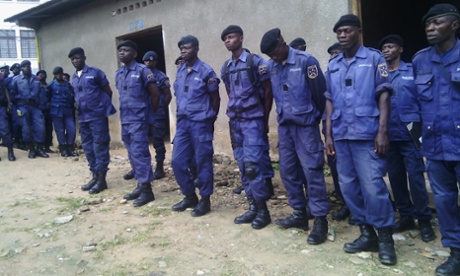
EU-funded program to support the National Police force
Police reform is an important entry point for security sector reform. The police are arguably the most visible and immediately present aspect of the security system, in a unique position to provide the foundations for stability, security and confidence in the state. The reform of the Congolese National Police (PNC) to create a more efficient, accountable and active police force is therefore a critical milestone to DRC’s SSR efforts.
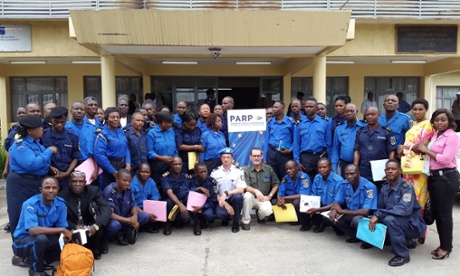
The European Union (EU) has been supporting the Government with these efforts, including through a programme (PARP) to reform the National Police of DRC. EUNIDA, a grouping of EU Member State implementing agencies was contracted for Phase II of the PARP programme with Crown Agents as the leading implementer.
PARP II, which will run from 2014 to 2016, focuses on four areas, providing comprehensive support and strengthening of all the necessary facets of development within the PNC:
• Planning and implementation of the reform
• Support to the Human Resources Department
• Support to the Department for Budget, Finance, Management Services and Infrastructure Maintenance
• Reconstruction and rehabilitation of training facilities.
Nationwide census of the Police force
A key step in the reform process is a nationwide census of PNC staff, estimated to number 110,000. Even though this is considered a high estimate it still falls short of what is needed. With a population of around 70 million, the DRC would need an estimated 150,000 officers to have an adequate ratio with civilians.
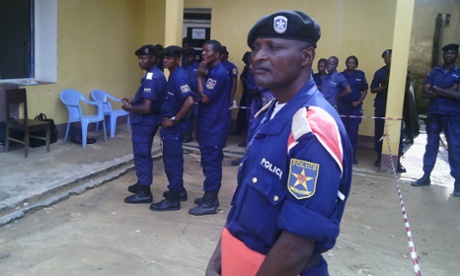
The census is critical for getting a more accurate picture of the total number of active police and identifying recruitment and training gaps that need to be filled. It will also help reveal possible ghost workers. The results of the census will set the groundwork for salaries to be paid electronically to all registered policemen, limiting opportunities for extortion and leakage. In recognition of the importance of a stronger police, the government recently marginally increased monthly salaries.
A census, usually a relatively straightforward exercise to complete, is more challenging for somewhere like DRC. Its ground transport has always been difficult: the terrain and climate present serious barriers to road construction and the distances are enormous. Local travel by air is unreliable and often travel by river is the only way to access remote provinces, though undoubtedly no more secure or rapid than alternative options.
PARP II has been helping to roll out the census simultaneously in 11 provinces since April 2015. We recently travelled to one of the census sites in DRC’s largest port town, Matadi, as part of a review of the project’s progress. Though it should have been one of the most accessible sites, a seven-hour car journey on one of the most well maintained roads in the country turned into a fifteen-hour odyssey, giving us a flavour of the logistical difficulties faced by our staff and the police officers involved in completing this exercise.
It’s problematic for both the census teams and for the policemen travelling to the census sites. The latter often have to travel on foot, some for up to two weeks to reach the sites. Once there, they are registered into the system and receive electronic ID cards containing information about their rank, location etc.
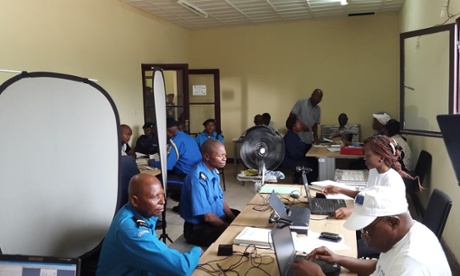
The census is an ongoing process given that it has to be repeated every few years to capture new recruits and remove those no longer serving, so it’s vital that the government takes ownership of the exercise and avoids over-reliance on the international community. Yet completing the census may well become more challenging with the recent division of the provinces from 11 to 26, effectively more than doubling the required census sites, requiring ever more human and financial resources.

Improving financial and human resources management
Running parallel to the census is training covering different basic aspects of police work, as well as responsibilities related to the budget department to ensure sufficient resources are captured and allocated to the PNC. Progress is ongoing on building a police training academy, ACAPOL, which is being partly funded by the DRC government.
While these combined elements form the stepping stones to ensuring that the PNC can act as a demilitarised unified force that is trained and adequately resourced, a lot still needs to be done. There is a need for a long-term approach, recognising that the difficulties faced by similar countries in the security sectors, notably in policing, are not amenable to short-term inventions. They require changes in culture and attitudes as well as institutional and human resource capacity development which take years to achieve.
Security sector reform must, therefore, be viewed as a process that requires long-term persistence. This is certainly true in DRC.
Content on this page is paid for and provided by Crown Agents a sponsor of the Guardian Global Development Professionals Network.