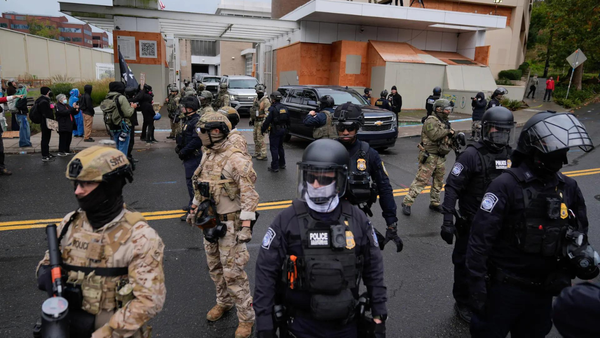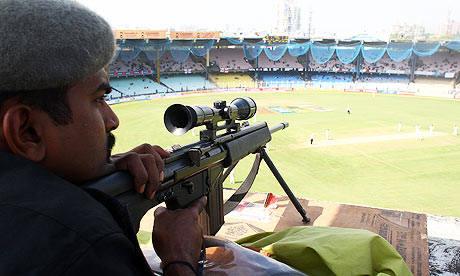
The motorcade from the Taj Coromandel to the MA Chidambaram Stadium could have been straight out of The Day of the Jackal, with two luxury coaches taking the place of Charles de Gaulle's Citroen DS. Rapid Action Force commandos ringed the perimeter of the ground, automatic weapons at the ready.
There were snipers on the roof, and probably as many policemen as spectators for the toss. The security checks were stringent, and if you wanted to carry anything more than your wallet and ticket, you did not make it in. No packed lunches, no water bottles and certainly no mobile phones.
At the last World Cup in the Caribbean, the killjoy attitude of the organisers kept thousands of fans away. In Chennai there was grudging acceptance of the security guidelines, and a Tamil Nadu Cricket Association official told the Guardian that between 5,000 and 6,000 people had made it through the turnstiles during the day. With India still to bat and the weekend coming, a far larger turnout is expected over the next few days, despite the paranoia induced by the Mumbai terror attacks and pre-Christmas examinations.
At 9.20am, 20 minutes after Kevin Pietersen had won the toss, both teams emerged wearing black armbands. The couple of thousand who had taken their plastic seats by then cheered, and then stood up to observe two minutes of silence in memory of the Mumbai victims. There were no hoots from idiots or clarion calls, just sombre acknowledgement of these unsafe times.
When the Indians ran out to raucous acclaim a while later, they still seemed in contemplative mood. It was not that England's openers started like a runaway train or that India bowled badly - only 63 runs came in the opening session - it was just that the searing intensity that had overwhelmed the Australians a month earlier was not in evidence. Tidy and restrictive, yes. Menacing? No.
There was no reversal of fortune after lunch either, with Andrew Strauss showing increasing fluency against pace and spin alike. Alastair Cook's dismissal brightened the mood in the stands, but with a fairly lush outfield keeping the ball in decent condition, there was no magical spell of reverse swing to have them jumping in their seats. That came after tea, and from a usual suspect. Few pace bowlers in the world right now are as adept as Zaheer Khan when bowling with the older ball, and in six overs after the interval he transformed the game. Strauss's reflexes kept out two searing yorkers that curved into his pads, but there was no such luck for Ian Bell or Kevin Pietersen. Playing with excessive caution and clearly expecting the full, swinging delivery, Pietersen fell to the sucker punch, a short ball directed at the body.
After that England meandered through to stumps, adding only 65 in the final session. Afterwards Harbhajan Singh, not one shy of the sly dig at the opposition, was full of praise for the English squad returning to India, even though he was not as complimentary about their spinners. "It was great that England came back," he said. "Hats off to these guys. After the Mumbai incident, we were all tense and scared but we cannot control these things."
These are difficult times for the Indian team. Used to being feted and pampered at home venues, they are now cooped up inside the hotel, surrounded by three or four layers of security. It has already caused a few strains, with Tamil Nadu police lodging a complaint against Zaheer for "high-handed behaviour".
Apparently annoyed that one of his guests was not allowed up to his room, Zaheer and the deputy commissioner had the sort of tête-à-tête that the Indians usually save for Australia. Harbhajan, though, was in far more accepting mood. "It's difficult," he said. "But everyone was scared and it's great to have the commandos. It gives us a feeling of safety."
Commentators are seldom slow with military metaphors whenever Virender Sehwag bats, but when he emerges with bat in hand today, on to a field guarded by men in blue fatigues with machine guns, such lazy analogies are likely to be abandoned. Times have changed.