Wuppertal, Germany
Cragg produces between three and five versions in different materials of nearly a dozen new works every year. He employs 20 full time workers in his studio, where the lingua franca is German. "The space works really well. I have a team of people who are very good at different aspects of handwork ... What I try to use the studio for is what I call ‘thinking with material’. To do that you need an arena. You need a page to write on. You need a space to work in. That is what a studio is." Photograph: Robin Friend
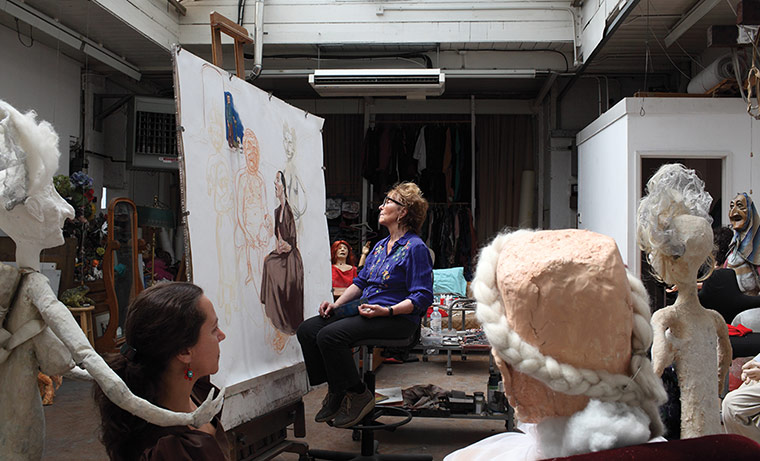
Camden, north London
Rego sits with her model of over 20 years, Lila Nunes, who came over from Portugal – Rego’s native country – to care for the artist’s husband and has sat for her ever since. Rego comes to her studio “not every day but mostly ... habit is a good thing. If you pick up a pencil and look at something and draw it, that cheers you up.” Rego’s studio is filled with the papier-mâché characters she uses for models, and has been described as looking like a little chamber of horrors. “As a caricaturist I like the obscene, the grotesque – the beautiful grotesque.” Photograph: Robin Freind
Angel, north London
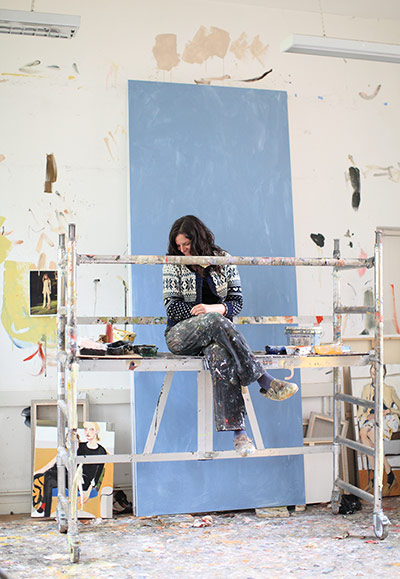
“My studio is somewhere that I find incredibly peaceful to come to. I sometimes come in for half an hour and look at books or just think. It’s an oasis I suppose ... I find it quite hard to have other people in this space. It taints it ... I know it’s a filthy messy space, but it’s my filthy messy space.” Photograph: Robin Friend
Deptford, south-east London
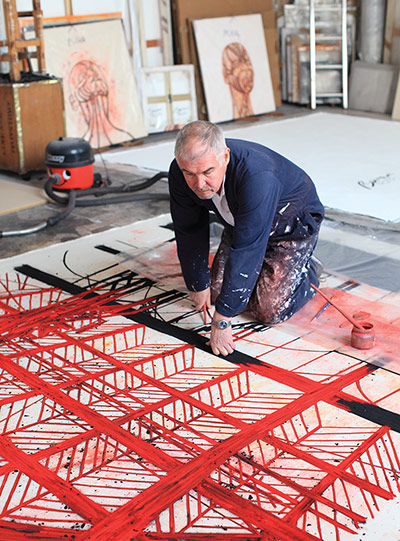
“I tend to work on the floor, sometimes on the wall and then on the floor. It’s constant movement between the vertical and the horizontal. Part of the reason I work on the floor is that I need the physical contact. You get the consistency of gravity and you can move the paint around ... I try to get in to my studio as often as possible. At times I set myself a certain goal to reach. Some days are very long.” Photograph: Robin Friend
Hackney Wick, east London
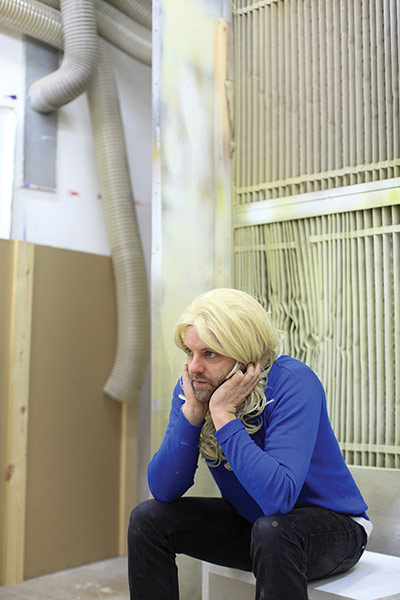
“If I worked on a desert island, I certainly wouldn’t make art the way I make it at the moment. I wouldn’t self-consciously be creating things for an audience. The audience would be myself, and that would result in a very different kind of project.” Turk often uses himself as a model for his art. “Being an artist allows me to play around with thinking about who I am, to experiment with the idea of who I might be.” Photograph: Robin Friend
Walthamstow, north-east London
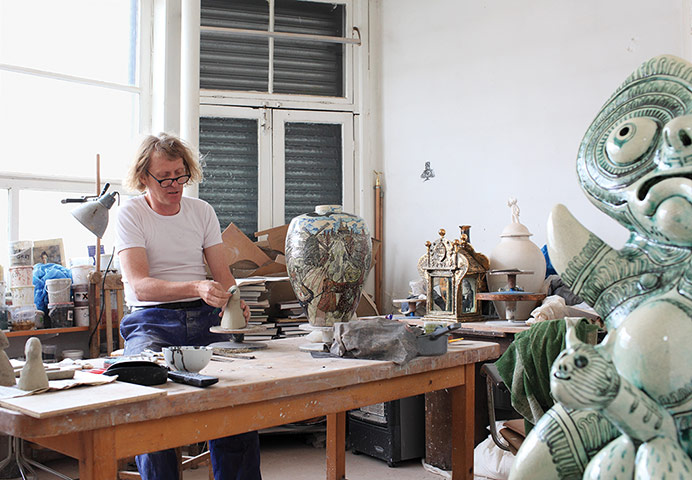
“When I was at college we all had our little chipboard cubicles that we worked in. Someone came up and went: ‘Oooh, you’ve got a meaty space!’ And I thought , yeah, I do like to have a busy space. I like the feeling that it’s got a density of creativity going on ... Claire never goes to the studio. Making pottery is a dirty business. You don’t go to the studio in a nice dress. It’s where you get on with stuff and make a mess and collapse in an armchair and listen to The Archers” Photograph: Robin Friend
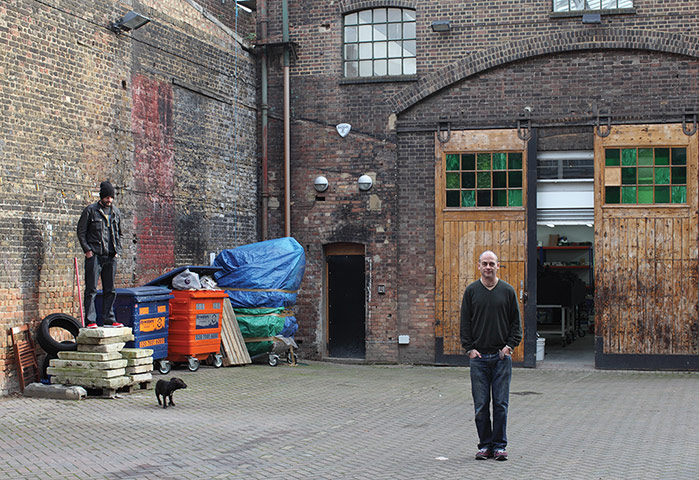
Hackney Wick, east London
Jake (left): “The work in the gallery is not the work in the studio. You can’t go back. You think about it in a very different way. Dinos: “Everything you make is a massive disappointment because it’s not the thing you wanted it to be ... Once it is outside our studio, it isn’t ours anyway. We can’t be held responsible for what it is seen as. It becomes an object in its own right.” Photograph: Robin Friend

Clerkenwell, London
Quinn’s orderly studio is crammed with works from his Garden series and sculptures that depict celebrities such as Kate Moss. "The studio is the place where it’s my world. When I leave I do take work home in my mind, you always carry it in your mind, but hopefully you can separate it or you will go insane. You have to turn your head off sometimes." Photograph: Robin Friend
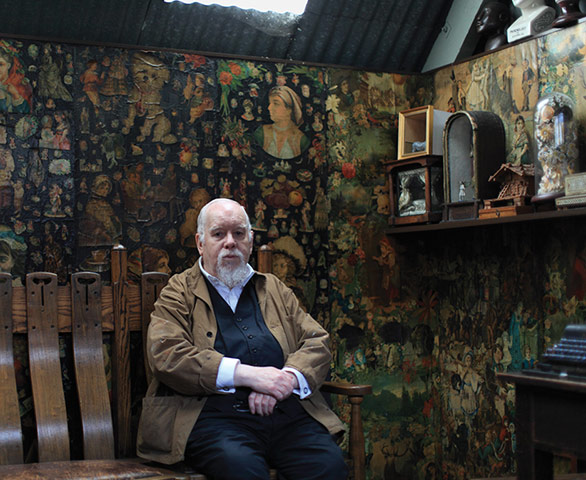
Hammersmith, west London
Peter Blake’s studio, a former Georgian stable, served as a builder’s yard and garage for horse-drawn buses during the first world war. Blake’s collection of objects placed higgledy-piggledy across the rambling space is famous as ‘a museum of everything’. In creating it, he was mostly inspired by childhood deprivation: "I was seven when the [second world] war started. As I was evacuated I missed that bit of childhood; I didn’t have any toys or anything." Photograph: Robin Friend

Oxford
"My studio does affect my work but not the core element. When I get in there I find my feet quite quickly ... A studio changes depending on what you need at a particular time. It can be a laboratory of ideas; it can be a safe haven; it can be somewhere you don’t want to go because the work’s not going right. If I’m not in the studio I feel a magnetic-pull back to it. It’s been like that since I was quite young." Photograph: Robin Friend
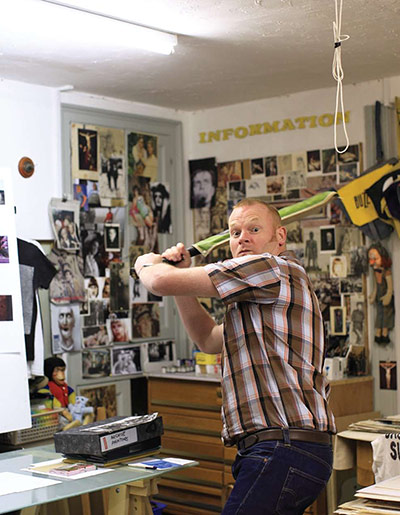
Ifracombe, Devon
"One thing I can’t do is share a studio. I can’t stand other people. I don’t want them anywhere near me when I’m working. I pretty much work office hours. I start at seven in the morning and finish at seven in the evening.’ Shaw lives and works in the same building, working downstairs in an abandoned shop and living upstairs with his girlfriend. ‘I go upstairs just before The Archers ... unless something drastic happens!" Photograph: Robin Friend

thamesandhudson.com Photograph: PR