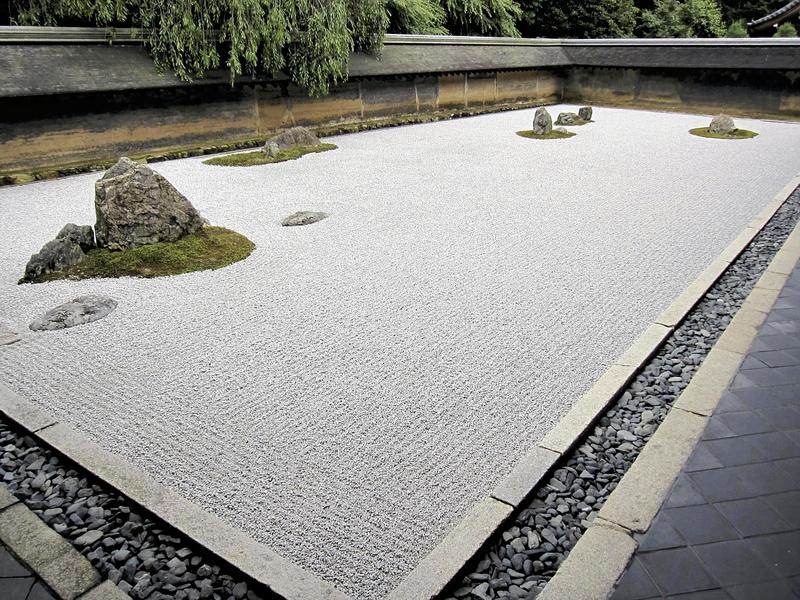
KYOTO -- Which place in Kyoto is most favored by foreign tourists? Americans and Chinese will probably visit Kinkakuji temple in Kita Ward on arriving at this ancient capital. The temple's Golden Pavilion shines at the side of a pond with its reflection on the water standing out against the green trees. They would say, "That view is majestic."
On the other hand, some French people told me that their first choice is the rock garden of Ryoanji temple in Ukyo Ward. They said they had a great time just quietly sitting and spending time in front of the garden known for its simple beauty, where rocks are placed on ground covered with white gravel.
The Golden Pavilion is a wooden structure, but much of its exterior is gilded with gold leaf. Its gold color glistening in the sunshine symbolizes wealth, so it is well received both in the East and West. The color contrasting with the surrounding green is also striking. Probably no more explanation is necessary.
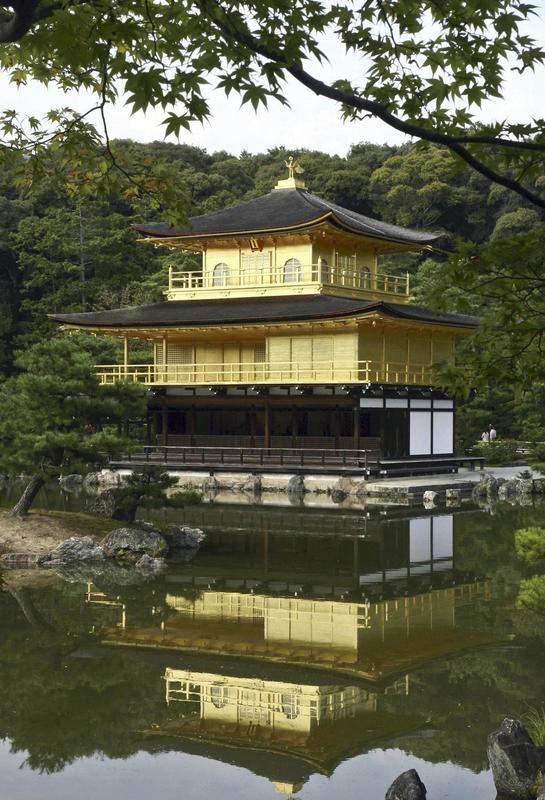
In contrast, Ryoanji's rock garden looks bland. It has no flowers and no pond filled with water. This style, called kare sansui, however, means something. "Kare" means no water. "Sansui" literally means mountains and areas of water, such as oceans, rivers and ponds, indicating a natural landscape. The rocks arranged in the Ryoanji garden signify mountains and islands in the ocean. Neat rows of rake marks are left in the white gravel to illustrate the flow of water and waves.
Many gardens in that style are found at Buddhist temples belonging to the Zen sect, including Ryoanji.
At the temple, white gravel is spread all over a lot that is slightly less than 300 square meters. One side of the garden faces the south side of the hojo, a term for the residence of the head monk at a Zen temple. Tsuiji-bei earthen walls are erected along the other sides of the garden. Fifteen rocks in various sizes are placed on the lot. Some green moss grows around the rocks.
You are not allowed to enter the garden. You should look at it from the hojo section. Staring for a while, you will probably feel the simple setting is like small and large islands in the ocean.
On further reflection, some people may find their own interpretations of what the display represents.
A well-known interpretation says that it is based on "tora no ko watashi" (crossing of tiger cubs), a story that goes as follows: A parent tiger crosses a river carrying its three cubs, one by one, in its mouth. One of the cubs, however, is so fierce that it attempts to devour the other cubs when the parent is not watching. To avoid it happening, these cubs should be transported in the correct order. Some say the crossing process is depicted by the rock pattern in a series of scenes.
Some people believe that the 15 rocks represent the number 15 -- the total of "shichi go san" (seven, five and three), a combination of three numbers representing good luck and featured in happy events. In fact, the 15 rocks somehow seem to form three groups, one each of seven, five and three rocks.
Still other people state that the rock display looks like a fan with one rock being a pivot. There is also a view that the rocks depict the kanji character "kokoro" (meaning heart), while another view says they are placed to look like Cassiopeia in the sky. There is also a statement that the lengths of two lines, each formed by connecting a large rock to another, are in the golden ratio of 1 to 1.618, an aesthetically pleasing, stable-looking proportion.
Even academic research has been conducted. A paper based on analysis of the garden's spatial structure concluded that it is abstract and a remarkably simple expression of a natural landscape. The research result was published in Nature, a distinguished British science journal, in 2002.
Thus, the garden looks dry at first, but this impression is deceptive. Visitors can read abundant meaning into it. It makes sense for me that it is also called "the garden of Zen" and "the garden of philosophy." I feel it represents the mystery of the East. No wonder it is favored by foreign people who like meditation.
Who built this garden is unknown. One thing for certain is that the temple was founded in 1450 by Hosokawa Katsumoto, who commanded one of the two rival forces during the Onin War (1467-77).
The war is a turning point of Japanese cultural history. After the war, people in this country, who had favored dazzling works of art, started to prefer objects featuring the plain, quiet worldview of wabi and sabi.
* * *
This column, which appears once a month, is about various aspects of the culture of Kyoto.
Mori was born and raised in Kyoto. He has 30 years of experience in reporting about Kyoto culture. He has extensively covered
scholars of the New Kyoto school, the heads of tea ceremony and flower arrangement schools, as well as maiko in the Gion area of the city.
Read more from The Japan News at https://japannews.yomiuri.co.jp/