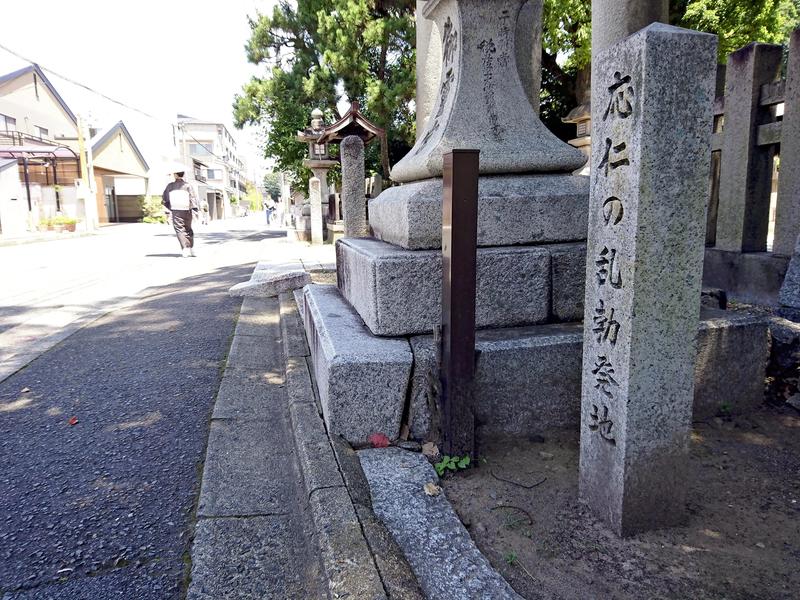
KYOTO -- If the Japanese refer to "the most recent war," in general it means World War II, in which about 3 million compatriots were killed. This is not always the case with Kyotoites. When they complain, "We had a really hard time in the most recent war," they often mean the Onin War, a civil war that lasted from 1467 to 1477 during the Muromachi period (1336-1573), when Kyoto was the capital of Japan.
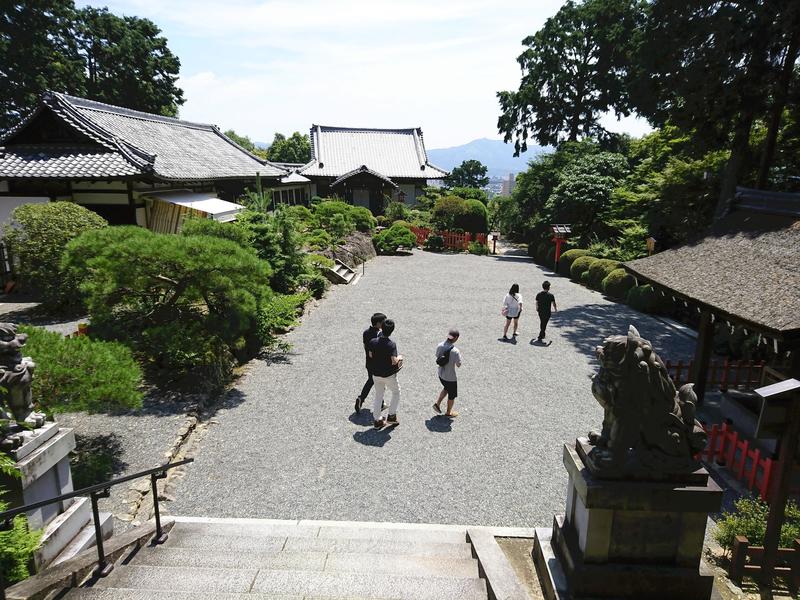
There is a famous confectionary shop known for aburi-mochi (small grilled rice cakes on skewers) near the Imamiya Shrine in Kita Ward, Kyoto. This shop, named Ichiwa, was established in the year 1000. Its proprietress says, "The whole area around this shop was destroyed by fire because the western army encamped on Mt. Funaoka near here."
The "western" army means the military forces commanded by warlord Yamana Sozen during the war, which split Japan in two. About 116,000 mounted warriors in its army were stationed in western Kyoto. Its rival, the "eastern" army was led by another warlord, Hosokawa Katsumoto, and encamped in eastern Kyoto with 161,500 warriors on horseback.
Ichiwa's proprietress talks about the war as if she had seen it in person because she "had heard about it from her grandmother again and again" since she was a child.
Both Yamana and Hosokawa held high positions in the Muromachi shogunate, so they easily made provincial lords dispatch military units for the war.
This war, however, was difficult to understand even for the people involved. Betrayals were rampant, and skirmishes occasionally happened. At other moments, the two camps just lingeringly squared off against each other. Over time, dispatched military units withdrew to their respective domains, having been unaware which side won.
Kyoto, the sole large city in Japan at that time, was devastated by the many soldiers who outnumbered local residents.
It was around that time when ashigaru, or low-ranking foot soldiers, appeared in Japanese history. Recruited from farmers and low-ranking urban residents, they frequently ransacked and set fire to buildings during the war.
If those buildings had been made of brick or stone, at least the exterior walls may have remained. However, local houses were made of wood. The only surviving buildings were dozo traditional storehouses where wooden walls are covered with earth and plaster, and a small number of temples, which were just able to escape by good fortune.
From then on, the shogunate's power gradually weakened, thereby leading to the Sengoku warring states period.
What was the shogun Ashikaga Yoshimasa doing at that time as the nation's supreme leader?
He initially took a neutral stance, then later supported the eastern army. However, all the measures he took resulted in failure. He ended up writing a waka poem that sounded like a work by a mere bystander: "Nevertheless, I expect [the civil war] will calm down eventually. I won't detest this world, however chaotic it is."
He would not evacuate his shogun's residence, even when there was a battle only 100 meters away. Instead, he enjoyed tea, appreciated the garden's well-designed landscape and admired his collection of ink paintings.
Although he was totally incompetent in politics, he exercised outstanding leadership in various cultural activities. He was also an excellent producer of verse-linking renga and flower arrangement events, as well as noh performances. Donald Keene, a renowned scholar of Japanese literature, gives credit to Yoshimasa for embedding a new sense of beauty in the fertile ground that had been destroyed in the Onin War.
In fact, Japanese culture had been under a strong Chinese influence, but it was disrupted by the war and changed into an original culture under Yoshimasa's leadership.
During World War II, Kyoto was little-affected by air raids. When people here look back on its history, it makes some sense that they first think of the Onin War as a turning point to make a new start. Therefore, they probably mention it as "the most recent war."
After the Meiji Restoration, Kyoto was no longer the capital of Japan. Today, the city nevertheless identifies itself as a cultural capital. Its current standing owes a considerable debt to Yoshimasa.
* * *
This column, which appears once a month, is about various aspects of the culture of Kyoto.
Mori was born and raised in Kyoto. He has 30 years of experience in reporting about Kyoto culture. He has extensively covered scholars of the New Kyoto school, the heads of tea ceremony and flower arrangement schools, as well as maiko in the Gion area of the city.
Read more from The Japan News at https://japannews.yomiuri.co.jp/