KYOTO -- Many travel guidebooks on Kyoto suggest visits to Kinkakuji and Ginkakuji temples, often comparing their famous pavilions. Their names look similar even when written in kanji characters: Kinkaku means "golden pavilion" and Ginkaku, "silver pavilion."
The two Rinzai sect Zen Buddhist temples are sub-temples of Shokokuji temple. All three temples are headed by the same chief priest, Raitei Arima.
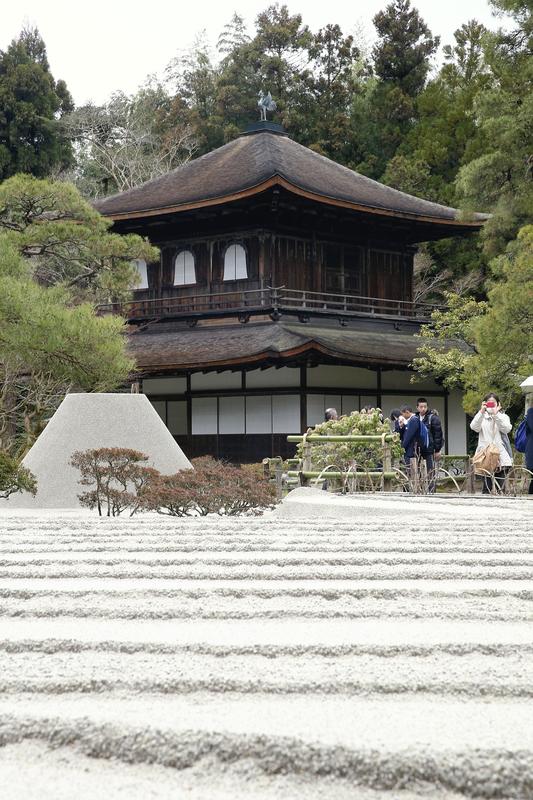
While the exterior walls of Kinkaku pavilion are covered with gold foil, giving the building a distinctive luster worthy of its name, there is no silver in sight at Ginkaku pavilion. The exterior walls on its first floor are plastered white and the second-floor walls are exposed wood -- observed from a distance, the structure looks quite dark. If people visit expecting to see a silver version of Kinkakuji, they will likely leave disappointed.
The temple complex that houses Ginkaku was originally built as a villa for Ashikaga Yoshimasa, the eighth shogun of the Muromachi shogunate. Construction of the villa began in 1482, but Yoshimasa died before Ginkaku's completion. In accordance with his will, the villa was turned into a temple after his death. The residence included several buildings, and a two-story pavilion among them was later named Ginkaku, which ultimately became the informal name of the whole temple.
What kind of design did the shogun choose for the pavilion?
Various theories have circulated about the original design of the building. Some have said the building was originally decorated with silver foil that peeled off over time, while others claim there was never any intention for silver to be used. There is also an opinion that a plan to apply silver foil was called off, either because Yoshimasa died or due to a shortage of funds as a result of the protracted civil war.
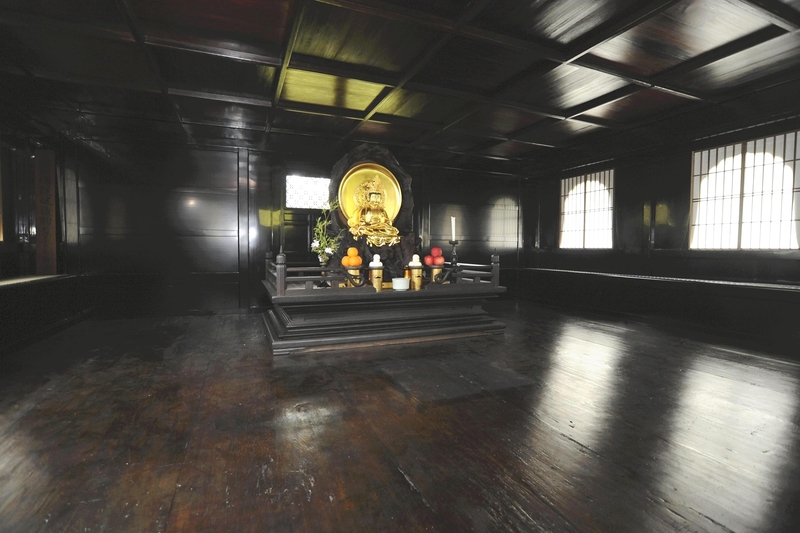
The mystery was partially solved in 2007 when researchers conducted tests when repair work was being carried out at the pavilion. No trace of silver was detected on the walls, proving that silver foil had never been applied. The investigation also revealed that the second-story walls used to be coated in black lacquer.
"The lacquered wall would have been glossy at first, which may have looked like shining silver," an official of the cultural assets protection division of the Kyoto prefectural board of education said after the investigation.
Arima, the temples' chief priest, however, has a different view. Yoshimasa's grandfather Ashikaga Yoshimitsu, the third shogun of the Muromachi shogunate, built the golden pavilion. To model himself on his grandfather, Yoshimasa built his own pavilion. People aware of the building's history in later years started to call Yoshimasa's pavilion Ginkaku to distinguish the structures, according to Arima.
There is a tradition in Japan and China of revering people or things in pairs. For example, the famous Chinese poets, Li Bai, and Du Fu are typically spoken of as a pair. Similarly, Hokusai and Hiroshige are paired as the greatest ukiyo-e landscape artists: Who's to say which of the two is the superior artist?
In sumo, the two highest-ranking yokozuna are thought of as a pair, with one representing the east and one the west -- the superior wrestler represents the east.
Reflecting a similar hierarchy, Kinkaku typically precedes Ginkaku, when mentioned as a pair.
Although some may insist on pointing out that Ginkaku was likely coated with lacquer, not silver, the reverence of pairs in Japanese culture will prevail. If one of the two is gold, then the other can only be silver.
* * *
This column, which appears once a month, is about various aspects of the culture of Kyoto.
Mori was born and raised in Kyoto. He has 30 years of experience in reporting about Kyoto culture. He has extensively covered scholars of the New Kyoto school, the heads of tea ceremony and flower arrangement schools, as well as maiko in the Gion area of the city.
Read more from The Japan News at https://japannews.yomiuri.co.jp/