I’m not a humanitarian, nor do I profess to be. But both my parents are humanitarians, and, in my line of work, there are humanitarians around me all the time at varying distances depending on their comfort level.
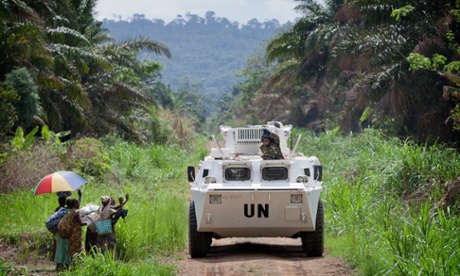
I’m a civilian who works with peacekeepers; I move around with guys with guns to meet other guys with guns. My job is to disarm militias, so humanitarians are my clients and, like any good service provider, I try my best to give them the best service possible. After all, although the powers that be have directed us to “neutralise” the organisation the militias work for, it’s easier to get them to disarm voluntarily than to do it the hard way.
Although many still hold the view of peacekeepers standing in a line acting as a buffer between two warring sides, more often then not we have to do things the hard way, especially when we are deployed in places where there is no peace to keep. As a result, humanitarians tend to keep their distance and do everything possible to make themselves look different.
While humanitarians place prominent “no weapon” stickers on their cars and raise flags identifying them with such and such organisation, my car, often the same model, beckons for more guns to come inside and dirty the upholstery. In fact, if you don’t have a gun or don’t know where to find one, I’m not sure we would have much to talk about.
But it’s not only about the stickers; we have very different jobs and keep different company. Humanitarians are very focused on preserving the humanitarian “neutral space”, so most of them don’t like to interact with peacekeepers or even the civilian guys like me who work with them. They say it cramps their style, makes them look less neutral. It probably doesn’t make much of a difference to a child soldier high on glue but I understand their concern – they want my clients to know that they are not taking a side.
However, that said, when there are just a few ex-pats in a small posting, socialising can become a little complicated, if not awkward. Under the right conditions, we eat together, play cards and reminisce about the close calls we had while drinking warm lager from the ubiquitous and indestructible African beer bottle. But even if we have similar educations and backgrounds, our jobs make us very different creatures and we sometimes find it difficult to dance without stepping on the others toes.
One time, during Halloween, I went with some friends to a party at the residence of a particularly prickly humanitarian NGO who will remain nameless. I was wearing my best roman toga complete with a golden crown. I thought I looked pretty good and largely harmless. However, somehow they noticed I was from the other tribe, the dark side. Before I managed to slug down my first pint, they asked me politely but firmly to leave. Miffed, I tucked my toga between my legs, grabbed a few slices of the local gouda cheese and made my way back to the comfort of my own clan.
A few days later, I was out in the field again still licking the wounds of my social scar. There had been a little skirmish between two of the rival militias in the neighbouring valley, nothing out of the ordinary, when along came the same NGO staff who had so unceremoniously ejected me from their premises. It seems they were getting nervous and wanted to get inside our enclosure. I liked to think they wanted to discuss how cool my Halloween costume had been, and maybe to patch up the misunderstanding with a bottle of duty-free scotch. But in truth it probably had more to do with my other companions, the Uruguayan peacekeepers who were standing at the ready scanning the horizon.
I paused for a moment. I wasn’t planning to stop them coming in, I’m not that much of a jerk. I paused because I knew how difficult it was for them to come over and ask for help. Humanitarians operate in very difficult environments, in places you would not want to describe to your mum if you had the phone reception to call. And they do it with only the protection of their humanitarian space, a permeable shield built on principles rather than hardware. It’s a shield that doesn’t stop bullets when they are flying around and it is one that is too often and too easily violated in today’s world.
So, in a roundabout way, I want to pay respect to the guys and girls who abide by their unique social code, and who stick that black sticker with the strike through the gun. We inhabit the same physical space and almost trip over each other in grocery stores to buy overpriced imported goods, but we are different and I guess, even though it would be great if we could hang out more, it should remain that way.
I did let them in, by the way.
Do you have a secret aid worker story you’d like to tell? You can contact us confidentially at globaldevpros@theguardian.com – please put “Secret aid worker” in the subject line.
Join our community of development professionals and humanitarians. Follow @GuardianGDP on Twitter