The day is drawing near when human beings will be able to work, shop and perform other tasks by manipulating robots that serve as our eyes, arms and legs.
The key element in these activities will be avatar robots. Their development is rapidly progressing, with Japanese companies planning to introduce them in locations ranging from convenience stores to outer space. They are also expected to provide assistance in such situations as school classes and medical examinations at hospitals.
Easing labor shortage
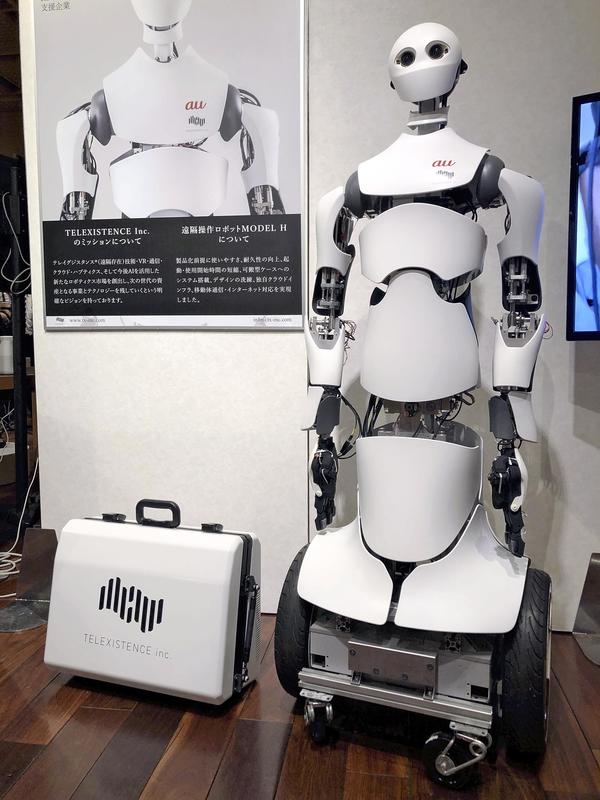
The Tokyo-based venture company Telexistence Inc. will begin operating robotic humanoid avatars on an experimental basis at convenience stores in the capital this summer. Its goal is to help alleviate the increasingly serious labor shortage at 24-hour convenience stores and elsewhere in the city.
Telexistence developed a humanoid prototype in 2018. Its head is equipped with such features as cameras and microphones, and it has two human-like arms and hands.
What the robot sees is transmitted by the cameras to goggles worn by the operator of the robot, and when the operator puts on special gloves and moves their hands, the robot's arms and hands will move the same way almost simultaneously.
There are sensors on the robot's hands, and through the operator's special gloves the robot can convey the feel of the items it is touching via such means as vibrations, pressure and heat.
"It can take hold of and move items with no problem. It's very technologically advanced," Telexistence Chief Operating Officer Yuichiro Hikosaka, 36, said with confidence.
A model is currently being developed to work as a "convenience store staffer." In addition to such elements as lightening the body of the robot and increasing its durability, Telexistence is working on refinements to narrow down the necessary functions regarding touch.
Avatar robots would also make it possible to work via the internet from one's home at convenience stores, factories and other remote locations. "A type of working will become possible in which we're not constrained by distance," Hikosaka said.
There are also plans to robotize various operations in the future, by teaching artificial intelligence systems to handle the maneuvering currently done by humans.
"I hope we can solve Japan's labor problem through robots," Hikosaka said.
Experiment on the ISS
Efforts are also underway to expand avatar robots' field of operation into space.
The Tokyo-based venture company Gitai Inc. is cooperating with the Japan Aerospace Exploration Agency (JAXA) to develop an avatar robot that would perform operations on behalf of human astronauts on the International Space Station about 400 kilometers above the Earth.
Because an avatar robot in space would be operated from the Earth, its movements must be precise. Particularly important in space is safety management -- preventing collisions with astronauts, the body of a ship and equipment. If a collision resulted in injury to an astronaut, or opened a hole in a wall and allowed oxygen to leak outside of a ship, it could cause irreparable harm.
Gitai has developed a system that can respond to collisions in units of one-one-thousandth of a second, by reading minimal changes in the flow of electricity powering the robot. It has also applied its efforts to visual transmission technology, in order to allow the operator to smoothly manipulate the robot.
The company intends to begin experimental operation of the robot on the ISS as soon as the end of this year. Envisioned future uses include such activities as collecting space debris and constructing bases on the moon and Mars.
"There will definitely come a day when people can send their 'second body' from the Earth into space and work there," said Gitai Chief Executive Officer Sho Nakanose.
Supporting schools, hospitals
The application of avatar robots also appears likely to spread beyond the realm of work. Ideas being considered include using them to enable children who attend school on remote islands of Okinawa Prefecture to take classes at schools on the main island. Such robots might also be used to enable main island hospitals to assist in medical examinations on remote islands.
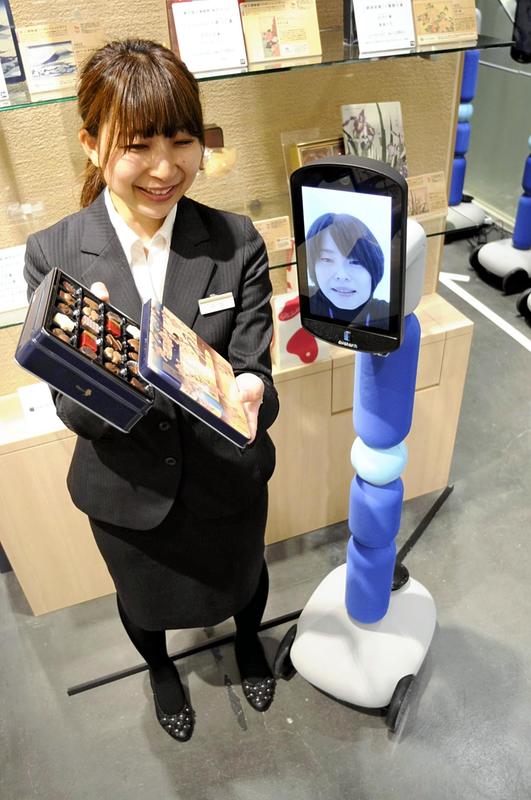
ANA Holdings Inc. has developed such a robot, and in December last year it opened a special commercial facility for a limited time in Tokyo's Nihonbashi Muromachi area in cooperation with the Isetan Mitsukoshi. The robot can be operated via the internet from one's home on a laptop or other device.
The experiment was well received, with users saying that unlike internet shopping, being waited on by sales staff through the robot gave them the special feeling of shopping in a department store.
ANA Holdings is planning to install about 1,000 such avatar robots at local government offices, department stores, tourism facilities and elsewhere by the Tokyo Games this year. According to director Akira Fukabori, "We want to develop avatars into a form of social infrastructure."
A concept born in Japan
Research and development of avatar robots is underway around the world. In the United States, the XPRIZE Foundation is currently holding the ANA Avatar XPRIZE competition aimed at the development of an advanced avatar system that can perform a variety of tasks, such as care services and disaster rescue.
Sponsored by All Nippon Airways, the overall prize money amounts to 10 million dollars, or about 1.1 billion yen. Seventy-seven teams from 19 countries, including 14 teams from Japan, have been chosen for the main competition.
The World Economic Forum is also paying attention to avatar robots. It included them among its 2019 list of the top 10 emerging technologies, saying they were expected to bring about changes in daily life and work about as dramatic as those caused by the spread of smartphones.
The field of avatar robotics has its roots in Japan. Susumi Tachi, a professor emeritus at the University of Tokyo and chairman of Telexistence, proposed the concept in 1980 of "telexistence," the idea that a person could actually exist in another location from their physical one and operate freely in that location. Although the internet was not widely available at that time, there have been advances in various technologies since then that form the foundation of avatar robots, including AI, robotics, virtual reality and the next-generation 5G communications standard that will transmit large volumes of data at high speeds.
In addition to domestic venture companies, large firms such as Toyota Motor Corp. are entering the field.
"Forty years have passed, and the times have caught up," said Tachi, who has continued to pursue research and development. "I hope avatar robots will lead to people having easier lives and create a society in which people can feel fulfilled by their work."
Read more from The Japan News at https://japannews.yomiuri.co.jp/