Closing summary

Another wave of correspondence between the future monarch, Prince Charles, and government ministers was unleashed by the Cabinet Office - and unexpectedly so. The decision to release the second tranche of letters cuts short what was set to be yet another legal battle - a freedom of information tribunal was due to hold a hearing later this year on whether the Guardian should be given access to this batch. So now on top of Patagonian toothfish, lynx helicopters and badger culling, we can now add ragwort, hospital food and homeopathy to Charles’s tick list of topics to nudge the Government over.
So what did Prince Charles and ministers write about?
- Former international development minister Douglas Alexander revealed the heir to the throne asked for support for one of his charities, Turquoise Mountain, a regeneration project in Kabul, Afghanistan - but funding was not given (see 14.46).
- The Prince of Wales sets out in impassioned terms the reasons why he “persists” with efforts to integrate complementary medicines into conventional healthcare. “I cannot bear people suffering unnecessarily when a complementary approach could make a real difference,” Charles says (see 15.12)
- Former health secretary Alan Johnson addressed concerns raised by the Prince over the control of the spread of ragwort, a wild flower, across the UK (see 15.30).
- Prince Charles expressed his hopes to discuss heritage matters with the former culture minister Ben Bradshaw, particularly “the conversion and re-use of major historic sites, many of which are lying derelict and abandoned by unscrupulous owners” (see 15.48)
- Prince Charles urged Flint to consider meeting with his Regeneration Trust charity to discuss local council failures in protecting historical sites. The heir to the throne really hammers local authorities’ record as he also moves to promote his own preferred developers (see 16.35).
- Prince Charles promoted an initiative which links hospital catering to local farmers’ hubs. He hailed the leader of the project at Royal Brompton Hospital, named in the letter as Mike Duckett, and a hospital food supplier, whose name has been redacted (see 16.54)
We’re closing the live blog now. Thanks for your comments below the line. I have the honour to remain, Sir, your most humble and obedient servant.
Prince Charles’s top five most unusual concerns
Here are five of the most bizarre issues the future monarch lobbied ministers over in both batches of letters published by the government.
- Ragwort

Nicknamed stinking willy, the spread of this wild flower has appeared to have troubled Prince Charles. Alan Johnson, the former health secretary, wrote to the Prince to put his mind at rest. It’s a registered weed and there are no herbal medicines containing the potentially toxic substance.
-
Patagonian toothfish

In a letter to former environment minister Elliot Morley, the future monarch calls for greater priority to be placed on protecting the Patagonian toothfish and in turn, the albatross, which feeds on the species.
- Scott and Shackleton’s Antarctic huts

The Prince asked former culture secretary Tessa Jowell to bend the rules and supply funding to overseas heritage projects, including the Antarctic huts used by Scott and Shackleton.
- Denbigh hospital and Torr Vale Mill in Derbyshire
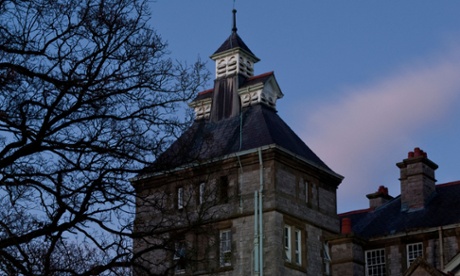
The Prince laments the loss of these two historical sites with melodrama, as he tells Caroline Flint:
The terrible loss of value represented by decaying buildings such as Denbigh Hospital in Wales and Torr Vale Mill in Derbyshire, for instance, makes me weep!
- Irish gaols
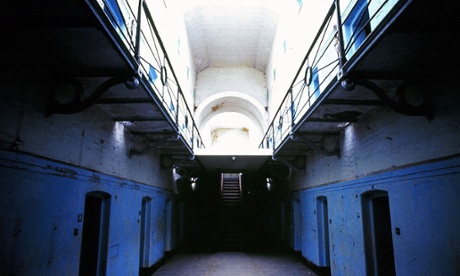
The heir to the throne intervened in a bid to save one of Northern Ireland’s most important historical buildings - Armagh gaol. In a letter to former Northern Ireland secretary Paul Murphy, he also showed an in-depth knowledge of Irish gaols as he recommended other examples of interest.
Updated
Letter to the-then health secretary, Alan Johnson, July 2008

In this letter, Prince Charles pushes an initiative which links hospital catering to local farmers’ hubs. He hails the leader of the project at Royal Brompton Hospital, named in the letter as Mike Duckett, and a hospital food supplier, whose name has been redacted.
The unnamed man acts as a middle man selling fresh food to retailers, restauranteurs and the public sector, Charles explains.
The Prince writes:
Mike says that buying seasonal, fresh (and, wherever possible, organic) food has ensured patients enjoy better quality and more flavoured food, which has retained its natural nutrients and so their health has, of course, benefitted. And because they enjoy eating it, waste has been minimised.
He adds:
At the same time (redacted) is giving farmers in Kent a secure and consistent market for their produce which, as you can imagine, makes all the difference.
Letter to former housing minister, Caroline Flint, March 2008

In this letter, in a lively passage, Prince Charles urges Flint to consider meeting with his Regeneration Trust charity to discuss local council failures in protecting historical sites. The heir to the throne really hammers local authorities’ record as he also moves to promote his own preferred developers.
I am not sure if I managed to mention to you the enormous frustration my Regeneration Trust has experienced over the past fifteen years in relation to countless local heritage-led regeneration projects where progress has ground to an expensive halt because of the reluctance or inability of local councils to assert their powers at the optimum time to save historic buildings from complete dereliction at the the hands of careless private ownership, when they could have become real community assets providing wonderful places to live and work?
The terrible loss of value represented by decaying buildings such as Denbigh Hospital in Wales and Torr Vale Mill in Derbyshire, for instance, makes me weep!
In both these cases my Trust has sympathetic developers and sponsors waiting in the wings and yet the councils still prevaricate and countless opportunities for providing a mixed form of housing tenure in attractive surroundings are being tragically and scandalously lost.
Letters to former housing ministers, Yvette Cooper and Caroline Flint, in 2007 and 2008

Prince Charles’s concern and detailed knowledge on the issue of affordable rural housing come through clearly in two letters to housing ministers in 2007 and 2008. In the first, to Yvette Cooper, he tells her he “appreciates more than I can say” that his Foundation for the Built Environment was going to be able to contribute to Labour’s ill-fated eco-towns project. The Prince says new developments should be “sympathetically” - i.e. conservatively - designed and that allowing 15 homes or more in one development can “completely undermine the character of the village”.
The 2008 letter, to Cooper’s successor as housing minister, Caroline Flint, continues the theme. Prince Charles is delighted that Flint may be able to to visit Poundbury, the new estate of traditional and neo-classical homes built on the Prince’s land near Dorchester. He also offers his charities’s help to Flint in her own constituency of Doncaster. Flint does not take up the offer in her reply. She also gently rebuffs suggestions from the Prince on how the government might better use its funding linked to rural housing.
Prince Charles becomes passionate about the loss of listed historic buildings to dereliction “at the hands of careless private owners”. He wrote: “The terrible loss of value represented by decaying buildings such as Denbigh Hospital in Wales and Torr Vale Mill in Derbyshire, for instance, makes me weep!” Flint says she will look into how to help local authorities to use their powers to force building repairs, but Denbigh Hospital remains in ruins as does Torr Vale Mill. A curious final paragraph in Charles’s letter says: “It would be wonderful, as we discussed, if we could establish an exchange of secondees” between the government department and the Prince’s charities.
Overall, as with his previously released letters on farming, the Prince comes over as knowledgable and, on some issues, prescient. The availability of affordable housing remains as much an issue today as it was seven years ago.
Read the second batch of Prince Charles’ letters in full
Here’s some initial reaction from the Twitter commentariat to the second batch of letters between Prince Charles to government ministers to be published.
Daily Mail royal correspondent Rebecca English...
Looks as if the issue of complementary medicine will be the most tricky issue for Charles this time.. #spidermemos
— Rebecca English (@RE_DailyMail) June 4, 2015
Anti-monarchy campaigners Republic...
Letters clearly showing Charles making demands on NHS spending https://t.co/x9joun0QHo
— Republic (@RepublicStaff) June 4, 2015
Daily Mirror’s royal reporter Victoria Murphy...
Charles' letter to Alan Johnson in September 2007 probably most controversial -urging for safeguarding of Homeopathic Hospitals' funding
— Victoria Murphy (@QueenVicMirror) June 4, 2015
And chief reporter at Royal Central James Brookes...
Always good to see that parliamentary assistants and civil servants recognise #PrinceCharles’ signature. pic.twitter.com/uXtWE6mEiW
— James Brookes (@james_elliott_) June 4, 2015
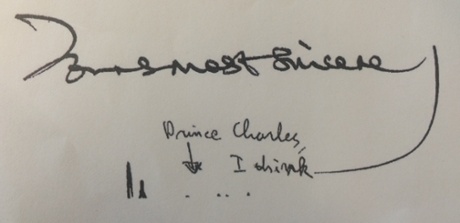
At the bottom of the letter from Prince Charles to former culture secretary Ben Bradshaw, a civil servant appears to have found the heir to the throne’s signature a little hard to read.
MPs must confront Prince Charles over political meddling - Republic

MPs should confront Prince Charles over his political interfering, following the release of a second batch of his letters, anti-monarchy campaigners Republic have said.
Republic’s chief executive, Graham Smith, said:
These letters show a deliberate and persistent effort by Prince Charles to interfere in the political process, to demand changes to government policy.
As heir to the throne Charles is expected to keep his opinions to himself. If he doesn’t like that arrangement he can always remove himself from the line of succession and become a private citizen. Instead he is deliberately and wilfully abusing his position.
Charles has been demanding the cash-strapped NHS spend money on homeopathy, despite all the evidence against its efficacy. He’s entitled to his opinion, but mustn’t abuse his position to force his opinion on others.
Anyone can lobby a government minister if they wish, but Charles has unique and secretive access and the opportunity to put pressure on ministers.
It is now essential that the full extent of Prince Charles’s interfering is exposed. Voters have a right to know what impact he is having on public policy. I’m calling on MPs to investigate this issue and demand Charles refrain from further meddling.
Letter to the then culture secretary, Ben Bradshaw, June 2009

In this letter to Bradshaw, the Prince notes that the minister has “moved up in the world” to the position of culture secretary before discussing the arts, which he says are “rather close to my own heart”.
The Prince then expresses his hopes to discuss heritage matters with the minister, particularly “the conversion and re-use of major historic sites, many of which are lying derelict and abandoned by unscrupulous owners”.
As many of these historic sites are often in fairly deprived areas, their revitalisation can make a big difference. Not only that, but I do feel we owe it to those dedicated craftsmen who built the buildings in the first place, and many of whose descendants probably still live in the area, to bring their dedicated workmanship back to life.
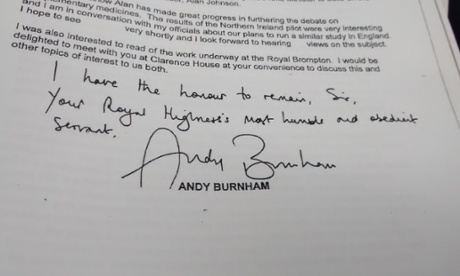
Former health secretary and current Labour leadership contender, Andy Burnham, displays his deferential side as he signs off his correspondence to the Prince of Wales.
He writes:
I would be delighted to meet with you at Clarence House at your convenience to discuss this and other topics of interest to us both.
And then adds in his own hand:
I have the honour to remain, Sir, your Royal Highness’s most humble and obedient servant.
Letters from then housing minister, Yvette Cooper, December 2007

In December 2007, then housing minister Yvette Cooper now Labour leadership hopeful, expressed enthusiasm for the Prince’s architecture trust playing a “significant role” in the design of the Labour governments plans for new Eco Towns.
Charles wrote to Cooper outlining his preference for “small-scale” housing schemes (underlined in pen). In a letter that used language similar to a Nimby (Not-in-my-back-yard) objection to a planning application for new rural homes, he said: “Six well-designed houses in a hamlet or village are often all that is needed to make a small rural community viable. Equally, building fifteen homes, or more completely undermine the dynamics and character of the village - destroying the very thing which everyone is striving to protect.”
In response to the Prince, Cooper said: “I am strongly of the view that the Prince’s Foundation should play a significant role in encouraging and advising on the design elements of eco-towns, drawing on its well-established expertise and experience.”
Letter from the-then health secretary, Alan Johnson, January 2008

In this letter, Johnson is addressing concerns raised by the future monarch over the control of the spread of ragwort, a wild flower, across the UK. Johnson says:
I am aware that ragwort is classed as an injurious weed under the Weeds Act 1959 and as such many bodies have policies on its control.
Johnson then moves to reassure the Prince there are no herbal medicines available containing ragwort, which can have an adverse impact on health. Johnson continues:
I hope this gives you some reassurance that this issue is taken very seriously and I am sure colleagues in Defra (Department for Environment, Food and Rural Affairs) will be able to provide you with further assurances about controlling the spread of the plant.
Letter to former health minister, Alan Johnson, September 2007

The heir to the throne pressed the then health minister, Alan Johnson, to preserve the funding of NHS homeopathic hospitals “and the threats they appear to face to their existence”.
In a letter on September 19 2007, Charles said the referrals to Royal London Homeopathic Hospital were increasing “until what seems to amount to a recent ‘anti-homeopathic campaign’.”
He said three homeopathic hospitals “faced large and threatened cuts in funding from local healthcare commissioners” despite “the fact that these homeopathic hospitals deal with many patients with real health problems who otherwise would require treatment elsewhere, often at greater expense”.
Letter to former health minister, Alan Johnson, September 2007

In this letter to Johnson, the Prince of Wales sets out in impassioned terms the reasons why he “persists” with efforts to integrate complementary medicines into conventional healthcare. The Prince says:
I cannot bear people suffering unnecessarily when a complementary approach could make a real difference. I have been convinced for many years that we in the United Kingdom need to do more to encourage and facilitate good health, as well as to treat illness, and that there should be more of a “whole person” approach to the treatment of illness rather than a “reductionist” focus on the particular ailment.
In addition, I am sure that more can be done to take advantage of complementary medicine, not as an alternative or competitor to conventional medicine, but as part of an integrated approach with the same doctor being able to provide or suggest conventional and/or complementary remedies and treatments as he and the patient see fit.

My colleagues Rob Evans and Robert Booth have this first take on the latest round of letters Prince Charles to ministers.
Prince Charles wrote to Labour ministers about the use of complementary medicines, the state of the world’s rainforests, and hospital food, the second batch of royal correspondence released following a successful freedom of information request by the Guardian shows.
The 17 “black spider memos”, written between 2006 and 2009 to ministers in four departments including Alan Johnson and Andy Burnham, also see Charles discuss Labour’s plans for a new generation of “eco towns”.
According to Clarence House, Charles wrote concerning homeopathy in hospitals: “I cannot bear people suffering unnecessarily when a complementary approach could make a real difference.”
Seventeen letters from prince to government ministers believed to be about issues including health, rural affairs and architecture
The government’s decision to release the correspondence cuts short what was set to be another battle over the publication of the second tranche of the prince’s correspondence with ministers. A freedom of information tribunal was to hold a hearing later this year on whether the Guardian should be given access to this batch.
Letter from the-then health secretary, Alan Johnson, undated

In a letter to Prince Charles, Johnson recalls they had “spoke in detail about hospital food” and promises to consider the Prince’s proposals to develop a hub to improve food procurement in the public sector.
Letter from former health secretary, Andy Burnham, June 2009

The newly appointed health secretary, Andy Burnham, wrote to the Prince to thank him for his letter and to suggest a meeting to discuss the possibility of a study on integrating complementary medicine in hospitals in England.
I know Alan (Johnson) has made great progress in furthering the debate on complementary medicines. The results of the Northern Ireland pilot were very interesting and I am in conversation with my officials about our plans to run a similar study in England.
Letter from the then international development minister, Douglas Alexander, March 2008

In a letter to the Prince of Wales, Alexander says the heir to the throne asked about support for one of his charities, Turquoise Mountain, a regeneration project in Kabul, Afghanistan.
You also asked about possible support for the Turquoise Mountain Foundation in Afghanistan... we have moved away from funding smaller scale initiatives such as this - and towards funding larger-scale government programmes.
Prince of Wales raising issues of "public concern" - Clarence House

The latest batch of Prince Charles’s letters to ministers shows his concerns for UK and wider world, Clarence House has said.
Reacting to the publication of the second round of letters, a Clarence House spokesman said:
The correspondence published by the Government today, Thursday 4 June, shows the range of The Prince of Wales’ concerns and interests for this country and the wider world.
The letters published by the Government show the Prince of Wales expressing concern about issues that he has raised in public like affordable rural housing, the quality of hospital food, the preservation and regeneration of historic buildings, an integrated approach to healthcare, climate change, and others. In all these cases, The Prince of Wales is raising issues of public concern, and trying to find practical ways to address the issues.
Second batch of Prince Charles's 'black spider memos' published
The second batch of letters from Prince Charles to ministers have been published here.
Here are some of the stand-out topics covered in the latest tranche of correspondence between the Prince of Wales and ministers:
- Deforestation
- The plight of tropical rainforests
- Affordable housing in rural areas
- Complementary medicine
- Arts and heritage projects

What did the first batch of letters from Prince Charles to ministers contain?
- The Prince of Wales expressed strong concern over difficulties faced by the military in Iraq, particularly resources and the poor performance of Lynx helicopters.
- He delves in to great detail on farming and environment issues from badger culls, to farming subsidies, bureaucratic red tape and the “arm lock” of the supermarkets.
- Prince Charles urges ministers to protect listed buildings from demolition.
- He asks ministers to bend the rules and supply funding to overseas heritage projects, in this case, the Antarctic huts used by Scott and Shackleton.
- The future monarch calls for greater priority to be placed on protecting the Patagonian toothfish and in turn, the albatross.
- The Prince of Wales lobbies for a specific individual to be given a job as an agricultural arbitrator.
- Prince Charles pushes for greater attention to be given to the redevelopment of a derelict hospital, which his own charity had worked on.
- He discusses his “old fashioned views” on how teachers should do their jobs - and dismisses a modern notion that they act as “facilitators” or “coaches”.
For a refresher on what Prince Charles’s black spider memos are, watch this video made before the first tranche was released.
Opening summary

A second batch of letters written by Prince Charles to government ministers is to be published imminently – and we’ll have all the revelations and reaction from across the political spectrum and royal commentariat right here on this live blog.
The 17 letters, expected at 2.30pm, cover the prince’s correspondence between 2006 and 2009 with ministers in four departments.
The newest cache is released some three weeks after the government published 27 letters between the heir to the throne and ministers, bringing an end to a decade-long battle that started with a freedom of information request in April 2005 by Guardian journalist Rob Evans.
The first batch dated from 2004 and 2005 and showed Charles petitioning ministers on a colourful range of subjects from the Iraq war to alternative therapies and from Antarctic huts to Patagonian toothfish.
Today, we can expect to see more of the same as the latest round is thought to include correspondence between the prince and several government ministers about issues including health, rural affairs and architecture.
The government’s decision to release the second tranche of letters cuts short what was set to be yet another legal battle. A freedom of information tribunal was due to hold a hearing later this year on whether the Guardian should be given access to this batch.
The government’s failed attempt to block publication of the first letters cost more than £400,000 in legal expenses.
So stay with us for the most comprehensive breakdown of the latest letters, and analysis from our team of specialist correspondents.