SEATTLE _ Like many an astronomer before him, Woodruff T. "Woody" Sullivan III works at night. All night, usually. While much of the world around him is sucked into vapid prime-time game shows and other distractions, Sullivan's brain is freed to roam in the enveloping silence, unleashed to dance with stars far beyond.
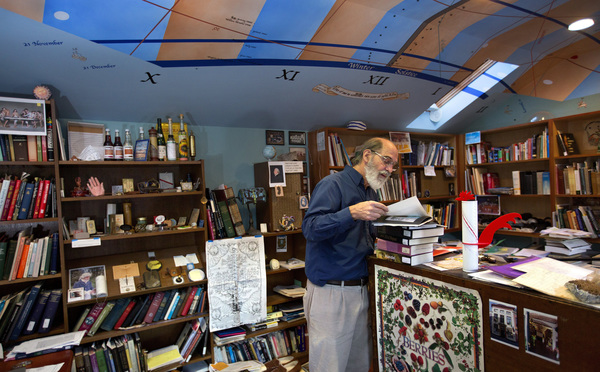
In the stillness of this graveyard shift in Sullivan's "Man Lodge" _ a converted garage atop Seattle's Phinney Ridge _ phones do not ring; televisions do not blare; email slows to an occasional, bot-produced slice of overnight spam. The focused stare of Sullivan, a professor emeritus in astronomy and astrobiology at the University of Washington, is devoted only to the work _ the math, geometry, physics, biology, history and the music they all can make together _ on a glowing computer monitor resting on a busy wooden desktop.
It's a seat in which most of us would squirm. Granted, even some of the non-astrophysicists among us, staring into the night sky and summoning the voice of the late Carl Sagan describing the vast universe and its "billions and billions" of potential life-spawning orbs, will ask the occasional cosmic questions, including: OK, that's the universe; but where did it come from? In what space does it exist, and what is beyond it? And could we really be daring and/or arrogant enough to even ask whether we're the only sentient creatures in it?
But this is the point where most of us gladly jump off the mind-blowing cosmic thought train and scurry back to the mind-numbing comfort of Facebook, knitting needles, cable news, or a glass or three of wine. Some stuff, we conclude, is best just left alone.
For the Woody Sullivans of the world, however, this point of mere-mortal mental meltdown is the jumping-off spot: the place where physics, having dealt with many earthbound quandaries, leaps forth into an exponentially larger universe of discovery.
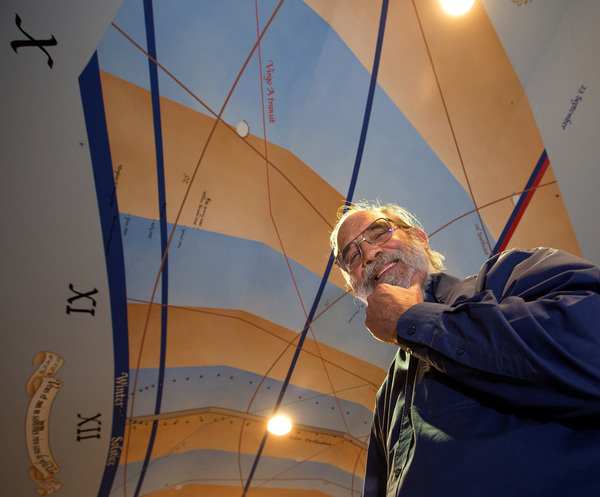
For Sullivan, the launchpad for this leap is a humble backyard enclave on Palatine Avenue North, beneath a ceiling-painted sundial record of the movements of Planet Earth, marked by events ranging from full solar eclipses to the birth of his two daughters. It is here that Sullivan, 72, parks himself nightly, between artfully stacked mounds of books and paper, to ponder alluring mysteries of the universe.

Chief among these, recently: What are the mathematical odds that our technological civilization has been the only one of its kind in the 14 billion-year history of the universe? And, perhaps more immediately urgent, why in the name of God is it so bloody difficult to format a Microsoft Word document that contains both text in "portrait" orientation and a table meant to be read in "landscape"?
Naturally, there is a major difference between the two, Sullivan will tell you with a characteristic laugh: The first one turned out to be a solvable problem.