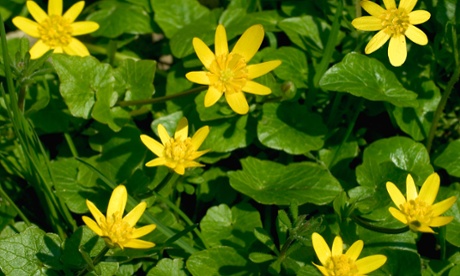
They come from the sun, the lesser celandines – like particles blown in on solar winds they flower, sun-like. Open buttercups with heart-shaped leaves, the lesser celandines are some of the first flowers, and they like the soggy waysides. They can emerge as single teasers or erupt in sudden brassy flashes in that where-have-you-been time of year when a splash of colour is needed by insects and people alike.
Common and taken for granted once, they spark up the yellow pulse that includes primroses, cowslips and daffs, but they will slip back into the unconscious when the drama of spring takes hold. Each year, fewer wild plants return from the mud of memory. Once common and taken-for-granted flowers are fading away.
Last weekend’s launch of The Flora and Vegetation of Shropshire saw a gathering of botanical and conservation clans at Preston Montford, near Shrewsbury. Produced from 350,000 records collected by more than 1,000 volunteer naturalists and written by Sarah Whild and Alex Lockton, The Flora is a wonderful collection of botanical records, distribution maps, illustrations and photographs, and the story of the changing nature of Shropshire’s flora.
The last really important county flora was the Ecological Flora of Shropshire, first published in 1985. Ian Trueman, one of its authors, told me that comparing data from the 30 years between these works it appears we’re good at maintaining the very special places but terrible at keeping the plants of common waysides and hedges.
Many plants are being lost. One botanist lamented yellow pansies, so numerous you trod on them at every step for miles across a hill, now confined to one little field. Another was concerned there was less political will for conservation now.
It’s hard to believe that in the most environmentally aware decades the loss of wild plants has accelerated. This marks a failure of the stumbling conservation movement we all have to share. The diligent and heart-felt work of amateur naturalists and conservationists is easily lost in the noise of human progress. However, I see each bite of data, each act of witness as bright and vital as a lesser celandine flower, humble in its title but brilliant in its presence – a collective joy.
Paul Evans (@DrPaulEvans1)