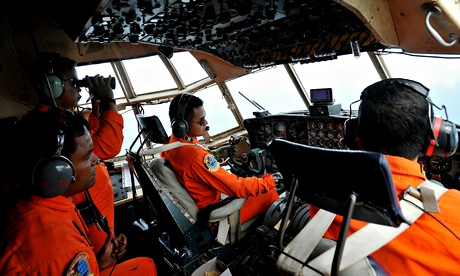
The huge international search for missing AirAsia QZ8501 is set to expand on Tuesday as France, Australia, Malaysia, Singapore and China all sent ships and aircraft to join the operation off the Indonesian coast.
At least 15 ships, seven aircraft and four helicopters searched on Monday for any signs of the Airbus A320-200, which vanished from radar screens on Sunday morning with 162 people on board as it approached violent weather about 40 minutes into a two-hour flight between Surabaya, in east Java, and Singapore.
An Indonesian search rescue official said the plane was presumed to be “at the bottom of the sea”. No wreckage has been found. Weather was impeding search efforts, with rough waves decreasing visibility on the water and intermittent rain clouds obscuring the waves from above.
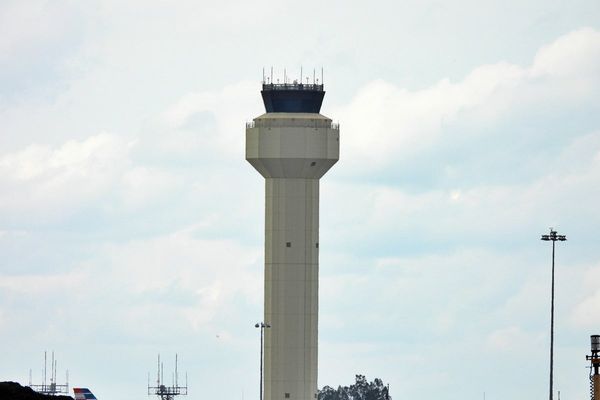
The plane, operated by an Indonesian subsidiary of the Malaysian budget airline AirAsia, had reportedly requested permission to increase altitude from 32,000ft (9,750 metres) to 38,000ft (11,600 metres) to avoid bad weather. The request was not immediately granted because of other aircraft in the area and five minutes later the plane lost contact with Jakarta air traffic controllers. It did not send a distress signal.
On board were seven crew members and 155 passengers, including 16 children and one infant. The vast majority on board were Indonesian, the co-pilot was French, and the passengers included three South Koreans, a Malaysian, and a British man with his two-year-old Singaporean daughter. Named in reports as Chi-Man Choi, the energy industry executive was understood to have boarded the flight at the last minute with his daughter Zoe.
His brother Chi-Wai Choi, a 46-year-old optometrist from Alsager, Cheshire, said he was “prepared for the worst”.
More vessels and planes were expected to join the hunt on Tuesday as four more areas were added to the seven searched so far across the large but relatively shallow sea.
Officials have asked the UK, US and France for sonar technology and underwater search assistance. A US navy fleet off the coast of Japan said it stood ready to assist if requested. In a statement on its website, China’s defence ministry said it had sent a warship to the South China Sea and planes had begun preparatory work for search operations.
Bambang Soelistyo, Indonesia’s National Search and Rescue Agency chief, said: “Based on the co-ordinates given to us and evaluation that the estimated crash position is in the sea, the hypothesis is the plane is at the bottom of the sea. That’s the preliminary suspicion and it can develop based on the evaluation of the result of our search.”
He added that “the capability of our equipment is not optimum”, and Indonesia would reach out to other countries including the UK, France and the US for technology that might be required to retrieve the plane from the seabed.
Aerial surveys on Monday reported two oily patches off the Indonesian coast, but it was not known if they were related to the missing jet. The Indonesian air force spokesman Hadi Tjahjanto said searchers were checking a report of an oil slick off Belitung, an area with heavy traffic. They had picked up an emergency locator signal off the south of Borneo but no subsequent signal was found, he said. Oil samples would be collected and analysed, said Tjahjanto, to see if they had come from a ship or the plane.
Other objects spotted in the water, about 700 miles (1,120km) from the point of last contact, are not believed to be connected to the flight.
The AirAsia chief executive, Tony Fernandes, 50, tweeted on Monday: “My heart bleeds for all the relatives of my crew and our passengers. Nothing is more important to us.”
The Indonesian president, Joko Widodo, has ordered an immediate review of all aviation procedures, and vowed to find the flight no matter how long a search operation was required. He told a press conference he was shocked to hear about the flight’s disappearance.
“I could feel the concern, the frustration and the sadness experienced by the passengers’ families, and I believe also felt by all the people of Indonesia,” he said.
Anger was growing among relatives of the missing who were gathered at a crisis centre in Surabaya. “We’ve been here for two days but the information is unclear,” Franky Chandra, who has a sibling and three friends among the passengers, told Reuters news agency.
The search, which includes local fishermen, is focused on an area of 70 square nautical miles between the island of Belitung, off Sumatra, and Borneo island. The sea in the search area is between 50 and 100 metres deep.
The pilot, Iryanto, who like many Indonesians goes by one name, had logged more than 20,000 flying hours, a significant number.
Online discussions among pilots centred on unconfirmed secondary radar data from Malaysia that suggested the missing plane was climbing at a speed of 353 knots, about 100 knots too slow in such weather conditions. “At that altitude, that speed is exceedingly dangerous,” the Sydney-based aviation expert Geoff Thomas told Reuters.
“At that altitude, the thin air, the wings won’t support the aircraft at that speed and you get an aerodynamic stall.”




.png?w=600)