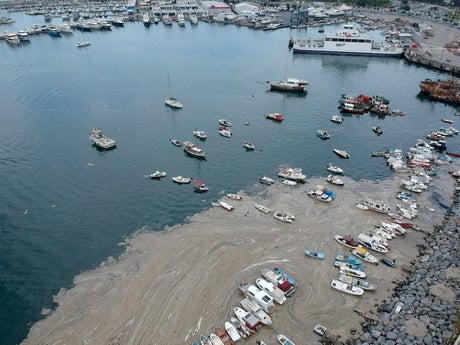
Turkey has vowed to defeat a plague of “sea snot” that is threatening marine life in the Sea of Marmara, with marine creatures at risk of dying from suffocation due to the substance.
A thick slimy layer of organic matter, known as marine mucilage, has spread through the sea south of Istanbul, blanketing harbours, shorelines and swathes of seawater.
The viscous substance poses a threat to marine life and the fishing industry as some of the matter has sunk below the waves, suffocating life on the seabed.
Speaking from a marine research vessel on Sunday, Turkey’s environment minister Murat Kurum said he would soon reveal details of a disaster management plan to protect the sea area.
“We will take all the necessary steps within three years and realise the projects that will save not only the present but also the future together,” Mr Kurum said.
Recent drone footage shot over the Sea of Marmara has shown ferries and cargo ships crossing harbours and seawater covered with the substance, while divers have reported large numbers of fish are dying.
On Saturday, the country’s president Recep Tayyip Erdogan blamed the outbreak on untreated water from cities including Istanbul, which is home to 16 million people, and pledged to “clear our seas from the mucilage scourge”.
He noted that there could be “enormous” trouble for the area if the mucilage spreads to the Black Sea, adding that officials must act “without delay”.
Mr Erdogan’s government has already dispatched a 300-strong team of officials to assess the area and inspect water treatment facilities and potential sources of pollution.
Scientists have warned that climate change and pollution have contributed to the proliferation of the organic matter, which contains a wide variety of microorganisms and can flourish when nutrient-rich sewage flows into seawater.
It is thought that the increasing amount of sea snot is linked to high sea temperatures as well as the discharge of untreated sewage into the sea.
Earlier this week, hydrobiologist Levent Artuz warned that ecological problems like the mucilage outbreak would continue unless there was behavioural change, noting the increased discharge of sewage into Turkish waters in recent years.
“As long as we carry on with those practises, it does not make much sense to expect different results. We will continue to encounter disasters like this,” Mr Artuz told Reuters.
Additional reporting by agencies