Last year was perhaps the “Year of the Tight End” in the NFL Draft. A year ago football fans saw sixteen tight ends drafted – the most since the 2015 draft class – and two players from the same school come off the board in the first round. Iowa’s T.J. Hockenson was drafted eighth overall by the Detroit Lions, while his teammate Noah Fant came off the board 20th to the Denver Broncos. In all, eight players were drafted on the first two days of the 2019 Draft at the tight end position.
This group, however, might not match those numbers. In fact, you might be waiting until midway through the second round to see the first tight end come off the board.
This year’s crop contains a number of players who fit perhaps one role (move tight end) or another role (blocking tight end). Finding the prototypical, “do it all” type of player might take a bit of work. There are some potential players in that mold, who will be near the top of that list as you might expect, but there are still questions about what they can do in the NFL.
So if you are a fan of a team needing help at this position, pack some patience.
1. Cole Kmet, TE, Notre Dame

Height: 6’6″ Weight: 262
40-Yard Dash: 4.7 seconds
Bench Press: N/A
Vertical Jump: 37 inches
Broad Jump: 10 feet 3 inches
3-Cone Drill: 7.44 seconds
20-Yard Shuttle: 4.41 seconds
60-Yard Shuttle: N/A
Bio: Cole Kmet was a highly-regarded recruit coming out of high school, where he was a two-sport athlete for St. Viator High School in Illinois. Kmet was, according to 247Sports, the third-best tight end recruit in the nation, and out of his 16 scholarship offers he decided to select Notre Dame. In addition to his work as a tight end, Kmet was a left-handed pitcher both in high school and in college, and he pitched for the Fighting Irish as a freshman and sophomore before an arm injury ended his sophomore season. He then chose to focus on football. During his freshman year he led Notre Dame with eight saves as a relief pitcher.
On the gridiron, Kmet did not contribute on a consistent basis until this last season. As a true sophomore in 2018 he managed just 15 receptions on 17 targets, for 162 yards. Last year, however, he caught 43 passes for 515 yards and six touchdowns, averaging 12 yards per reception.
Stat to Know: Kmet did his best work in the intermediate area of the field. Notre Dame passers had a rating of 102.5 when targeting him between 10 and 19 yards downfield.
Strengths: Sometimes a game in front of a national audience can propel a prospect towards the top of draft boards, and for Kmet that game might have been a primetime outing against the University of Georgia down in Athens. After missing the first three games of the season with a broken collarbone, Kmet caught nine passes for 108 yards (both season-high numbers for him) and a touchdown. Kmet showed up on his first reception of the game, displaying some toughness after the catch as well as some incredible contact balance for a 6’6″ tight end:
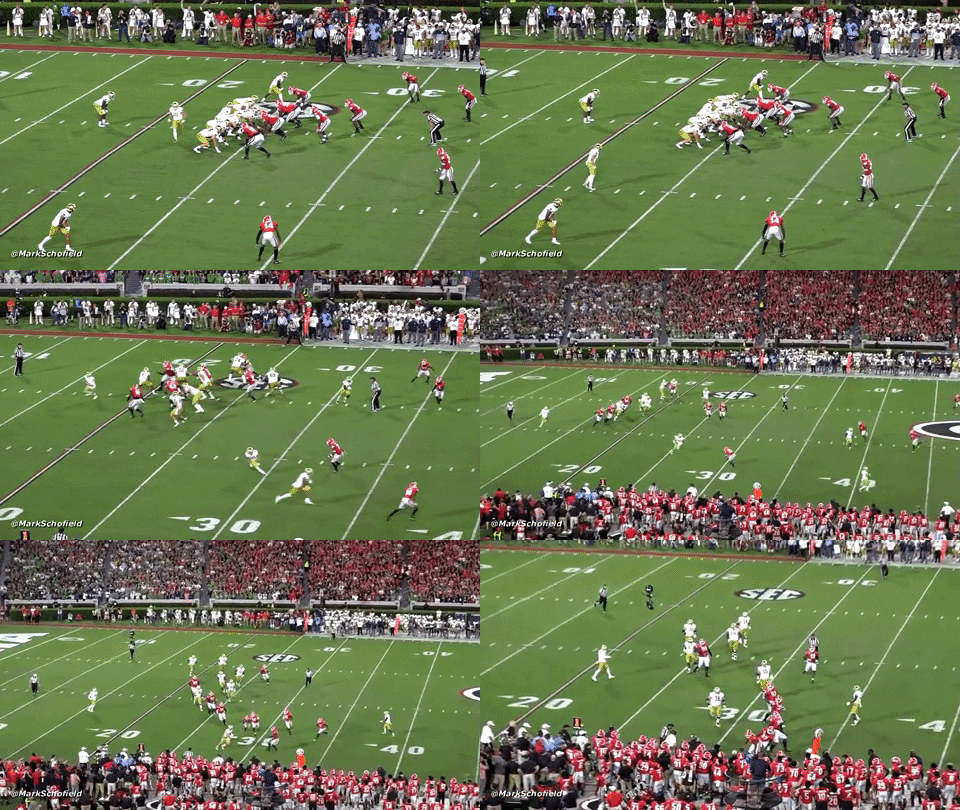
In addition, if you think about where NFL offenses look to attack defenses, your eyes will be drawn to the seams. Given the prevalance of single-high coverage in the professional game, offenses need to attack the seams. Having a tight end that can do this both before and after the catch is going to help an offense:
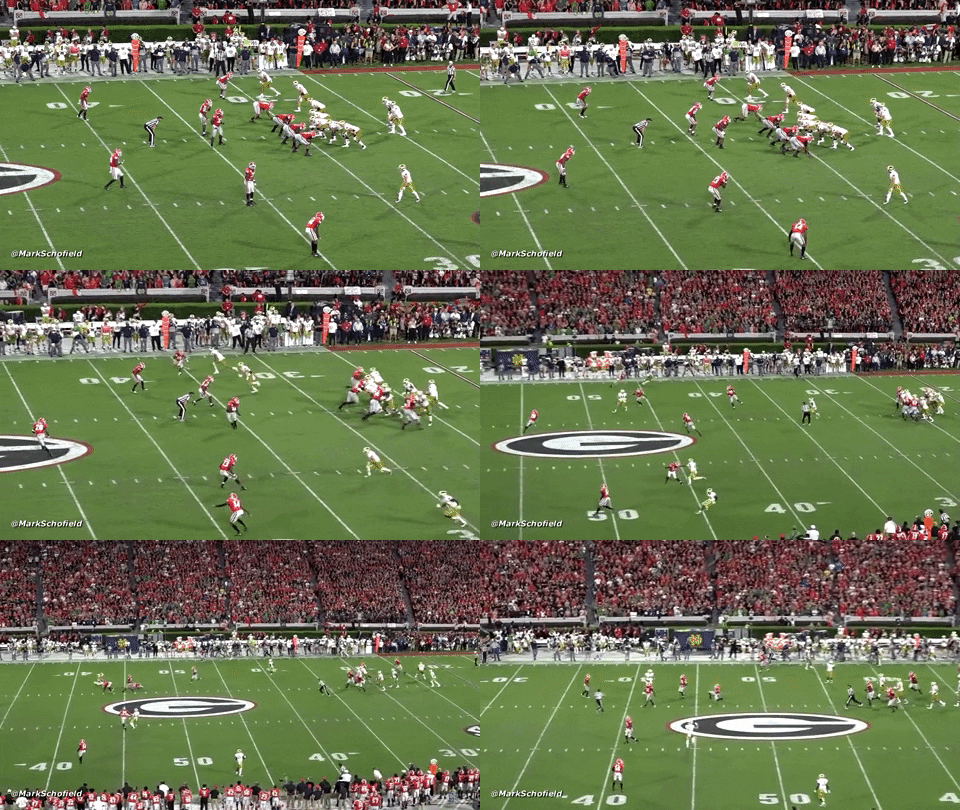
On this seam route Kmet shows the ability to change pace as a route runner, saving an extra gear for when he needs to accelerate past the second-level defenders. He also absorbs a shot after the catch, but hangs on while the safety is slow to get up.
As a route-runner, his ability to find an extra gear as well as how he comes off the line of scrimmage give him an advantage over some of the other TEs in this class. He seems to get an extra step on most of his routes, giving him just a bit more separation than his peers. Kmet is not the most technically-sound route-runner at the position, but his combination of size, burst and straight-line speed gives him an advantage. He also has a tremendous catch radius, which will make him a quarterback’s security blanket on third down situations.
Kmet is also adept at chipping pass rushers before releasing on his route, as well as generating yardage after the catch with power. He will not accelerate away from would-be tacklers, nor is he that shifty after the catch, but he uses his size and power to make sure he gets all the meat off the bone with each reception.
As an inline blocker, Kmet handles more responsibilities in this realm than most college tight ends. Notre Dame did task him with pass protection responsibilities, and he also shows good awareness to adjust his blocking assignment post-snap if his pre-snap read of the play changes due to a defensive adjustment. Kmet is also a good blocker in space, who can get out in front of screens or work to the second-level on run designs.
Weaknesses: Kmet’s hands are not as solid as you might expect, and he relies on his body and frame in close quarters or in contested catch situations to secure the football. While his physical prowess after the catch is how he generates additional yardage, he can be re-routed or jammed off the line by linebackers. It did take a while for him to produce in Notre Dame’s offense, so that is worth mentioning, as is his injury history. Both the left elbow injury and the broken collarbone are areas for NFL teams to explore before the draft.
Conclusion: In a weak tight end class, Kmet’s ability to perhaps be an all-around tight end – something that is rare to find coming out of college – coupled with his ideal size and his solid play make him perhaps the safest option at the position. He seems ready to handle all the aspects of playing the tight end position at the next level, while many other prospects in this class might be forced to specialize in one way or another. Kmet’s ability to create enough space as a receiver is going to be a big plus for him as he makes the transition to the next level.
Comparison: Lance Zierlein from NFL.com compared him to Tyler Higbee, and that comparison makes some sense. You can also see another Notre Dame product, Tyler Eifert, in Kmet’s game.
2. Adam Trautman, TE, Dayton

Height: 6’5″ Weight: 255
40-Yard Dash: 4.8 seconds
Bench Press: 18 reps
Vertical Jump: 34.5 inches
Broad Jump: 9 feet 6 inches
3-Cone Drill: 6.78 seconds
20-Yard Shuttle: 4.27 seconds
60-Yard Shuttle: N/A
Bio: There are “late bloomers” and then there is Adam Trautman. At Elk Rapids High School in upper Michigan, Trautman was a quarterback running an option offense through his junior season. As an undersized QB in an old school offense, most of the bigger college programs passed on him. Elk Rapids transitioned to more of a modern spread approach his senior year, but the only schools to show interest in him as a recruit were from the FCS, including Cornell and Harvard. He ultimately chose Dayton, signing as a quarterback.
After his redshirt season, Trautman moved to tight end for the 2016 campaign. That year he appeared in 11 games for the Flyers, starting seven, and he lined up at a number of positions including tight end, wide receiver and even wildcat QB. As a redshirt sophomore in 2017, he started all 11 games for Dayton, leading the team with 537 receiving yards. Another strong junior season put him on the radar of NFL scouts, such as Jim Nagy, the Executive Director of the Senior Bowl, and in 2019 as a senior he led the Flyers with 916 receiving yards and 70 receptions, which was a school record across all positions. He also led Dayton with 14 receiving touchdowns. Trautman parlayed that success into a spot down in Mobile, where he stood out as perhaps the best tight end of the group.
Stat to Know: Sure, it was against FCS competition, but according to charting by Pro Football Focus Trautman had 27 explosive plays of 15 or more yards, which would have been tops in the FBS.
Strengths: While Cole Kmet has the potential to be that all-around tight end that is rare to find coming out of college, Trautman has been that player during his time at Dayton, albeit at the FCS level. The Flyers used him inline, in the slot and out wide, almost identically to how the New England Patriots employed Rob Gronkowski. Other tight ends in this group struggled in the blocking part of the position, but Trautman relished it, telling the assembled media both at the Senior Bowl and in Indianapolis for the Combine that his favorite thing to do on the field is not what you expect:
You just know the old school football minds are going to eat that up.
But as a blocker Trautman is solid. He handles inline responsibilities well, and when tasked with pass protection against defensive ends he “builds his house” from the feet upwards. He slides well, anchors his lower body and combines both his lower and upper body strength to handle pass rushers.
When studying a lower-level prospect, you want to see some level of dominance. Trautman provided that for the Flyers. Just watch the two plays of his game against Valparaiso. On the first play he motions into the wing next to the left tackle and does this:
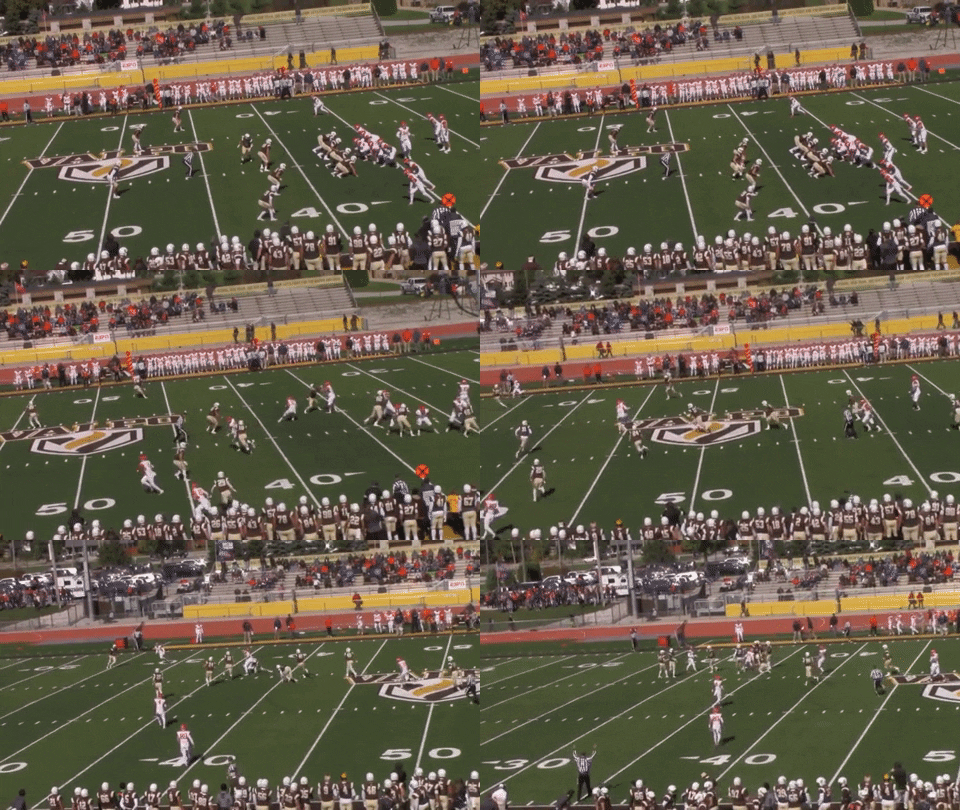
Trautman runs through the linebacker, works open against zone coverage, goes up to get a high throw, runs over the safety and drags the next few defenders who try to tackle him for additional yardage.
Then on the next play he gets behind the defense on a trick play:
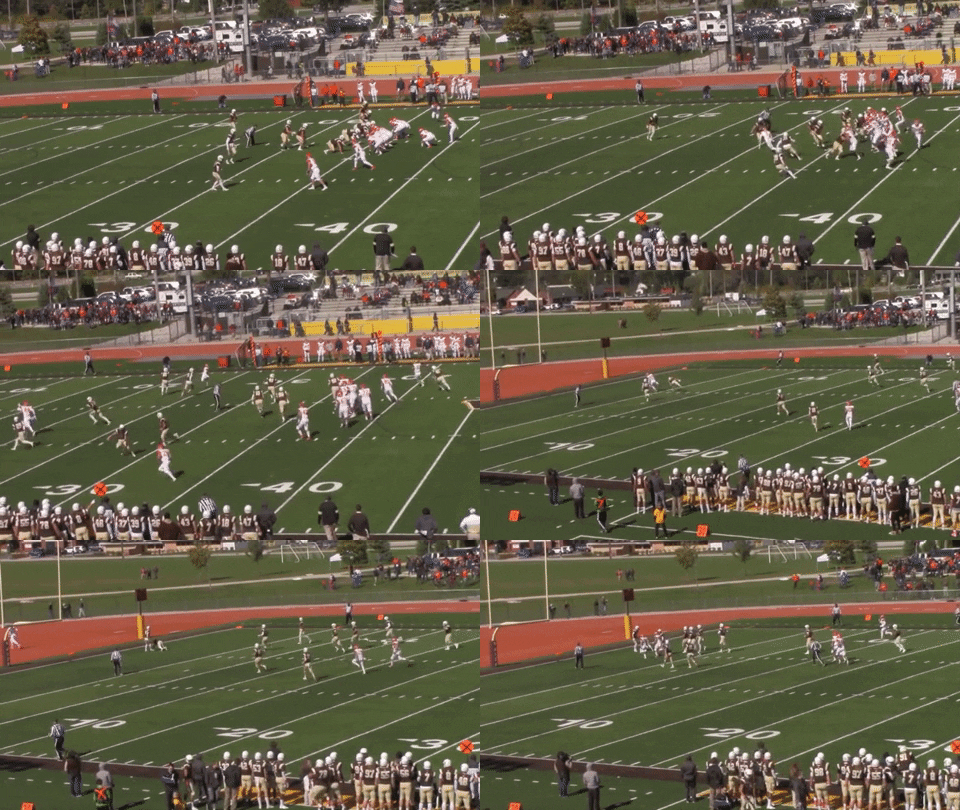
Even though the throw is off target, he manages to get his big left hand out there and one-hand this throw for a touchdown. These two plays look more like viral videos of quarantined fathers schooling their young sons in backyard games of whiffleball than a college tight end showing what he can do.
You know, like this video:
Trautman has the tools to become a great route-runner in the NFL. Currently he is explosive off the line of scrimmage and uses his change-of-direction ability plus his burst to create separation. He gets both into and out of breaks well, and with some refinement he could become a consistent mismatch threat in the NFL.
Weaknesses: You have to begin with the level of competition. While he was dominant against FCS talent, questions do exist about how that translates to the NFL. That is why the Senior Bowl was a huge opportunity for him, and during that week he demonstrated that he could both handle the blocking assignments in the league, as well as be a mismatch player against better athletes. First, the change of direction ability:
Then, the blocking ability:
While Trautman’s three-cone time speaks to his change-of-direction ability, his 40-yard dash of 4.8 seconds was just in the 55th percentile among tight ends. But what he lacks in straight-line speed, he makes up for at the TE position.
Really, however, the only weakness to his game is trying to project what he can do against elite talent. On film, with the opportunities he’s had in front of him, he has excelled.
Conclusion: Ultimately, Trautman might be the best prospect in this class. The only think keeping him from the top spot is what Kmet has done against better competition, but even that is just a slim margin between the two. Trautman has enjoyed a solid pre-draft process and if a team is satisfied with what he displayed at Dayton, as well as what he did in Mobile during the Senior Bowl, he could very well be the first TE off the board. Prospects with true all-around ability are rare in today’s college game, with so many spread offenses asking tight ends to be more slot players, so finding a prospect who can line up next to the tackle and punch a DE in the mouth on one snap, then align in the slot and run away from linebackers on the next, is a rare combination. Even if you have to look to the FCS to find that player.
Comparison: Pro Football Focus likened Trautman to Mark Andrews coming out of the University of Oklahoma, and that comparison makes a great deal of sense. Trautman, like Andrews, can handle the inline portion of the game but can also be a problem for defenses downfield in the passing game.
3. Hunter Bryant, TE, Washington

Height: 6’2″ Weight: 28
40-Yard Dash: 4.74 seconds
Bench Press: 23 reps
Vertical Jump: 32.5 inches
Broad Jump: 9 feet 7 inches
3-Cone Drill: 7.08 seconds
20-Yard Shuttle: 4.74 seconds
60-Yard Shuttle: N/A
Bio: Hunter Bryant had scholarship offers from a number of Power 5 schools, including Auburn, Nebraska and Oklahoma, but the Washington native decided to stay close to home and play for the instate Huskies. While in high school, the Eastside Catholic product hauled in 138 passes for 2,483 yards and 35 touchdowns, impressive production at the prep level.
Bryant saw minimal action his freshman and sophomore seasons, playing just 195 snaps as a true freshman and 143 as a sophomore. But as a junior in 2019 his production took off. He caught 52 passes on 80 targets for 297 yards – a solid 15.9 average yards per reception 0 and three touchdowns.
Stat to Know: Bryant has averaged more than 15 yards per reception each of his three seasons in college. As a freshman he averaged exactly 15.0 yards, and as a sophomore that number jumped to his career-high mark of 21.6.
Strengths: After Cole Kmet and Adam Trautman, this tight end class is filled more with players who are either a move-type tight end, or more of the inline blocker type. Bryant right now is more of your move-type tight end who shows flashes of being able to take on increased inline duties in the NFL, but will need some time to grow into that role. Right now his strength is as a receiver, who can operate out of the slot or the wing and use his combination of speed and athletic ability to work himself open against safeties and linebackers. He attacks the football in flight and almost always reaches full extension reaching for the football, avoiding some of the body catch issues that other players struggle with. Bryant does not have a complete route tree on his resume, but what he runs he excels at, as you can see him running away from defenders on post routes, shallow crossers, sit routes versus zone, deep outs on sail concepts, seam routes and wheel routes from the wing. He also checks that competitive toughness box. In his game against California he landed awkwardly on his left wrist but battled through the rest of the game.
As a blocker, his best reps come when he can use pre-snap leverage and advantageous angles to his benefit. He can serve as a backside blocker in zone schemes, and executes that slice block working from a wing to the backside on inside zone schemes well. Washington also aligned Bryant as an H-Back at times and you could see him taking on linebackers at the point of attack from that alignment with a favorable angle and a bit of a running head start.
Weaknesses: Pro Football Focus charted him with just six drops at Washington, but he was a bit more inconsistent this past season with his hands. The Huskies also seemed to run away from him when he was aligned inline, perhaps not trusting that he could handle inline responsibilities at the point of attack. His frame is more of an H-Back than a true tight end, and his lack of height might limit his options down in the red zone. There were times when Washington would leave him on the sidelines in goal-to-go situations. He also has a bit of an injury history, as a knee injury suffered in 2018 ended his season early.
Conclusion: What likely works in his favor is that Bryant is the mold of where NFL offenses are heading. Even teams that operate with a lot of 12 offensive personnel are looking for a move-type tight end who can win mismatches, and that is his calling card in the NFL. His lack of height might limit his options down near the goalline, but what he does in the open field and after the catch is going to convert a lot of third downs in the NFL. You might not leave him in on pass protection and he won’t be the guy you run the football behind on third and short, but if you need someone to beat a linebacker on third and long, he is your guy.
Comparison: Another tight end who lacked the height and frame coming out of college was Delaine Walker, and he build himself into more of a prototypical tight end. Bryant would be wise to study a lot of the Tennessee Titans standout as he looks to transition to the NFL.
4. Brycen Hopkins, TE, Purdue

Height: 6’5″ Weight: 255
40-Yard Dash: 4.8 seconds
Bench Press: 18 reps
Vertical Jump: 34.5 inches
Broad Jump: 9 feet 6 inches
3-Cone Drill: 6.78 seconds
20-Yard Shuttle: 4.27 seconds
60-Yard Shuttle: N/A
Bio: With an NFL lineage and an all-around background as an athlete, Brycen Hopkins is sure to get attention come draft time. His father, Brad, was a first-round selection as an offensive tackle by the Houston Oilers, who made two Pro Bowls during his time with the Oilers and then the Tennessee Titans. Brad, a three-sport athlete, wanted to pursue his first love basketball, but started playing football only as a junior in high school. He turned down a scholarship offer from Florida to play for the Boilermakers.
He first saw the field as a redshirt freshman in 2016, but took on more and more of a role in the Purdue offense each season. Last year was his most productive in college, as he caught 61 passes on 89 targets for 832 yards and seven touchdowns, all career highs.
Stat to Know: Hopkins, according to Pro Football Focus charting information, had 22 drops since 2016. That is eight more than any other tight end in this class.
Strengths: Out at Indianapolis for the NFL Scouting Combine, Hopkins was asked who is his training with to get ready for the NFL. In an interview with Steelers Depot he gave this answer:
[My dad is] actually helping me train down in Boost Performance in Nashville. He’s got the line, he’s helping the o-line. I’m getting coached by [former Ravens’ wide receiver] Derrick Mason in the receiving game. My dad is actually a big part of the process.
That should provide some insight as to how Hopkins will best be used in the NFL. He is more a tight end in name only, and his best utilization in the league will be as a big slot, bigger-bodied receiver. He has burst off the line of scrimmage and after the catch, and he shows the ability to almost immediately transition from receiver to ball-carrier. His catch and run against TCU on a simple stick route is something you would love to see from a wide receiver, let alone a tight end:
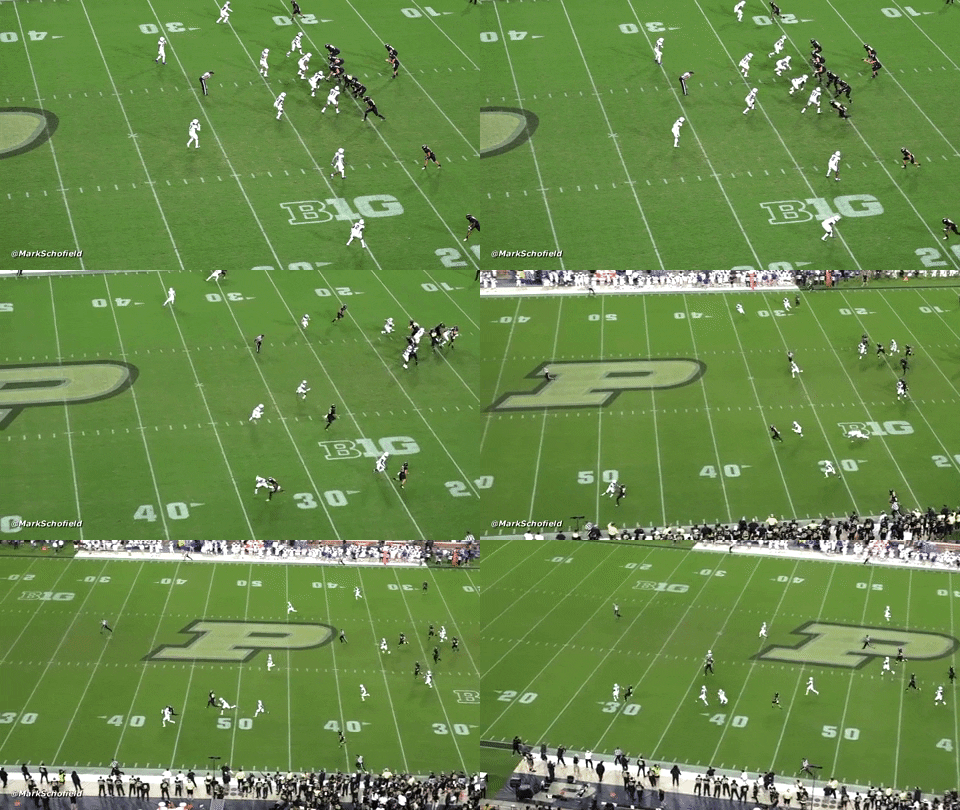
Hopkins also has the ability to run away from most defenders who will be tasked with covering him. That ability to be a mismatch weapon is going to give his offensive coordinator a lot of flexibility in the NFL.
Despite his issue with drops, Hopkins has the ability to go up and get the football, and already has the wherewithal to attack the football at the high point. He is not the best route-runner at the position, but his combination of burst and speed makes him difficult to cover, and his route-running has improved over his time at Purdue. He also has the size to be a target down in the red zone, which is something teams will covet.
Weaknesses: Hopkins is perhaps a tight end in name only, and teams looking for that complete player might not value him as highly as others in this class. This might get more to his scheme fit and potential usage in the league. If you are aligning him as an inline tight end and asking him to block defensive ends one-on-one more than a handful of times a season, you are using him wrong. Put him in the slot, move him around, and let him be a weapon in the downfield passing game.
Drops, perhaps more of the concentration variety, are an issue. The PFF charting data speaks for itself in that regard.
If you are studying him as a blocker, you’ll see someone who has the lateral quickness to handle responsibility in a zone-blocking scheme. Zone–heavy teams might be okay with him on the backside of such plays, as he can usually get across the face of the nearest defender and wall them off from backside pursuit. But you aren’t lining up in the i-formation behind him and running 96 or 97 Power behind him.
Conclusion: Hopkins benefits from the time we are living in, in that his type of tight end is probably still going to find a spot in the league. He can be that type of mismatch player that offensive coordinators will find a use for, and conversely the type of problem player that will keep defensive coordinators up at night. What limits him is that his is more of a projection if you are looking for a complete package at the position. His best opportunity is to stick early given what he brings as a receiver at the position, as he learns to round out the rest of his game.
Comparison: Mike Gesicki. Gesicki was used in a similar manner by Penn State, and it took a while for him to complete the picture as a tight end. But he was also a very dangerous move-type TE coming out of college, and Hopkins is similar in that regard.
5. Josiah Deguara, TE, Cincinnati

Height: 6’2″ Weight: 242
40-Yard Dash: 4.72 seconds
Bench Press: 25 reps
Vertical Jump: 35.5 inches
Broad Jump: 9 feet 7 inches
3-Cone Drill: 7.15 seconds
20-Yard Shuttle: 4.35 seconds
60-Yard Shuttle: N/A
Bio: Josiah Deguara did not have a lot of options coming out of high school, where he was a three-sport athlete for Folsom High School out in California. Deguara was a baseball player and a starter on a basketball team that won a Northern California Championship, but when it came time to choose from scholarship options, only the flexbone Air Force Academy and Cincinnati came calling.
Deguara had his breakthrough season for the Bearcats in 2018, when he caught 38 passes for 468 yards and five touchdowns. Last year he improved on those numbers, with 39 receptions on 71 targets for 504 yards and seven touchdowns, and he averaged 12.9 yards per catch. All of those numbers were career-highs for him.
Stat to Know: The Scouting Combine was a favorable outing for him, as his bench press numbers (25 reps – 87th percentile) combined with his 10-yard split in the 40-yard dash (1.56 seconds – 97th percentile) demonstrated the power and explosiveness that he can produce.
Strengths: If you are placing a bet on the prospect after Cole Kmet and Adam Trautman who can best translate into an all-around tight end, Deguara might be the safe play. In the Cincinnati offense he was used almost 60% of the time as an inline player, using Pro Football Focus charting data, and he was very effective as a blocker. His game against Ohio State is certainly worthy of study, because at times he was aligned one-on-one against Chase Young both in the run game and in pass protection. He got the better of Young on a few different blocks, and even handled him in pass protection, albeit with some help from a running back. Not too many other prospects in this class could make such a claim.
Deguara is also a high-effort player. He stays working across the field when he sees his QB scrambling, constantly working to stay in his field of vision. He also made a notable play against UCLA, chasing down a defender after an interception to make a tackle. But this effort translates to what he can do as a receiver, as you can see on this reception against the Buckeyes:
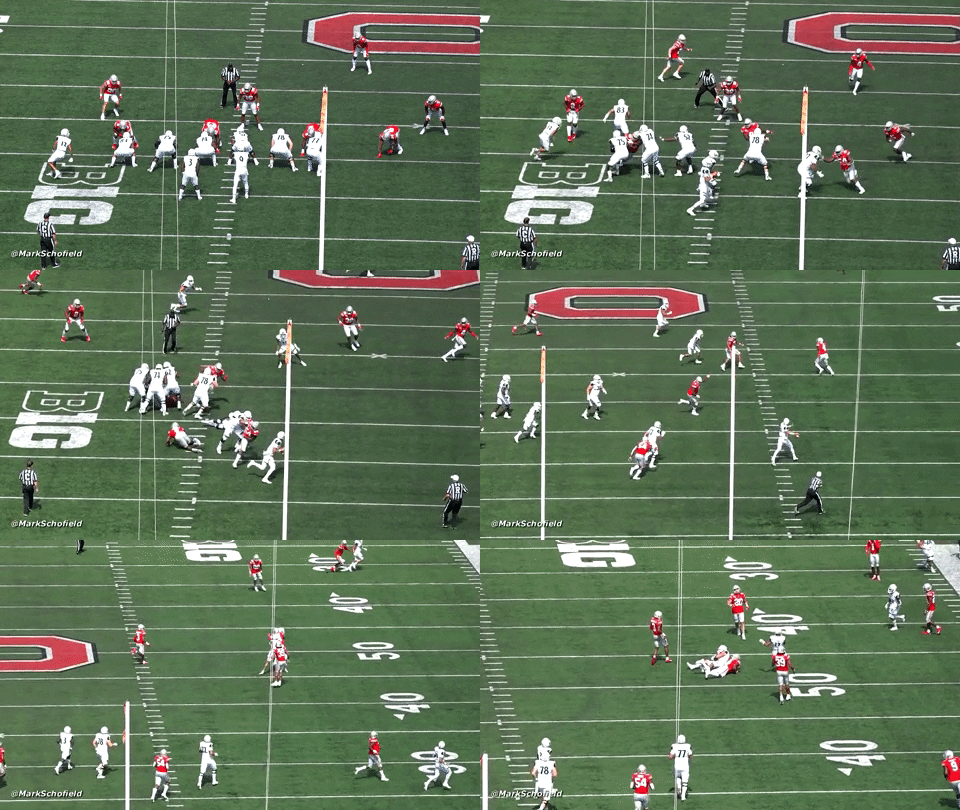
First, you can see how he uses his hands and upper body on this route, getting open off the line of scrimmage. Then Deguara keeps working down the parallel before high-pointing the football in traffic to come down with the catch.
He is also effective working up the seams, and some of his releases on film are NFL-ready. Deguara has a combination of footwork and upper body moves such as swims that will beat jam attempts by second-level defenders, enabling him to get into his routes quickly.
Weaknesses: While the effort and execution was there in college, Deguara lacks prototypical size and length to serve as a consistent inline blocker in the NFL. Teams will need to bet on what he did on film and hope the he could have that Delaine Walker-like transition given his size.
He is also not the most impressive athlete, he is more of a power and explosiveness type of player. He relied on his frame more at the catch point than other tight ends in this class, and that might not always work in contested catch situations in the NFL. Despite his route-running ability and array of release moves, he does round off routes at times, letting defenders get underneath him.
Conclusion: Players like Deguara have a knack for sticking on rosters given their effort and willingness to do some of the dirty things that coaches love. His effort on routes and as a blocker will endear him to many coaches in the league, and what he showed on film is the promise of a potential all-around TE in the league. He will face questions about his athleticism and size, and will need to develop parts of his game like refining his routes and more consistency at the catch point, but he could be a potential growth project at the tight end position while contributing early as more of an H-Back.
Comparison: It is because of that potential as an H-Back that the career path for Deguara could be one of Kyle Juszczyk’s. Juszczyk was a tight end at Harvard University that carved out more of a hybrid role in the NFL, being used as a TE, an H-Back and a fullback. Deguara has similar potential and size, as the current 49er was 6’1″ 248 coming out of the Ivy League. An offensive coordinator with some vision could find a role for him as a rookie, and perhaps that is where he best belongs.
6. Albert Okwuegbunam

Height: 6’5″ Weight: 258
40-Yard Dash: 4.49 seconds
Bench Press: N/A
Vertical Jump: N/A
Broad Jump: N/A
3-Cone Drill: N/A
20-Yard Shuttle: N/A
60-Yard Shuttle: N/A
Bio: If you were buying first-round futures at the tight end position a few years ago, Albert Okwuegbunam seemed like a sure bet. Listed at 6’5″ 223 coming out of Scared Heart Griffin High School in Illinois, “Albert O” had tons of scholarship offers, including from Iowa, Iowa State and Indiana. He picked Missouri, and in his redshirt-freshman season of 2017 that futures bet seemed likely to pay off. That year he caught 29 passes on 20 targets for 409 yards and 11 touchdowns, averaging 14.1 yards per catch.
The problem? That was basically the high-water mark of his production. The following year, with Drew Lock still his quarterback, Okwuegbunam caught 43 passes for just 467 yards – an average of just 10.9 yards – for only six touchdowns. He dipped even further last season, catching just 26 passes for 306 yards and six touchdowns, as Missouri transitioned from Lock to Kelly Bryant, the Clemson transfer at the quarterback position.
Stat to Know: 141.4. That was the passer rating Tigers’ quarterbacks had when targeting Okwuegbunam on throws more than 20 yards downfield. Of course, it was a small sample size, with four catches on seven targets for three touchdowns. But with his straight-line speed, he could be a vertical threat up the seams in the NFL. Keep that in mind.
Strengths: Okwuegbunam’s speed turned heads at the Combine, but it should not have been such a surprise. His strengths as a receiver showed up when he could work vertically or across the field on crossing routes. There, you could see him run away from defenders. Okwuegbunam also does a very good job of threatening defenders with his releases, showing the ability to stress leverage and set himself up to get separation on his breaks. He also sinks his hips better than expected, and he has the ability to pace his routes and shift into a second gear to get separation. After the catch he has size and power to rely on, but he also shows the ability to use a stiff-arm in the open field to get additional yardage.
As a blocker, Okwuegbunam could use some refinement, but he has the size to get into players and the power to use a single-arm technique when on the backside of zone running plays. He also showed good awareness when lined up next to the tackle, with the ability to identify late creepers into the box and change his course of attack in response. Okwuegbunam also has the upper-body strength to turn defenders at the point of attack, so he could work in a gap/power scheme.
Weaknesses: What happened? Most players improve their production as their career unfolds, but Okwuegbunam trended in the opposite direction. Part of this could have been a change in the offense, as offensive coordinator Derek Dooley installed a more “pro style” offense in 2018 that might have limited his opportunities. He also tens to push off at times at the top of his route stem, which will draw flags in the NFL. Okwuegbunam could be more of a contested catch demon with his size, but at times he was outworked by defensive backs at the catch point. You would expect more from him in those situations.
Conclusion: Okwuegbunam flipped the script a bit with the 40-yard dash he posted at Lucas Oil Stadium, which forced many evaluators to turn the tape back on to see what they might have missed on film. It was there to be seen, with his ability to separate on straight-line routes such as seams and crossers. There is enough to work with in terms of his blocking ability, and his recognition and awareness pre-snap is half the battle when a college TE transitions to the NFL. At this point in this draft class you are likely looking at lottery tickets, and his size and athleticism is worth that shot.
Comparison: Joe Marino of The Draft Network brought out the Martellus Bennett comparison for Okwuegbunam, and that makes a great deal of sense.
7. Devin Asiasi, TE, UCLA

Height: 6’3″ Weight: 257
40-Yard Dash: 4.73 seconds
Bench Press: 16
Vertical Jump: 30.5 inches
Broad Jump: 9 feet 7 inches
3-Cone Drill: N/A
20-Yard Shuttle: N/A
60-Yard Shuttle: N/A
Bio: Coming out of high school Devin Asiasi had a number of options, including USC, UCLA and Washington. But he chose to leave the west coast behind and enrolled at Michigan to play for Jim Harbaugh. He played in 13 games for the Wolverines in 2016, catching two passes for 18 yards. But after just one year he headed back west, transferring to UCLA.
2019 was his single year of solid production. Last year he caught 44 passes on 68 targets for 641 yards and four touchdowns, averaging 14.6 yards per reception. He dropped just one pass a year ago, the third-lowest drop rate among tight ends according to Pro Football Focus and their charting data.
Stat to Know: Many of the tight ends in this class did their best work detached from the line. Asiasi, however, averaged three quarters of a yard more per route working inline as opposed to when he was outside, according to PFF charting data.
Strengths: Asiasi also has the potential to become an all-around tight end, thanks to his combination of blocking skills and what he was able to do do releasing from an inline alignment. As a receiver he shows the awareness to find open spaces in zone coverage, and his releases off the line of scrimmage are sudden and with purpose. He threatens the leverage of the nearest defender well, and when jammed off the line he barely loses a step. After the catch he can do some damage, thanks to his combination of power and size. He averaged 5.6 yards after the catch this past season, and he’ll be someone who will fight for that extra yard on a pivotal third down situation.
As a blocker, Asiasi is dependable both inline and when working in space. He showed good footwork on both zone and gap/power schemes, and even showed some power at the point of attack in both designs. UCLA was not afraid to run behind him, unlike some of the other offenses and their tight ends from this class. He can even trap interior defensive linemen from an H-Back or a wing alignment, another rare trait from this TE group. He was used both as a lead blocker from an H-Back alignment on gap/power designs, and also as an arc blocker in front of the quarterback on some zone running packages.
Weaknesses: Despite the lack of drops, Asiasi could be better in traffic. He often let the football come into his frame rather than going and getting it, which is something to watch. He lacks the long speed of some of the players in this class, making him a better option against zone coverage than man coverage. The effort is there on his routes, but with some refinement they could be much more improved. At times the routes lack a sense of urgency. You could also see that on some slice block opportunities working across the formation, as he would be late to arrive to the backside, letting his responsibility impact the play in the backfield. Asiasi also has a tendency to drop his eyes before contact when working as an inline blocker, making him susceptible to swim moves right before impact.
Conclusion: With so many move-type TEs in this class, Asiasi could benefit from being one of the more traditional type players available to teams. He has the traits and the film to play more of an inline role, and for teams looking to fill that kind of spot he might be a great option late in the draft. There is something to work with when it comes to the receiving part of the position, and his awareness to find grass against zone coverage is notable, and something that other players will need time to develop.
Comparison: Asiasi is reminiscent of Luke Willson, a player more in the blocking-TE mold but who can contribute with awareness in space and against zone coverage. He might not develop into a top-flight, TE1 type of player but there is always a role to be found for a player with his skillset.
8. Harrison Bryant, TE, Florida Atlantic

Height: 6’5″ Weight: 243
40-Yard Dash: 4.73 seconds
Bench Press: 13 reps
Vertical Jump: 32.5 inches
Broad Jump: 9 feet 2 inches
3-Cone Drill: 7.41
20-Yard Shuttle: 4.37 seconds
60-Yard Shuttle: N/A
Bio: Harrison Bryant was a three-sport athlete at John Milledge High School, starring in football, basketball and baseball. He was a two-way player on the gridiron, and caught 39 passes for 608 yards and 10 touchdowns while recording 100 combined tackles, including 14 for a loss, his senior season. Florida Atlantic was the only FBS program to give him a scholarship offer, so it was time to become an Owl.
Bryant was a focal point of the Owls’ offense the past few seasons, and his senior campaign was certainly an impressive effort. Last year he caught 65 passes on 94 targets, for 1,004 yards and seven touchdowns. Yes, I do believe that is the first time I needed the comma when writing out receiving yardage for any player in this group. That stellar senior campaign earned him an invitation to Mobile for the Senior Bowl.
Stat to Know: Bryant is impressive after the catch, as noted by the average of 6.0 yards post-reception as well as the 23 missed tackles forced since 2017.
Strengths: If you like Brycen Hopkins, you’ll like Bryant. He is also perhaps a tight end in name only, who is impressive off the line of scrimmage or when flexed outside. He can get separation on routes from all alignments and to all levels of the field, and makes some tough catches working over the middle and in traffic. As the numbers attest, he has some juice after the catch, both with some power as well as some burst and change-of-direction ability. Bryant also flashed some double-move ability, such as on a sluggo route against North Texas this past season.
As a blocker, the effort is certainly there. He is willing to work from both the inline alignment as well as in space. His blocking ability is best used out in the ope field, whether blocking in front of screens or moving to space from an H-Back alignment. There were rare occasions when Florida Atlantic asked him to handle pass protection responsibilities, and he could handle those tasks provided he had help from either a nearby tackle or a running back chipping his assignment.
He also checks the “competitive toughness” box. On the above-mentioned sluggo route against North Texas he took a shot to the knee that looked ugly and sent him limping off the field. But he was back on the next series giving it his all despite being clearly hampered by the hit.
Weaknesses: A lot of his production this season came on schemed designs. Now, that speaks to how the offense tried to run their passing game through him, which is a feat in itself given that he is a tight end, but you do wonder how he will be able to create on his own in the NFL. While the effort is there as a blocker, the execution often is not, especially when used inline. He also had a problem with drops this past season, and it showed up mainly in contested catch situations.
He also seemed to lose his footing a lot, which is something to watch for. There were times on film when he let his feet get outside of his frame, costing him chances at big plays when he was sent crashing to the turf.
Also, Bryant did not have the best combine. The testing was subpar for someone who projects to be a move TE, and the wingspan and arm length is also an area of concern.
Conclusion: There is a lot to like about Bryant, but given the fact he is likely a move tight end only, there are better options in this draft class. But what he does well will be helpful in an NFL offense, and with the way the game is trending there is certainly a way to use him and make him a viable threat in the passing game. He may never become a prototype TE, but if he can create mismatches at all levels of the field and generate some explosive plays, that can certainly help an NFL offense score points.
Comparison: Bryant reminds one of Jacob Hollister, who became a favorite target of Russell Wilson this past season. You can scheme him open down the field and look to him in the passing game, but you are not going to rely on him as a lead blocker anytime soon.
9. Thaddeus Moss, TE, LSU

Height: 6’2″ Weight: 250
40-Yard Dash: N/A
Bench Press: N/A
Vertical Jump: N/A
Broad Jump: N/A
3-Cone Drill: N/A
20-Yard Shuttle: N/A
60-Yard Shuttle: N/A
Bio: Brycen Hopkins is not the only tight end with NFL genes in this draft class. Thaddeus Moss, son of Hall of Fame wide receiver Randy Moss, is looking to make the leap to the league after helping LSU win a National Championship. Moss began his career at N.C. State, but transferred to LSU after one season with the Wolfpack.
While he has just one season of production, it was an impressive one as part of Joe Brady’s passing game for the Tigers. Moss caught 47 of 57 targets for 570 yards and four touchdowns, averaging 12.1 yards per reception. He also flashed some flexibility, playing 489 snaps inline but also 125 snaps in the slot for LSU.
Stat to Know: Moss did not have a single drop in 2019.
Strengths: If you want a physical blocker who can put a defensive end on his back before releasing to the flat to catch a checkdown from a quarterback under duress, Moss is your guy. He might be the most physical blocker in this entire group, and he can be dominant both inline and in the wing. Moss is not the most athletic prospect at this position, but he has the footwork as well as enough functional athleticism to operate well both playside and backside on zone blocking designs. When Moss is backside, he is athletic enough to cutblock defensive ends to the turf. He also is extremely adept at chipping defensive ends before releasing into his routes, and Moss loads up for those shots on DEs. His film is replete with clips of him putting an unsuspecting DE on his backside.
As a receiver, Moss is more a “space finder” than a separator. His athleticism as a blocker does not completely translate into winning one-on-one matchups as a receiver, but his physical nature does. There are times when he gets his separation more due to swinging a stray elbow or two rather than crossing someone up on a break. He also does a very good job at finding space in zones, and has some good contact balance after the catch. He will not juke would-be tacklers in the open field, but he might run them over.
We mentioned his hands, but his body control helped make him a national name in LSU’s win over Alabama:
A reception like that is beautiful in any language.
Weaknesses: What Moss brings to the table in terms of physicality and blocking prowess he cannot match with athleticism and ability as a true receiver. Downfield separation is not his best trait, and he needs to learn how to work back to the football better in man coverage situations. Too many times he let the ball come to him, or simply failed to get open when his quarterback started to scramble. He also lacks the height to be a true red zone mismatch piece. He might be built more like a fullback or an H-Back, so one could consider using him differently in the NFL. That might negate what he brings to the table as an inline blocker, however.
Conclusion: Moss’ ball skills and inline blocking ability harken back to the early 1980s, before the growth of 11 personnel and move tight ends. In another era Moss might be the top tight end of the bunch, with his ability to function more as a sixth offensive lineman for a run-heavy system. In today’s game he is more of a TE2 type of player, who can contribute schematically in the passing game but be a force as a blocker. There is certainly room for that type of player in the league, but it becomes a matter of value.
Comparison: David Morgan. Moss seems similar to the veteran blocking tight end, who was drafted in the sixth round of the 2016 NFL Draft. Morgan was a devastating blocker, who could contribute at times in the passing game.
10. Cheyenne O’Grady, TE, Arkansas

Height: 6’4″ Weight: 253
40-Yard Dash: 4.81 seconds
Bench Press: 16 reps
Vertical Jump: 34 inches
Broad Jump: 9 feet 11 inches
3-Cone Drill: 7.3 seconds
20-Yard Shuttle: 4.34
60-Yard Shuttle: N/A
Bio: Cheyenne “C.J.” O’Grady came to Indianapolis for the Scouting Combine with more questions surrounding him than answers. He was a four-star recruit coming out of Fayetteville High School and turned down several offers to stay home and attend his home town school, Arkansas. His time on campus was marked by an arrest as a freshman for suspicion of DWI and possession of alcohol, suspensions from two different coaching staffs, and he eventually left the team midway through his senior campaign.
When he was on the field O’Grady looked the part of an early-round tight end. He was a focal part of the Razorbacks’ offense this season – before leaving the squad – and he caught 33 passes (a career-high) for 372 yards and three touchdowns. He did this on just seven games. But in early November he was suspended by the team and decided to “step away” from the program.
I know. Your “Spidey Sense” is tingling too.
Stat to Know: During his career O’Grady broke 17 tackles on just 87 career receptions. That is an impressive percentage.
Strengths: O’Grady could be a top tight end in this class if it were not for the off field issues. He has the route-running ability to separate consistently from man coverage, and the ability to secure the football almost perfectly at the catch point. Pro Football Focus charted him with just four drops on 89 career catchable passes, and impressive percentage. He is very physical at the catch point, and plays like this are going to keep him on the radar of many NFL clubs:
Not only does he absorb the shot here and hang onto the football, O’Grady maintains his contact balance and fights for additional yardage after the catch. Converting a third-and-long in this fashion? That will put you on NFL radars, and earn the trust of your future pro passer.
Weaknesses: Beyond the character red flags – and there certainly are many – there is also a question of effort. At times O’Grady seems to take routes off, and there are blocking assignments when he somehow manages to avoid hitting a single soul over the course of a play. He lacks consistent finishing with his blocks, and there times that he does not even attempt to catch throws outside of his catch radius.
Then there is the effort he put on the turf at Lucas Oil Stadium. For players with character red flags, a massive showing at the Combine can help to ease fears in NFL front offices. For example, linebacker Willie Gay Jr. turned heads with his Combine performance, and that might make it easier for a General Manager to turn in a card with his name on it. O’Grady turned in an average Combine, in terms of his 40-yard dash time (4.81 seconds) and his three-cone drill (7.3 seconds, 39th percentile).
To his credit, he took ownership of his mistakes at Arkansas, and even admitted under questioning from Arif Hasan from The Athletic – Minnesota that he was finally in shape for the first time in a long time:
But one has to wonder – especially in a global climate when teams cannot take extra meetings with prospects due to the COVID-19 crisis – is a team going to feel comfortable drafting a player with this background?
Conclusion: There is a famous quote about the draft process attributable to Arizona Cardinals’ General Manager Steve Keim: “If Hannibal Lecter ran a 4.3, we’d probably diagnose it as an eating disorder.” O’Grady, even with his off-field issues, still might attract a draft pick in a weak tight end class. He had a chance to run the TE equivalent of that 4.3 at the Combine, but failed to take advantage of the opportunity. The team that takes a chance on his is getting a potential mismatch player in the receiving game, but is it worth the risk? Especially for a prospect on the older side, set to turn 24 as a rookie? The negatives might outweigh the potential positives.
Comparison: PFF compared him to Lance Kendricks in their Draft Guide, and if O’Grady manages to put it all together, he has that kind of ceiling. The question is, how confident are you – and NFL teams – that he will meet that ceiling?
11. Jared Pinkney, TE, Vanderbilt

Height: 6’4″ Weight: 257
40-Yard Dash: 4.96 seconds
Bench Press: 23 reps
Vertical Jump: 34 inches
Broad Jump: N/A
3-Cone Drill: N/A
20-Yard Shuttle: N/A
60-Yard Shuttle: N/A
Bio: Jared Pinkney was a three-star wide receiver coming out of Norcross High School in Georgia, and entertained offers from Nebraska, Florida and UCF before settling on Vanderbilt University. He was injured in his first college game against Western Kentucky and received a medical redshirt from the NCAA, and the team then moved him to tight end prior to the 2016 season.
His best year on campus was in 2018, when he was an Associated Press All-SEC Second Team selection at tight end. His 50 receptions were the most by a Vanderbilt tight end since 1984, and he gained 774 yards receiving with seven touchdowns. He averaged 15.5 yards per reception, second-most on the entire roster. Rather than jump to the NFL in a loaded tight end class, Pinkney returned to school.
The prospect might be second-guessing that decision. His production dropped precipitously, as he caught just 20 passes on 43 targets for a mere 233 yards (a career-low) and two touchdowns (also a career-low). Vanderbilt struggled at the quarterback position with the graduation of Kyle Shurmur, and perhaps that contributed to his lack of production. But this is an issue to consider when evaluating Pinkney.
Stat to Know: Over his career, Pinkney broke 21 tackles on 114 receptions, according to Pro Football Focus. He can make you miss after the catch.
Strengths: Pinkney has the size and frame to be a legitimate red zone weapon. He struggled at times to separate from Grant Delpit in their meeting during the 2019 season, but that is a potential first-round safety. He was able to get separation in his other contests, and moves well for a player of his size. Pinkney drops his hips into and out of his cuts, and at times showed the ability to run away from linebackers and even bigger safeties in the open field.
Generally, his hands are consistent at the catch point, and PFF charted him with just a pair of drops last season. However, one of those was a really bad drop when he was wide open on a sail route working towards the outside, but the pass hung in the air a bit longer than he expected and he failed to secure the catch.
As a blocker, the potential is there, but the finish is not. More on that in a moment. He is at his best right now in the open field, working in space against players in the secondary.
Weaknesses: Pinkney needs to learn how to finish as a blocker. Too many times he believes his initial punch is going to carry the play, and defenders simply regroup and rally to the ball-carrier as the watches the rest of the play. If he could start finishing his blocks better, one could have more confidence in him translating to the next level. He does have solid technique when blocking inline, and shows the ability to get his head around and seal a defender from the gap, but he needs to finish better.
As a receiver, Pinkney could stand to refine his route-running. The basic skillset is there, but unlike some TEs in this class he lacks the ability to use pace and change of tempo to get separation. He also was re-routed too easily at times, and could work back to the football with more aggression.
Conclusion: Even with these weaknesses, a season of great production coupled with some potential as an inline blocker might be enough to earn him a look early on Day Three in this class. Someone with second team All-SEC on their resume brings something to the table, playing against that level of competition. If a team looks at his 2018 tape and likes what they see, Pinkney is coming off the board sooner than we expect.
Comparison: Charles Clay. Pinkney could play more of an H-Back role with the ability to move more inline as he refines his blocking technique.