Every year, narratives emerge around the NFL Draft. Often, they can be position-related. For example, I’m old enough to remember when the 2017 quarterback class was considered fool’s gold, and that the 2018 quarterback group was the one to get excited for. Well, someone forgot to tell Deshaun Watson and Patrick Mahomes that…
But sometimes the narratives are reasonable. Ask anyone about this year’s draft and the first thing that usually comes up is how talented and deep this wide receiver group is. That narrative is spot on. This is an incredibly talented group. Look at any “Top 50” list and count the number of wideouts. Of these next 11 prospects, you could make a case any of the first ten players to be a first-round selection. This group is just that good.
Now as a result, it can be hard to rank them. In some cases it might just come down to a matter of personal preference. There is almost no way to incorrectly rank these players, given just how talented they are. Furthermore, drop any of these prospects into a different draft class and whether they are at the top of this list or near the bottom, they are likely pushing for the top spot in another class.
Again, this group is that good.
In fact, it was tough limiting this list to just 11 players. Some who did not make this cut are also fantastic prospects, who could be drafted late on Day Two or even early on Day Three and be immediate contributors. If I wanted to, I could probably put together a list of 25 good-to-great prospects at the WR position from this draft class.
Now that I think about it, I could not.
(I don’t believe that, I just don’t want my editors to get any ideas…)
Editor’s Note: Eyes on the prize, bud.
On to the rankings.
Lamb | Jeudy | Ruggs III | Shenault | Jefferson | Higgins | Mims | Reagor | Aiyuk | Pittman | Johnson
1. CeeDee Lamb, Oklahoma

Height: 6’2″ Weight: 198
40-Yard Dash: 4.5 seconds
Bench Press: 11 reps
Vertical Jump: 34.5 inches
Broad Jump: 10 feet 4 inches
3-Cone Drill: N/A
20-Yard Shuttle: N/A
60-Yard Shuttle: N/A
Bio: From the moment he stepped on campus, CeeDee Lamb was contributing to the Oklahoma passing game. As a true freshman in 2017 Lamb caught 46 passes (on 68 targets) for 801 yards and seven touchdowns, averaging 17.5 yards per reception. His numbers improved every single season he was on the field, jumping to 65 receptions for 1,156 yards and 11 touchdowns as a sophomore, and 62 receptions for 1,325 yards and 14 touchdowns last season. As a junior in 2019, Lamb averaged an incredible 21.4 yards per reception, the third-highest average in the nation and the highest among receivers with more than 40 receptions.
Stat to Know: 146.5. That is the passer rating Lamb generated on his targets over the past two seasons in Norman. I think NFL quarterbacks would love having someone like that to throw to.
Strengths: Another thing that will make Lamb’s NFL quarterbacks happy is the receiver’s catch radius. The idea of a “50/50 ball” goes out the window with Lamb’s ability to snare throws that seem to be off target:
Then this is this play against UCLA that still looks absurd:
Wherever the pass is, Lamb can go and get it. He excels at the catch point, and does a tremendous job of high-pointing the football.
Lamb is also a technically sound route-runner, who is at his best on routes working back to the quarterback off the vertical stem. Curls, comebacks and hitches all see him rolling his hips down into the break and working back to the QB violently, gaining separation as he cuts. After the catch? Lamb is explosive there as well, and PFF charted him with 26 broken tackles last season, the most in the country. On the rare occasions when he faced press coverage, Lamb was able to win at the line of scrimmage by getting small and evading the jam, allowing him to get into his route quickly.
Weaknesses: Lamb’s top end speed is not elite, but the 4.5 that he ran at Indianapolis was perhaps a tic quicker than most expected from him. This could be a prime example of overthinking a prospect, because his catch radius and route-running means that even without elite speed, he is usually open enough. He also operated in a wide-open offense that generated a ton of free release for him, so despite his ability to beat press when he saw it, he’ll see a lot more of it when he moves to the league.
Conclusion: Unless you’re Al Davis and speed is the bottom line, Lamb is as clean as it gets from a WR prospect. His hands, catch radius and ability after the reception make him a fit for almost any offense, and he projects as an ideal “Z” receiver in most systems. He can operate effectively at all levels of the field, and is a genuine threat with the football in his hands in space. Teams that overthink his long speed and pass on him are going to regret that decision.
Comparison: PFF compared Lamb to DeAndre Hopkins in their draft guide, and the comparison is apt. He might not have the top end speed of other receivers, but his route-running and catch radius, plus his play style and projected NFL role, align well with Hopkins.
Lamb | Jeudy | Ruggs III | Shenault | Jefferson | Higgins | Mims | Reagor | Aiyuk | Pittman | Johnson
2. Jerry Jeudy, Alabama

Height: 6’1″ Weight: 193
40-Yard Dash: 4.45 seconds
Bench Press: N/A
Vertical Jump: 35 inches
Broad Jump: 10 feet
3-Cone Drill: N/A
20-Yard Shuttle: 4.53 seconds
60-Yard Shuttle: N/A
Bio: Jerry Jeudy was one of the top wide receiver recruits coming out of high school, choosing Alabama over a home state option in the University of Miami. He contributed in a small way as a freshman in 2017, catching 14 passes for 264 yards and a pair of touchdowns, but exploded on the national stage as a sophomore in 2018. That season he caught 68 passes on 101 targets for 1,313 yards and 14 touchdowns, averaging a whopping 19.3 yards per reception. Last year he still managed to put up prodigious receiving numbers in a crowded group of receivers, catching 77 passes on 108 targets for 1,163 yards and ten touchdowns.
Stat to Know: Jeudy played both in the slot and on the outside at Alabama, and a season ago he saw 326 snaps inside compared with 271 out wide, according to charting from Pro Football Focus. But he does real damage from the slot, averaging 3.49 yards per route run from the slot over the past two seasons.
Strengths: It is rare to find a complete route-runner coming out of the college game, but this wide receiver class provides some prospects who can give an offense almost a complete route tree coming out of college. Jeudy is no exception. He is the quintessential “full-body route runner,” who can use everything from head to toe to get a defender off balance and then get separation working away form them. Watch, for example, this stop route against Clemson:
Jeudy’s footwork and short-area quickness stands out here, but don’t ignore how he even uses his head at the top of the route, selling the cornerback on a potential vertical stem before finally breaking this off short and working back to the quarterback. This is elite work from the wide receiver here.
What also shows up on this route is Jeudy’s ability to manipulate the leverage of the defensive back on a route. The cornerback immediately snaps his hips to the middle of the field after the snap, giving Jeudy the inside angle but taking away the boundary. Jeudy uses that to his advantage by working into the cornerback’s “blind spot” on the outside, and then breaks off his route to make himself available for the QB.
Another strength of Jeudy’s comes at the catch point. He has solid hands, and can win against most cornerbacks even on those “50/50,” contested-catch situation.
Weaknesses: While Jeudy showed promising speed and change-of-direction ability on film, his three-cone time has some wondering if he can take what he put on film and translate it to the NFL. Jeudy also did not face press coverage as much as other receivers in this class, so he will need to show he can consistently beat press in the NFL, otherwise he might be limited to a slot receiver role as he learns that part of the game.
Conclusion: Jeudy has demonstrated over the past two seasons that he can be an extremely effective receiver at the next level. He gives almost a complete route tree on Day 1, and players with his footwork and full body technique can get separation from NFL defensive backs, which after all is the job of a WR. He is a schematically diverse receiver who can step into any NFL offense and contribute right away.
Comparison: It is hard to avoid comparing Jeudy to some of the previous Alabama receivers, but his route-running – from a full body element – is very reminiscent of Amari Cooper.
Lamb | Jeudy | Ruggs III | Shenault | Jefferson | Higgins | Mims | Reagor | Aiyuk | Pittman | Johnson
3. Henry Ruggs III, Alabama

Height: 5’11″ Weight: 188
40-Yard Dash: 4.27 seconds
Bench Press: N/A
Vertical Jump: 42 inches
Broad Jump: 10 feet 11 inches
3-Cone Drill: N/A
20-Yard Shuttle: N/A
60-Yard Shuttle: N/A
Bio: Henry Ruggs III came to the game of football late in high school, finally committing to the sport full time his junior year. Coming out of Alabama’s Robert E. Lee High School Ruggs had offers from Florida State, Auburn, Florida and Michigan but ultimately decided to stay close to home and play for Nick Saban at Alabama. He saw minimal playing time as a true freshman, but worked his way into the starting lineup as a sophomore in 2018 and never looked back. He caught 46 passes for 729 yards and 11 touchdowns in 2018, and another 40 passes for 744 yards and seven touchdowns last season. In each of his years with the Crimson Tide, Ruggs averaged over 15 yards per reception, including an impressive 18.6 a year ago.
What also helps his game is his well-rounded athletic background. Ruggs was also dominant on the basketball court as well as in track and field, and his senior year in high school he set a state record in the 100 meter dash with a time of 10.58 seconds.
Stat to Know: Ruggs dropped just five passes during his Alabama career, despite seeing a total of 139 targets.
Strengths: It is extremely easy to point at that 40-yard dash time and list speed as the first strength. It is certainly warranted, as Ruggs has the blazing wheels to make him a home run threat on any route, from anywhere on the field. I mean…
You cannot coach that, you cannot teach that, and you ultimately might fail to stop that. Ruggs has the potential to turn plays like that from an eight-yard gain into a touchdown in the blink of an eye.
But you would be mistaken to call Ruggs purely a speed guy. He is a solid route-runner who is unafraid to work over the middle of the field. Ruggs tracks the football well in the vertical passing game, and given his speed he is a threat on jet sweeps and in the screen game. Plus, similar to how the Kansas City Chiefs use Tyreek Hill, you can use him as a decoy at times. Send him in jet motion and watch the defense over-react, and then hit them for a huge play using another offensive piece.
Ruggs also is solid at the catch point, as illustrated by the small number of drops over his collegiate career.
Weaknesses: Some might point to his production, in contrast with say Jeudy’s, and wonder why with his combination of route-running and speed Ruggs did not put up better numbers. At first blush this could be a fair complaint, but remember that Ruggs was playing with Jeudy (a first-round talent this year) as well as Devonta Smith and Jaylen Waddle, who are likely future first-round selections. There are only so many targets to go around, and with Ruggs seeing the vast majority of his snaps on the outside, some of the players operating in the slot were often the first read. With four potential early picks to choose from, Alabama’s quarterbacks often knew their first read was going to be open.
Ruggs also could learn to attack defenders a bit better, in terms of setting them up with his release, attacking their leverage, threatening their frame and then getting separation off this breaks. His speed has enabled him to get consistent separation in the college game, but he will face a more level playing field at the next level.
Conclusion: Ultimately, Ruggs has that Ace card that you cannot scheme for as a defense: Pure speed. The NFL is a copycat league and teams that are trying to build an offense similar to what Andy Reid has assembled in Kansas City are going to want a player like Ruggs, who can force a defense to over-react and leave themselves exposed somewhere else on the field. Ruggs’ ability to stress a defense at every level of the field is going to cause defensive coordinators headaches from the day he enters the league.
Comparison: Having mentioned it earlier, his speed and potential usage is similar to how Tyreek Hill is utilized in Kansas City.
Lamb | Jeudy | Ruggs III | Shenault | Jefferson | Higgins | Mims | Reagor | Aiyuk | Pittman | Johnson
4. Laviska Shenault, Colorado

Height: 6’1″ Weight: 227
40-Yard Dash: 4.58 seconds
Bench Press: 17 reps
Vertical Jump: N/A
Broad Jump: N/A
3-Cone Drill: N/A
20-Yard Shuttle: N/A
60-Yard Shuttle: N/A
Bio: At DeSoto High in Texas, Laviska Shenault was a do-it-all player who saw time at tight end, slot receiver, outside receiver and even at H-Back. His prowess and versatility on the gridiron had many of the top programs, such as Alabama, Oklahoma State and LSU recruiting him, but he chose to head to the Pac-12 and Colorado.
As a true freshman, Shenault saw minimal playing time but produced some big plays, catching seven passes for a stunning 168 yards, an average of 24 yards per reception. In 2018 he became a starter, and caught 87 passes for 1,019 yards and six touchdowns, despite a toe injury that sidelined him for a few games and a torn labrum in his shoulder that he played through at the end of the year. Last year his production dipped a bit, perhaps due to the attention defenses were showing him, but he still caught 56 passes for 76 yards and four touchdowns, averaging 13.6 yards per catch.
Stat to Know: If you want someone who can make defenders miss in space, Sheault is your guy. He caused 44 missed tackles over the past two seasons according to Pro Football Focus, the most in this class of receivers.
Strengths: Today’s NFL is a matchup-based game. Offensive coordinators spend hours each week coming up with ways to get their best players into favorable matchup situations and then hope they can exploit those situations once the game begins. Shenault is that type of player that can be used all over the field, and he was exactly that at Colorado. The Buffaloes aligned him at running back, at quarterback, in the slot, in the wing, on the boundary and even at tight end, and he was able to contribute from all of those spots on the field.
Shenault is also a player whose competitive toughness shows up on film. Every draft cycle there are plays that stick with you as an evaluator, those proverbial “put the pen down” moments when you feel like you do not need to see anything else, this is a guy you will go to bat for come draft time. This, for me, was one of those moments:
That is a wide receiver running over a linebacker on a short-yardage situation in a tie game. One of those “gotta have it” moments. Also think about this play in this way: On a 4th-and-1 situation, Colorado’s offensive staff thought their best call was to hand the football to Shenault on a jet sweep.
Shenault is also an explosive player in the passing game, and someone who can be a threat first with his route, and then after the catch with his explosiveness. Take this touchdown against Air Force:
Shenault knows he has off coverage to work against, and makes himself and his frame available to his quarterback on this slant route. But then he is a pinball after the catch, who makes himself small and low, bounces off the would-be tacklers and turns what should have been a six-yard gain into a touchdown thanks to his power and contact balance. This shows his ability to transition from receiver to runner in a blink of an eye.
As a pure wide receiver, Shenault has shown the ability to threaten defensive backs with his routes, with a good knack for threatening their frame as well as beating press coverage off the line of scrimmage. He can use a dead leg move at times both off the line of scrimmage as well as in his breaks, that can be effective at both beating press coverage as well as getting separation on his breaks. He is a problem for defensive backs on routes working back down the stem, such as curls, hitches and comebacks, because his ability to threaten the vertical route gets him a great deal of separation working back towards the QB when he hits the breaks and lets the DB fly right by.
Weaknesses: You have to start with the injury history when it comes to Shenault. In addition to the injuries he suffered in 2018, he endured a groin injury this year that hampered him at the Combine (perhaps leading to his slow 40-yard time) and required surgery this offseason. If the injury history is any indication, this could add up to a big red flag. In an environment when medical examinations are tough to conduct for each individual team, Sheanult could slide down boards as a result.
While some of his routes are dangerous, he could use some refinement on routes such as out patterns, digs, and other situations when he needs to break off at a 90 degree angle. He tends to drift on those, and that technique could be cleaned up. At times he shows the awareness to find grass versus zone coverage, but he could stand to improve on that as well. Shenault also shows a willingness to contribute as a blocker, but often his to-go move in that regard is a simple shoulder into the half-man, rather than squaring up and taking a player on.
Conclusion: Shenault checks a lot of boxes for the modern NFL offense, and in a system with a creative play-designer he could be an immediate impact player as a rookie. He has a proven track record of being able to stress a defense from a variety of positions, and you can envision an offense using him as part of a tempo package and getting an advantage with however the defense chooses to play. If they stay in a small package, he could be used as a big slot or even a running back against defensive backs. If the defense stays in a base package, he could line up against linebackers.
The problem becomes how he can be used outside of that. Teams might not trust him to purely line up at receiver and win consistently. There are some routes where you can trust him to do that as a rookie, but perhaps not the entire playbook. If drafted by a team with a vision for him, he could be a true boom-type player as a rookie, but in some offensive with a more traditional approach, he might fail to reach his potential. Of course, all of this is dependent on the health question, which is one we cannot answer right now.
Comparison: Mike Renner from PFF had perhaps the most creative comparison for any player in this class, when he equated Shenault with Saquon Barkley. Different positions to be sure, but you can see how Shenault’s play-style and willingness to run defenders over fits with the New York Giants’ running back. Another popular comparison for him that fits, identified by Lance Zierlein of NFL.com, is Sammy Watkins.
Lamb | Jeudy | Ruggs III | Shenault | Jefferson | Higgins | Mims | Reagor | Aiyuk | Pittman | Johnson
5. Justin Jefferson, LSU

Height: 6’1″ Weight: 202
40-Yard Dash: 4.43 seconds
Bench Press: N/A
Vertical Jump: 37.5 inches
Broad Jump: 10 feet 6 inches
3-Cone Drill: N/A
20-Yard Shuttle: N/A
60-Yard Shuttle: N/A
Bio: A three-star recruit coming out of Destrehan High School in Destrehan, Louisiana where he was a two-way player for their football team, Justin Jefferson followed his older brothers to LSU. He was used sparingly in 2017 as a true freshman, but earned a starting wide receiver spot as a sophomore in 2018. That season he played nearly 700 offensive snaps – the bulk of them as an outside receiver – and caught 54 passes for 875 yards and six touchdowns in an offensive that relied heavily on the rushing attack.
Last year the Tigers reinvented their passing game under the direction of passing game coordinator Joe Brady, and Jefferson shifted into the slot for the high-flying LSU offense. He caught 111 passes on on 134 targets for a massive 1,540 yards and 18 touchdowns, averaging 13.9 yards per reception.
Jefferson built on the solid production for the Tigers with a stellar performance at the Combine, which has many analysts considering him a first-round lock.
Stat to Know: LSU quarterbacks had a passer rating of 121.4 when targeting Jefferson in 2018, the season he played 553 of his 697 snaps along the boundary. We will return to that in a minute.
Strengths: Truthfully, Jefferson should have been in the first-round discussion even before his performance in Indianapolis. This past season LSU used him on a ton of routes working across the middle, and Jefferson is fearless attacking that area of the field. He willingly puts himself into harm’s way but does not let that impact how he goes and gets the football between the hashmarks. He is deadly working over the middle against zone coverage, and has demonstrated a consistent ability to find the soft spots in zone schemes and make himself available for his quarterback. This would make him almost a perfect fit in an offense like Minnesota’s, where so much of their passing game is built off of outside zone play-action plays where the quarterback rolls out.
Jefferson also has supreme confidence in his hands, and almost every reception — regardless of where he is on the field — is made with his hands fully extended from his frame. It is rare to see him let the football into his chest. He is also a master of contested catch situations. According to charting data from Pro Football Focus, Jefferson owned the best contested catch conversion rate of any receiver in this draft class.
Jefferson also is adept at working in scramble drill situations. Sure, it helped to have a quarterback like Joe Burrow who excelled in that area, but he shows great awareness of space, maintains a solid relationship with his QB and keeps working until the whistle to give his quarterback a downfield option in those moments.
Not that blocking is a huge part of playing the wide receiver position, but as a blocker Jefferson wants to punch you in the mouth until the whistle blows. He plays with a chip on his shoulder when asked to block, and some of my favorite reps of his come when he is blocking downfield.
Weaknesses: Many list of weaknesses regarding Jefferson begin with the idea that he is simply a slot receiver and when considering using a first-round selection on him, there is better value to be had in the draft. Of his 937 snaps in 2019, a staggering 870 of those came from the slot. PFF charted him with just five snaps on the outside. As a result, most of his production this season – his huge breakout year – came when he was working from the slot, against off coverage, and with a “two-way go” in space.
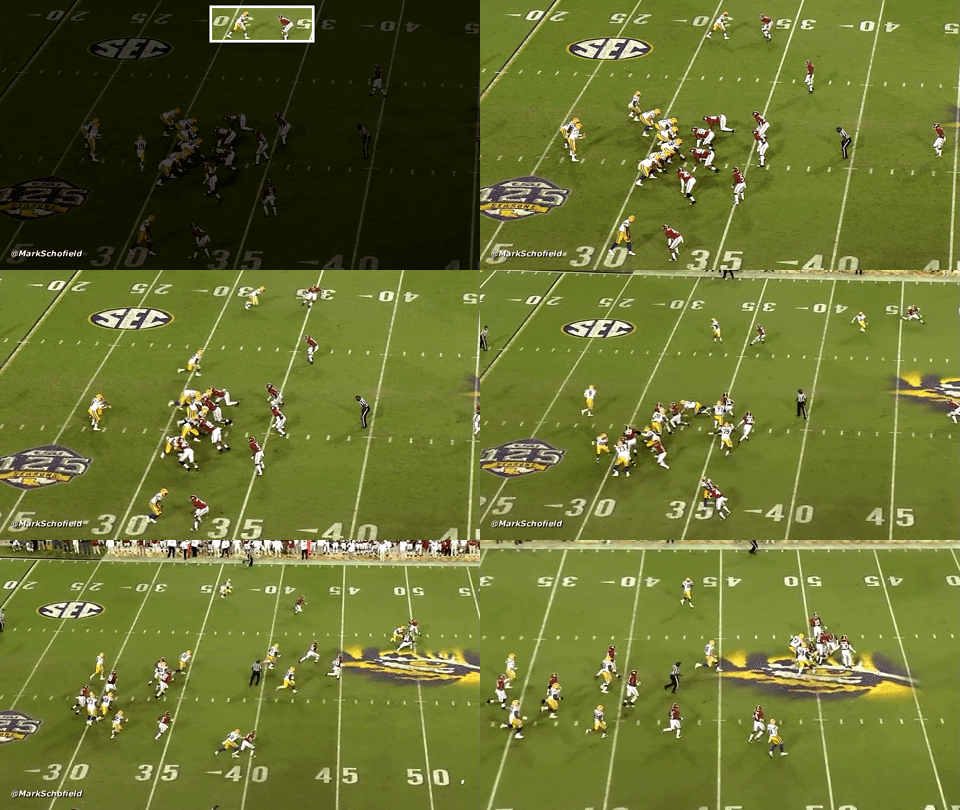
But let’s return to that “Stat to Know” for a second. Back in 2018, when LSU was more of a run-first offense and Jefferson played the majority of his snaps outside, passers had a QB rating of 121.4 when targeting him when he aligned to the boundary. When you watch film of him from 2018 – and expect this to be the subject of a much deeper analysis – you see him doing the things you want from an outside WR.
Like selling the cornerback on the vertical route before snapping inside on a Bang 8 post route from an outside alignment, plus some yardage after the catch in traffic:
Or running a textbook stop route against press alignment:
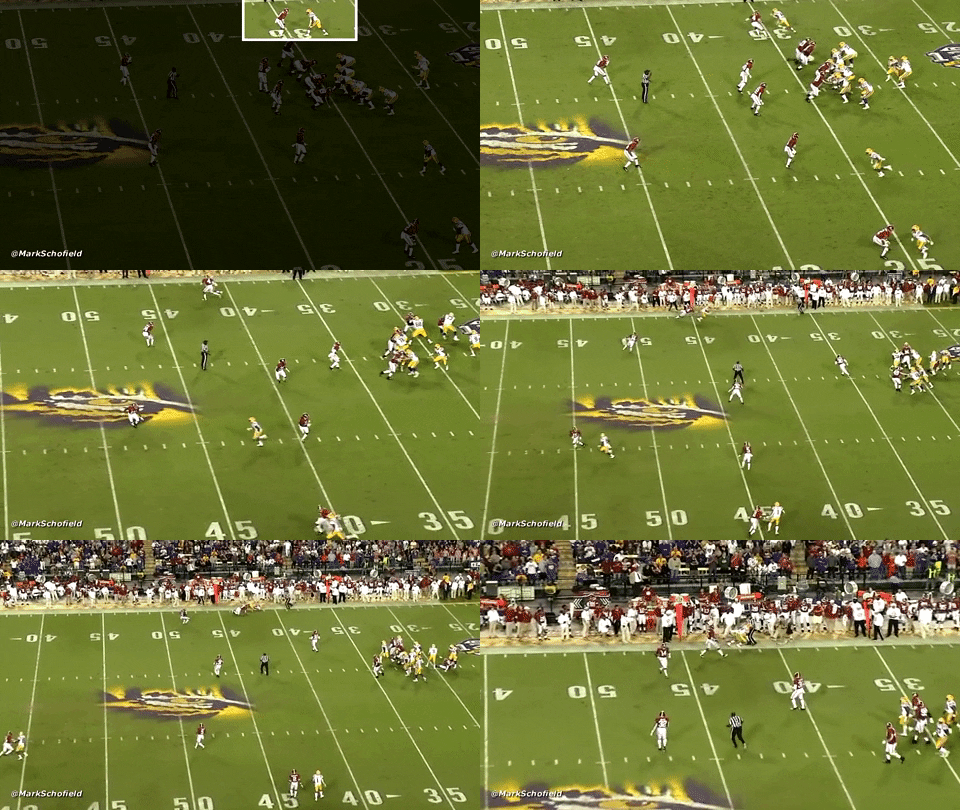
If your concerns about Jefferson are of the “he is a slot receiver only” variety, then if you look at his 2018 film you will see examples of him doing what you want boundary receivers to do, with production numbers to back up his tape.
If there are areas he could clean up, he tends to get knocked off routes at times due to contact, and he might need to add some size to his frame. That could slow him down a bit, making his speed and change-of-direction ability less of an advantage.
Conclusion: Jefferson has two seasons of solid production and tape where he was used in completely different roles. That should work in his favor, but instead many seem willing to view him as purely a slot receiver. Again, he has shown the ability to operate along the boundary and as such, teams should view him as a versatile receiver who can fill multiple spots in a passing game. Sure, he can operate from the slot and has he displayed in 2019, be very effective. But if put along the outside as a Z receiver, Jefferson can also beat press coverage and create separation on his own, without relying on scheme or design. Consider this: Great teams like the New England Patriots often ask the right question when it comes to evaluating pro or college prospects. That question is “What can he do?” Other teams tend to dwell on the negative, and wonder “What can’t he do?” Teams that take the more negative approach with Jefferson and isolate him as purely a slot receiver, are going to regret passing on him.
Comparison: Watching Jefferson I see a lot of JuJu Smith-Schuster. A player who might begin his career inside and may ultimately be best used as a slot receiver, but someone with the skillset to play on the boundary as well.
Lamb | Jeudy | Ruggs III | Shenault | Jefferson | Higgins | Mims | Reagor | Aiyuk | Pittman | Johnson
6. Tee Higgins, Clemson

Height: 6’4″ Weight: 205
40-Yard Dash: N/A
Bench Press: N/A
Vertical Jump: N/A
Broad Jump: N/A
3-Cone Drill: N/A
20-Yard Shuttle: N/A
60-Yard Shuttle: N/A
Bio: Most followers of the college game expected Tee Higgins to stay close to home and play for the University of Tennessee. The Oak Ridge, TN product originally committed to play for the Volunteers, but changed course and announced he was enrolling at Clemson in a well-produced, pyrotechnics-laden announcement video that was posted to Bleacher Report on the Fourth of July.
He played sparingly as a true freshman in 2017, but took on a bigger role each of the past two seasons. In 2018 he caught 59 passes for 936 yards and 12 touchdowns, and last season he caught 59 passes for 1,167 yards – averaging an impressive 19.8 yards per reception – for 13 touchdowns. Higgins is knows for his ability to “play above the rim,” something that we should have expected given what he did on the hardwood at Oak Ridge High School. He averaged 15 points and 6.6 rebounds per game as a junior at Oak Ridge, and led his team to a 20-2 record his final year in high school.
Stat to Know: Higgins is a true weapon in the downfield passing game. He had 565 “deep receiving yards” charted by Pro Football Focus (defined as yards created on throws 20 yards or more in the air), which was eighth-most among receivers in FBS a year ago.
Strengths: Higgins is your prototypical “X” receiver. A player who can win on the outside against press coverage, stress defenses down the field, and win at the catch point and in contested catch situations. If you want an example of how Higgins can still beat defenders with minimal separation, watch this reception against Syracuse from 2019:

Higgins runs a “Circle 7” route, stemming initially to the inside before working back towards the sideline on the diagonal. He handles the press coverage well, working inside the defender and threatening his leverage towards the middle of the field, then breaking back to the corner and high-pointing the ball to come down with the reception. Also note his hands on the release, how he is able to prevent the cornerback from getting into his chest or frame. This is what he displays on film, and those who question how he will handle press coverage in the NFL would be wise to watch this game, as he saw a ton of press from the Syracuse secondary.
For a bigger receiver, Higgins moves well both in his routes and after the catch. He shows the ability to create after the reception, both with his change-of-direction ability and the strength to break tackles. PFF credited him with ten or more broken tackles in each of the past two seasons.
Higgins also has a huge catch radius, as you might have expected from that clip against Syracuse. You see that show up on this three-play clip (which ends with the Syracuse reception):
Higgins also does a good job along the sideline with his feet, and will quickly make the adjustment to the NFL rules of getting both feet down in the field of play. He has confidence in this hands, consistently extending the arms to snatch the football from the sky rather than letting the football get into his frame.
Another thing that Higgins does well is how he handles his nearest defender when he is not involved in the play. He will vary his approach on blocking assignments. Sometimes he will show a route rather than immediately looking to block the cornerback, other times he will quickly stalk and mirror the DB. On a Trevor Lawrence red zone touchdown run against the Orangemen, Higgins even faked a fade route – jumping for the imaginary throw – to keep his defender guessing.
Weaknesses: Higgins was a darling of early draft boards at the WR position, but has faded in the post-season, pre-draft part of the calendar. It began in the National Semifinal Game against Ohio State, when he managed just four receptions for 33 yards in a matchup against Jeff Okudah. Then in the National Championship Game, LSU’s secondary held him to just three receptions for 52 yards.
Then Higgins decided not to run any of the drills at the Combine, waiting for the Clemson Pro Day. What did he do there, where prospects often improve on their numbers with the home field advantage? A 31 inch vertical, a 4.53 20-yard shuttle, a broad jump of 10 feet three inches, and a 4.54 40-yard dash. Not exactly numbers to write home about. That, perhaps coupled with the work Denzel Mims has done before the draft, has many considering Mims as the better “X” receiver option.
However, if you watch those two playoff games, you will still see Higgins beating press coverage at times, enough to make you believe that he can beat press at the next level. His film during the regular season backs up the notion that he can be a good-to-great “X” receiver in the NFL as well. He might need to run crisper routes, and could improve at getting consistent separation, but with what he brings to the table right now, he is a solid prospect.
Conclusion: Teams that need that consistent, ball-winning “X” receiver would be wise to look to Higgins early in the draft. On film he is what you want at the position: Someone who can beat press coverage at the line of scrimmage – and is experienced at doing so against great competition – and can win the football at the catch point and make his quarterback look good in the process. Avoid overthinking the process, trust the tape, and get your QB a new security blanket.
Comparison: Studying Higgins, I see a potential A.J. Green. That might be more of his ceiling, but his vertical ability, ball-winning and movement after the catch is reminiscent of the Cincinnati Bengals standout.
Lamb | Jeudy | Ruggs III | Shenault | Jefferson | Higgins | Mims | Reagor | Aiyuk | Pittman | Johnson
7. Denzel Mims, Baylor

Height: 6’3″ Weight: 207
40-Yard Dash: 4.38 seconds
Bench Press: 16 reps
Vertical Jump: 38.5 inches
Broad Jump: 10 feet 11 inches
3-Cone Drill: 6.66 seconds
20-Yard Shuttle: 4.43 seconds
60-Yard Shuttle: N/A
Bio: We often hear about the dynamic “three-sport athlete” in high school, who chose to focus on the gridiron but could have been an impact athlete in any number of collegiate sports. Denzel Mims is the rare “four-sport athlete,” who lettered in track, basketball, football and baseball. A three-star recruit coming out of Daingerfield High School in Texas, the only big programs to offer him a football scholarship were Texas Tech and Baylor. Mims headed to Waco, and broke out with a huge sophomore season that saw him haul in 61 passes for 1,087 yards and eight touchdowns, averaging 17.8 yards per reception.
He failed to match those numbers as a junior, and his production slid to just 55 catches for 794 yards and eight more TDs. Pro Football Focus charted him with 11 drops on 66 catchable passes, and his hands will be a focus of discussion in a few minutes. But last year Mims rebounded a bit, posting a career-high 66 receptions for 1,015 yards and a career-best 12 touchdowns.
Stat to Know: Issues at the catch point were not isolated to 2018. PFF charted Mims with 18 drops on 139 catchable passes, a 12.9% drop rate.
Strengths: Given his background in basketball and track, it should not be surprised that Mims is an explosive receiver who can make the spectacular catch look routine, and often goes up to get the football on passes that seem destined to be overthrows or land near the cheerleaders. Mims is an expert at the back shoulder catch, and is adept at adjusting to throws downfield either by twisting his body towards the sideline, or tracking the football down over his shoulder.
Mims is also a tough receiver, willing to work over the middle of the field and make the tough catch in traffic.
As a route-runner, he flashes good pace with his releases, and does a decent job at setting defenders up for double moves or sudden breaks. He is also a savvy player when the ball is in the air who will use his off arm to maintain space, while not doing enough to draw a flag for pass interference. Mims also has great feel for getting “into the blind spot” of a cornerback, before making a cut or releasing vertically. In the red zone, his catch radius and ability to play above the rim truly stands out.
Additionally, books might be written about his pre-draft process. After Baylor’s bowl game Mims headed to Mobile for the Senior Bowl and looked like the best receiver down in Alabama. He showed a great connection with quarterback Jalen Hurts and looked every bit the part of an NFL deep threat. Then Mims went to Indianapolis and made Lucas Oil Field his playground. His testing at the Combine truly turned heads, and his eventual draft position will be largely influenced with how he handled his opportunities leading up to the draft. If you consider that teams want to see how prospects take care of business on their own during this part of the calendar, Mims truly aced this portion of the test.
Weaknesses: Mims ran a limited route tree at Baylor. The routes he did run, such a curls, hitches, go routes and slants, he ran well, but the team that drafts him will need to ease him into the entire playbook. He also is limited after the catch, and averaged just 2.8 yards after the catch last season according to PFF, which tied him for 318th among collegiate receivers. If you are looking for a threat in the screen game, hopefully you are looking for a blocker. Mims had just one – yes one – screen reception last year and was held to no gain. More often Baylor would use him as the blocker on screen plays, which is a job he can handle. Then there is the drop issue. Mims had seven drops in 2019, and there are moments when he will drop the easy throw, such as a slant route, and will then make a spectacular catch. Some, such as Benjamin Solak from The Draft Network, have posited that it is a concentration issue with Mims: “Drops come when he gets lazy – doesn’t reach full extension, claps as he looks to turn upfield too early, or is running a shallow cross or slant or something similarly boring.” This is an issue of concern to watch as he transitions to the NFL.
Conclusion: Ultimately, Mims has the kind of raw traits, athleticism, and yes pre-draft process that is going to attract teams in a few weeks. His potential is a huge positive working in his favor, and he enters the draft on a huge upswing given what he did down in Mobile and at the Combine. He will need to expand his route diversity, and the drops are an issue he will need to contend with, but players of his size and explosiveness are not exactly a dime a dozen. You can see him taking on a rotational role immediately at either X or even the “Z” receiver spot, depending on the offense, and as he develops more diversity to his routes he can become that featured wideout by his second season.
Comparison: We can go old school here and talk about Willie Gault. Mims is a few inches taller, but both were track stars who became vertical threats in the NFL. Gault was a feared player down the field, keeping defenses honest while also dealing with the running game led by Walter Payton. Putting Mims on a play-action heavy team, like perhaps Baltimore, would be a nightmare for opposing defenses.
Lamb | Jeudy | Ruggs III | Shenault | Jefferson | Higgins | Mims | Reagor | Aiyuk | Pittman | Johnson
8. Jalen Reagor, TCU

Height: 5’11″ Weight: 206
40-Yard Dash: 4.47 seconds
Bench Press: 17 reps
Vertical Jump: 42 inches
Broad Jump: 11 feet 6 inches
3-Cone Drill: 7.31 seconds
20-Yard Shuttle: 4.46 seconds
60-Yard Shuttle: N/A
Bio: Jalen Reagor was a track and football star in high school, graded as a four-star recruit coming out of Waxahachie High School in Texas. He originally committed to Oklahoma, but flipped after taking a visit to TCU. Reagor could have enrolled early at TCU, but stayed in high school to finish his senior track season. He might be glad he did, as he posted a 24’5″ long jump to win gold at the Texas University Interscholastic Track League track meet in May of 2017.
Reagor was an immediate contributor at TCU. As a true freshman he caught 33 passes for 576 yards and eight touchdowns, averaging 17.5 yards per reception. His sophomore year was his best in college, as he posted 71 receptions on 131 targets for 1,040 yards and nine touchdowns, all of which would be career-high marks. Last season saw his production drop precipitously, as he caught just 43 passes for 611 yards and five touchdowns. A good deal of that, however, can be attributed to poor quarterback play. Pro Football Focus charted TCU passers with accurate throws on just 30.7% of Reagor’s targets in 2019.
Stat to Know: Over the past two seasons — and over the past 219 targets — Reagor had just 11 dropped passes.
Strengths: We often focus on the scheme fit when it comes to evaluating quarterbacks for the draft. But that should also be a consideration when studying wide receivers. Teams running more of a West Coast offense would be wise to pay particular attention to Reagon. He has great footwork at the line of scrimmage and quick feet on routes in the short- and intermediate-areas of the field, making him perhaps an ideal fit for a West Coast scheme. Reagor aligned almost exclusively along the right sideline, meaning he faced press coverage enough to get a sense of how he will make the transition to the league. He relies on a hesitation/stutter-step move to beat the press with his quick feet, and it has worked consistently for him at the college game. He shows great burst after the catch, and can be deadly on crossers and slants. West Coast offenses are built around yardage after the catch, and Reagor definitely checks that box.
Despite a profile that projects best to a West Coast offense, Reagor can also be dangerous in the vertical passing game. On this play against Texas he runs a double-move route against a Tampa 2 defense, and with solid quarterback play this should have been a huge gain for the Horned Frogs:
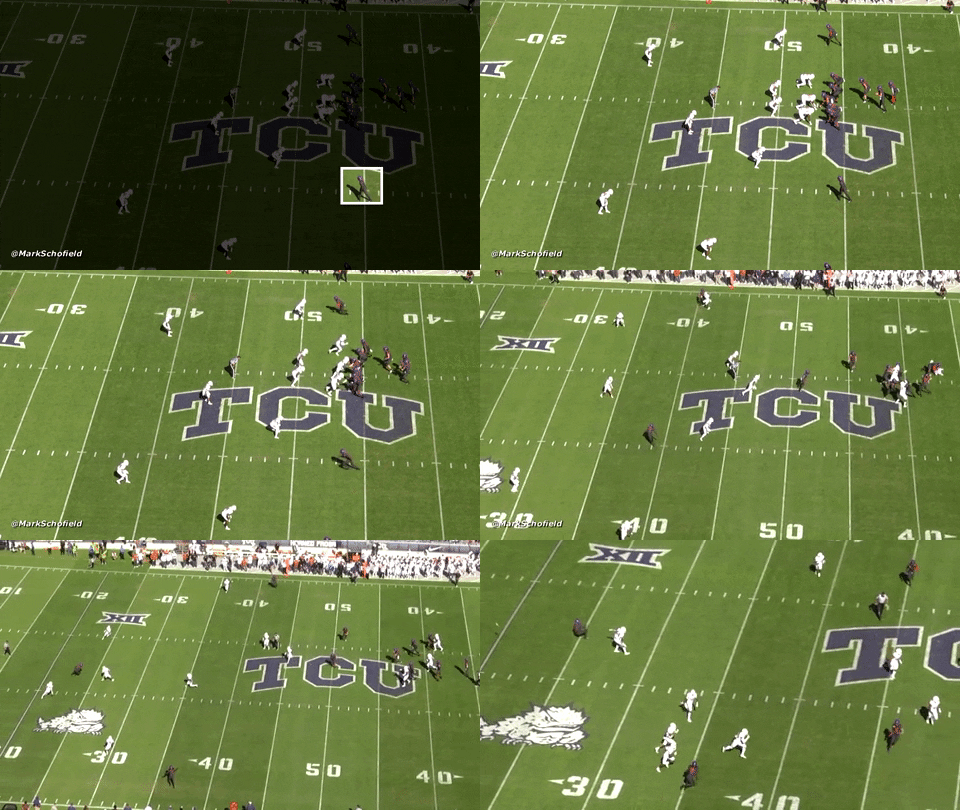
The Longhorns drop their middle of the field defender into a huge cushion, well off the line of scrimmage. Reagor shows that defender a route in front of him, and gets the player to squat on the potential shorter route. Then you see that explosive burst from the WR, getting over the top of that defender and erasing that huge pre-snap cushion.
You also see an example of how poor quarterback play limited his opportunities.
As Reagor’s results from the Combine indicate, he is an explosive athlete with elite change-of-direction and quickness. Both his broad jump and his vertical leap were in the upper echelon of prospects, and his 40-yard dash of 4.47, while actually disappointing in a sense given what he showed on film and in other tests, is plenty fast enough for the next level, at all areas of the field.
Weaknesses: While he had just the 11 drops over the past two seasons, there are moments on film when you see mistakes either due to a lack of concentration or focus. He had a drop on a wide-open out pattern early in TCU’s game against Oklahoma that was a good throw that he let slip right through his hands. His overall body of work is impressive in this area, but it is something to mention.
While he consistently worked against press and was able to win at the line of scrimmage with his hesitation/stutter-step move, NFL cornerbacks will figure that out eventually. He’ll need to develop a few more releases to switch up his approach, otherwise he’ll become a one-note wonder against tight coverage.
Something else to watch is the lack of production in the short- and intermediate-areas of the field last season. Again, this could be impacted by the quarterback play for TCU, but on throws of 0-9 yards last season Reagor had just 15 receptions (on 24 targets) and a passer rating when targeted of 61.1. Furthermore, his PFF grade on those throws was just 66.5, which tied him for 165th in FBS last season. (With the usual caveats about grading being more of a subjective exercise of course). On throws of 10-19 yards downfield, the numbers were not much better. Reagor had just eight receptions on 25 targets, for a passer rating of just 43.3 when targeted and a PFF grade of just 62.1. Considering that the bulk of NFL offenses are run in these areas of the field, it is worth mentioning. Again, part of that is due to the QB play, but those grades are worrisome.
Conclusion: The team that drafts him will likely look to his 2018 film, when he was a dominant player, and be calmed by what he showed as a sophomore. Reagor was in many respects the same player last season, but the production dropoff, coupled with some of his drops, creates something to consider. But for teams that run more of a West Coast offense, Reagor is perhaps an ideal target, either at the the back of the first round or sometime early on Day Two.
Comparison: Reagor is similar in play style to Nelson Agholor, when he was coming out of USC. Fans of the team that drafts him will hope his issues at the catch point do not continue into the league, like Agholor endured last season.
Lamb | Jeudy | Ruggs III | Shenault | Jefferson | Higgins | Mims | Reagor | Aiyuk | Pittman | Johnson
9. Brandon Aiyuk, Arizona State

Height: 6’0″ Weight: 205
40-Yard Dash: 4.5 seconds
Bench Press: 11 reps
Vertical Jump: 40 inches
Broad Jump: 10 feet 8 inches
3-Cone Drill: N/A
20-Yard Shuttle: N/A
60-Yard Shuttle: N/A
Bio: Brandon Aiyuk went the Junior College route, enrolling at California’s Sierra College after high school. During his two years in JUCO, he totaled 2,499 all-purpose yards, and 21 touchdowns. His prowess while at Sierra brought the big programs to campus, and Aiyuk spurred offers from Alabama, Tennessee and Kansas to play for the Sun Devils. His decision was influenced heavily by the fact that only Arizona State wanted him to play at wide receiver.
Aiyuk stepped right into the starting lineup, catching 33 passes for 474 yards and three touchdowns his first season in the desert. Last year he became more of a focal point in the ASU offense, and he caught 65 passes on 99 targets for 1,192 yards and eight touchdowns, averaging an impressive 18.3 yards per reception.
Stat to Know: Aiyuk is a monster after the catch. He averaged 10.9 yards after the reception in 2019, placing him sixth in FBS in that category.
Strengths: Home run hitters at the wide receiver position come in different forms. Some are the vertical threats, like Denzel Mims. Others work underneath but can take plays to the house with their explosiveness and speed, such as Henry Ruggs III. Aiyuk is a combination of both. He is a threat in the vertical passing game, as he tallied 384 yards on throws over 20 yards last season – 38th most in college football – on just 19 deep targets. But he can also turn those short routes into huge gains. Aiyuk is explosive off the line of scrimmage and maintains that speed into and out of his breaks, and through the catch point. Watch how he maintains his speed through the catch on this long touchdown against Washington State:
His explosiveness allows teams to involve him in the screen game as well as a runner. Jet sweeps are a way to get him involved in the offense, and on screens you see his burst and the immediate transition from receiver to runner after the catch. Pro Football Focus charted him with 241 yards last season on screen plays, eighth-most in college football.
Aiyuk can also be an immediate contributor on special teams, in the kick and punt return game. While that has been minimzed over the past few seasons in the NFL through rule changes, he can still change field position in a flash if given the chance. Last year he averaged 34 yards per kick return, and 16.1 yards per punt return. A few fewer first downs that the offense needs to pick up on the ensuing drive.
Weaknesses: Aiyuk seems to lack the confidence in his hands that other prospects in this class display on film. He lets a number of throws into his frame, and often looks more of a “body catcher” than anything else. That has translated into a lack of consistency at the catch point and on contested catch situations. His catch radius could be better, given his massive wingspan (Aiyuk measured in with a six foot, eight inch wingspan, impressive for someone six feet tall). There were times when he failed to bring in throws outside of his frame, which again points to the lack of confidence in his hands. Some might wonder at his lack of production his first year at ASU, and why he did not cut more into N’Keal Harry’s numbers in 2018. But I think his production in 2019 speaks for itself in that regard.
Conclusion: What Aiyuk brings to the table is impressive. His explosiveness off the line of scrimmage coupled with his ability to take any route to the house makes him an enticing prospect at the position. However, the first job of a receiver is to catch the football, and his inconsistency in that regard might give teams pause. Even with those issues, Aiyuk is still a scheme diverse receiver who can contribute immediately given his burst and ability after the catch, as he fine-tunes the craft of playing the position in the NFL.
Comparison: To ask Aiyuk himself, the comparison is Odell Beckham Jr. The prospect made that claim earlier this draft season. You can also see some Chris Godwin to his game, that comparison was suggested to me by Joe Ferraiola, a former colleague of mine at Inside the Pylon.
Lamb | Jeudy | Ruggs III | Shenault | Jefferson | Higgins | Mims | Reagor | Aiyuk | Pittman | Johnson
10. Michael Pittman Jr., USC

Height: 6’4″ Weight: 223
40-Yard Dash: 4.52 seconds
Bench Press: 13 reps
Vertical Jump: 36.5 inches
Broad Jump: 10 feet 1 inche
3-Cone Drill: 6.96 seconds
20-Yard Shuttle: 4.14 seconds
60-Yard Shuttle: N/A
Bio: With an NFL lineage and a strong high school resume, Michael Pittman Jr. was a highly-recruited prospect coming out of Oaks Christian. He was named to the Parade All-American first team as a senior, and was a stellar wide receiver, safety and returner in high school. He enrolled at USC, despite offers from schools like Arizona State, California, Nebraska, Notre Dame, Oregon, Oregon State, Notre Dame, UCLA, Washington and Washington State, to name a few.
It took a while for Pittman to contribute in the Trojans’ offense, but in 2017 he did manage to catch 23 passes on 36 targets for 404 yards and a pair of touchdowns, showing something of a connection with Sam Darnold in the USC offense. As a junior his production really improved, as he caught 41 passes for 75 yards and six touchdowns, averaging 18.4 yards per reception, which stands as his career-high. Last year was a huge season for him, with 101 receptions for 1,269 yards and eleven touchdowns.
Stat to Know: Five. That is the number of drops that Pro Football Focus charted him with on the 176 catchable passes thrown his way during his time at USC. An impressively small number of drops.
Strengths: Building off the previous point, Pittman attacks the football in flight and has no fear when it comes to his hands. He high points the football well, he adjusts to the football in flight well, and he is skilled at the back shoulder game. He shows good footwork against press coverage, and he is a varied receiver in the sense that USC aligned him both inside and outside.
Pittman might lack elite speed, but his breaks are violent and he manages to get separation despite having a reputation as a true burner. If you watch him on routes that work back down the stem, such as curls or comebacks, you will see how well he sinks his hips into the break and violently works back towards his passer, creating a huge gap between him and the nearest defender.
Pittman is not known as a vertical threat, perhaps due to his lack of elite long speed, but he does a good job at tracking the football downfield and creating space between himself and the nearest defender while giving his quarterback room to place vertical throws along the sideline. This downfield reception against Utah is a prime example:
The job Pittman does here of using his hands to fight through the contact, and then using his shoulder to create space while tracking the football, is high-level play. Plus, watch how he maintains his landmark on the field, working up the “bottom of the numbers” to give his quarterback space to drop this throw in towards the boundary. This is how receivers that lack “elite” speed can be vertical threats in the downfield passing game.
In fact, Pittman’s game against Utah is a must-watch if you are interested in scouting a wide receiver. Watch how he tracks and wins this football at its high point in front of the nearest safety:
That is a ball-winner.
Jordan Reid, a lead analyst for The Draft Network, put together this quick cutup of what Pittman did against Utah and it is worth the time:
Weaknesses: There are a few things to highlight with Pittman on the negative side of the ledger. He does not offer a ton after the catch, at least not yet. He has broken just 20 tackles on his 17 career catches, and last season averaged just 4.8 yards after the catch, tying him for 196th in college football. He also aligned almost exclusively on the left side of the formation last year, which will make him need to learn and adjust to be more flexible in the NFL. He also could stand to work a bit more when the initial route is not open, or his quarterback is forced to scramble. There were times on film when he would just stop his route, and not work to get into the quarterback’s field of vision or find open space against the coverage.
Conclusion: The bottom line is that Pittman does a number of things extremely well, which will make teams like him in the draft. He is a versatile receiver who can function in a number of different schemes, and his ability to use his frame as a receiver to create space coupled with what he displayed on short- and intermediate-area routes makes him a solid prospect. He seems to be moving up draft boards as this process lingers, and do not be surprised to see him drafted earlier than you might expect.
Comparison: Pro Football Focus compared him to Alshon Jeffery in their draft guide, and the comparison is apt. I also see a lot of Allen Robinson in his game. A receiver who is at his best working the short- and intermediate-areas of the field with his size and frame, but is also skilled enough to be a vertical threat despite track star speed.
Lamb | Jeudy | Ruggs III | Shenault | Jefferson | Higgins | Mims | Reagor | Aiyuk | Pittman | Johnson
11. Tyler Johnson, Minnesota

Height: 6’2″ Weight: 200
40-Yard Dash: N/A
Bench Press: N/A
Vertical Jump: N/A
Broad Jump:N/A
3-Cone Drill: N/A
20-Yard Shuttle: N/A
60-Yard Shuttle: N/A
Bio: Tyler Johnson was a quarterback and defensive back for Minneapolis North High School, who threw for 2,606 yards and 36 touchdowns as a senior, while also adding 1,110 yards and 20 touchdowns on the ground. He was recruited by a number of Big Ten schools including Iowa and Iowa State, but stayed home to play for the Golden Gophers. He moved to wide receiver for college, and was a dominant force in the Minnesota passing game the past two seasons. Last year alone he caught 87 passes on 119 targets for 1,317 yards and 13 touchdowns, averaging 15.1 yards per reception. He saved perhaps his best game for last, catching 12 passes for 204 yards and two touchdowns against Auburn in the Outback Bowl, in a game where he was matched up against Tigers’ cornerback Noah Igbinoghene, a defensive back who has an outside shot at being a first-round selection.
Stat to Know: While he does a number of things well, Johnson struggles with drops. Pro Football Focus charted him with 24 drops on 238 catchable throws over his college career, not the best percentage.
Strengths: Johnson is one of the better route runners in this class, with great footwork and fluid movement into and out of his breaks. Having worked out of the slot and on the outside, he has a versatile skillset that he will bring to his first NFL training camp. Given his experience playing along the boundary, Johnson is well versed at handling press coverage, and he has the movement skills and the upper body strength to play through contact at the line and work off defenders using tight man coverage after the snap.
Johnson also attacks the football well, which minimizes the issue with his drops. He understands leverage well, and shows on film the ability to threaten the leveraged shoulder of the defender and then using a great feel for timing breaking off the defender at the opportune moment. This is a great example of Johnson doing just that from the 2018 season on a slant route:
See how Johnson threatens the outside shoulder, selling the CB on a fade route? Once the receiver sees that the cornerback has bought the vertical release, he then cuts across his face on the slant route, and the defender is helpless to prevent the touchdown.
He is also a threat in contested catch situations, as well as down in the red zone on fade routes. On this red zone fade against Purdue, he again threatens the opposite shoulder, attacking inside to sell the slant before breaking vertically on the fade:
Johnson also does a good job at tracking the football over his shoulder in the vertical passing game. On this fade route from the slot against Northwestern, he manages to track the football down as it leads him towards the sideline, but he also has the presence of mind to get the feet in bounds, showing great awareness:
Some receivers just have a way of making things work, and Johnson is in that category.
Weaknesses: Where to begin? We can start with the athleticism. Johnson does not have top-end speed, and that shows up on film. Yes, as we illustrated he still has ways of getting open thanks to his route-running, but NFL DBs are much more experienced than the players he was facing in college, and his moves and releases at the line of scrimmage might not always work.
Then there are the drops. Given how well he attacks the football, he consistently gives him a chance at getting the football into his hands, but he will need to show a higher level of concentration at the catch point in the NFL.
Finally, while books might be written about Denzel Mims’ pre-draft process, Johnson’s might be a Maverick-style lesson in “what not to do.” He was initially given an invitation to the East-West Shrine Game, and with a good week down in Florida he could have parlayed that into a Senior Bowl invitation. But Johnson said he pulled out of the Shrine Game to prepare for the Combine.
But then in Indianapolis, he said he would participate in positional drills and team meetings only, and save his testing for his Pro Day.
Which was then canceled due to the COVID-19 crisis.
Without testing data on him, teams might be wary about drafting him, even with what he showed on film. When you add that to some rumblings about “poor character reports” as mentioned here by Bleacher Report’s Matt Miller, you start to wonder about how teams are going to feel about him.
Conclusion: In the end, Johnson is an elite route-runner who can separate from coverage thanks to his savvy and his understanding of how to press leverage advantages. What he does, he does well, and he can contribute immediately thanks to what he can do to get separation from press coverage. But in a strange global climate, without much data to go on from a testing and measurables standpoint, teams might be wary. When you add to that how he handled the process, risk averse decision-makers (i.e., the vast majority of NFL general managers) might look elsewhere.
Comparison: Johnson’s route-running ability is similar to what we saw from Anthony Miller coming out of college. You can see the ability to threaten leverage of the defender, the ability to set up routes well, and the ability to play inside or outside.
Lamb | Jeudy | Ruggs III | Shenault | Jefferson | Higgins | Mims | Reagor | Aiyuk | Pittman | Johnson
After 10 years practicing law in the Washington, D.C., area, Mark Schofield now dedicates his time to his first love: football. The former Wesleyan University quarterback’s writing has been featured in The Washington Post, Bleacher Report, SB Nation, Pro Football Weekly and the Matt Waldman Rookie Scouting Portfolio.