
To paraphrase an idea from the world of politics, do not tell me what you value at a position. Show me your top prospects at a position and I’ll tell you what you value at the position.
We can apply that idea to this list of top linebacker prospects. Look through these names and you will see what I value at the position: Athleticism, the ability to play in space, the fit in the modern NFL, the potential to defend the pass, and the likelihood of being a three-down player.
The players we grew up immortalizing, such as the Mike Singletarys of the world, are a throwback to a different time. An era when “three yards and a cloud of dust” was the rule, not the exception. To be a complete linebacker in today’s NFL you have to be able to stop the run on first down, and run with a seam route on third down. If you cannot do both, you are not going early in the draft. As such, the players with that ability – or at least potential – are getting the nod on lists like this.
So how do these players shake out?
1. Isaiah Simmons, Clemson

Height: 6’4″ Weight: 238
40-Yard Dash: 4.39 seconds
Bench Press: N/A
Vertical Jump: 39 inches
Broad Jump: 11 feet
3-Cone Drill: N/A
20-Yard Shuttle: N/A
60-Yard Shuttle: N/A
Bio: Isaiah Simmons was a two-sport athlete for Olathe North High School in Olathe, Kansas. Simmons was a wide receiver and a defensive back on the football team, and a long jumper for the track-and-field team. Simmons was the state champion in the long jump in both 2014 and 2015, and his career-bests jump was 23’8″. But as a three-star prospect on the gridiron, he committed to Clemson over Michigan, Nebraska and Missouri. He started his career for the Tigers in 2017, playing primarily as a safety. In 2018 Simmons spent most of his time in the slot, and according to Pro Football Focus he fared well, as they graded him with an overall grade of 88.9 playing as a slot cornerback.
Last year, Simmons did it all. He played 100 or more snaps at edge defender, linebacker, strong safety, free safety and slot cornerback. On film, he excelled at every single position.
Stat to Know: Simmons is extremely disruptive at the catch point. He forced eight incompletions, tying him for the top number among linebackers last season.
Strengths: Where to begin? Simmons has the athleticism to cover wide receivers both out of the slot and on the outside. He has the awareness to make plays in space at all levels of the field. He has the size and length to erase tight ends in the passing game. Simmons was built to play defense in the modern NFL. It does not take long to see how he can impact a game. Take the National Championship Game against LSU. Right at the outset, he blitzes off edge on the first play of the game, chases Joe Burrow all over the field and keeps him (as best as he can) in the pocket. Second play of the game, covers Thaddeus Moss on a stick route, plays off him, breaks perfectly on the route for a pass breakup, and he reads the route concept perfectly. He plays sideline-to-sideline against the pass and the run. If you are running a route near him and he can get to you, he is going to put you on your backside with a jam (ask Moss about that). He can play as a half-field safety and break downhill on plays in front of him. He can run stride-for-stride with Justin Jefferson on a crossing route in the red zone.
Simmons can do everything asked of him on the football field.
Some might wonder about his ability to defend the run as a more traditional linebacker. The film shows a player who handles his responsibilities and assignments the right way. For example against Wofford he was tasked with handling the pitch man on speed option plays, and he did that assignment perfectly. So if you ask him to align at middle linebacker and fit into a gap against the run, he will do that too.
Where he does truly stand out is what he can do against the passing game. Given his experience at both safety and slot cornerback, everything feels natural for him. He can play off coverage over receivers, tight ends and running backs and click-and-close to the catch point like a cornerback. When in zone coverage he knows just how long to stick on a route before passing it off to the next defender. While he can play a single- or two-deep safety role, he can also play in the middle of a Tampa 2 in that underneath hole spot and erase tight ends.
Perhaps my favorite play of his is this one from the National Championship Game:
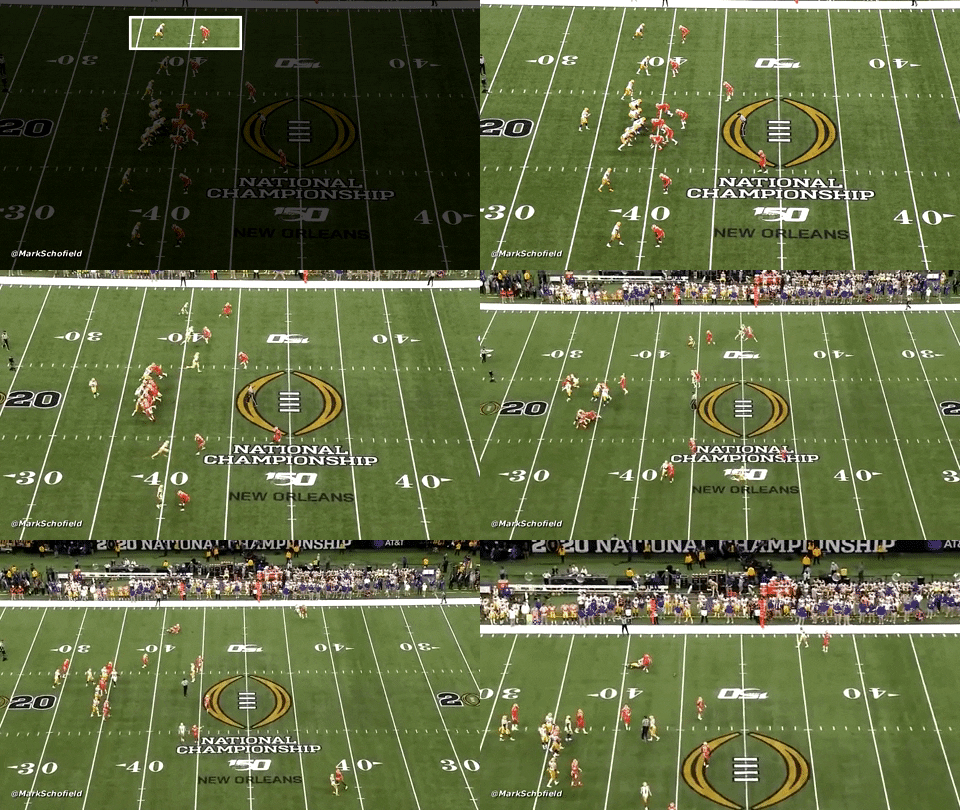
Simmons aligns along the boundary across from running back Clyde Edward-Helarie. He backpedals off the snap and recognizes the route concept, a smash-fade design with the running back running a hitch route and the slot receiver releasing vertically on a fade route. Simmons, despite the rub element to this concept, does not panic. Instead he slides down over the hitch while keeping an eye on Burrow, and when the QB throws the hitch route the defender is in perfect position to break up the throw at the catch point.
Weaknesses: For a player like this, we need to handle the weaknesses section a little differently.
The fear with Simmons is that an NFL team tries to pigeon-hole into a specific role. Whether as a “linebacker” or a “safety,” and by doing so eliminates the versatility and athleticism that Simmons offers on the defensive side of the football. If he is artifically hamstrung by old school minds on his NFL coaching staff, that will reduce much of what he offers. So the hope is that Simmons lands with a forward-thinking defensive mind who employs him more as a matchup weapon than anything else.
Now yes, there are parts of what he has done over the past few years that require a bit of projection. He played in a defense that was predominantly a 3-1-7 defense, and it is unlikely his NFL home is going to copy what Brent Venables put together for Clemson. So projecting him as an off-ball player fitting gaps against the run is a bit of an unknown. But again, asking him to be that kind of player is just overthinking what he can be in the NFL.
So the weakness is really just a lack of imagination from his NFL coaching staff.
Conclusion: The bottom line is that Isaiah Simmons is a defensive specialist that you can employ virtually anywhere on the field. You can see him rush the passer off the edge on first down, lock down a tight end on second down, and run with a slot receiver on third down. He can play a single-high safety look, or as a half-field safety, or even at boundary corner if necessary. His best “traditional” NFL role might be as a middle linebacker in a heavy Tampa-2 defense. He could be the modern version of Derrick Brooks in that role, running with tight ends and slot receivers, but in today’s game there is so much more that he can do. Draft him and just start dreaming of different ways to employ him.
Comparision: Captain America. Iron Man. Superman. Black Panther. Thor. Basically pick a superhero and that is Isaiah Simmons. Except Batman. He was a rich guy who bought a ton of toys. That is my hot take for the day.
2. Patrick Queen, LSU

Height: 6’0″ Weight: 229
40-Yard Dash: 4.5 seconds
Bench Press: 18 reps
Vertical Jump: 35 inches
Broad Jump: 10 feet 5 inches
3-Cone Drill: N/A
20-Yard Shuttle: N/A
60-Yard Shuttle: N/A
Bio: Patrick Queen was a four-star recruit coming out of Livonia High School in Livonia, Louisiana. He played both linebacker and running back, and ran for over 1,400 yards and 19 touchdowns as a senior along with 66 tackles and six passes defended. He was given offers from schools such as Indiana, Nebraska and Tulane, but chose to stay in-state and play for the Tigers.
Queen did not crack the starting lineup until three games into the 2019 season, but instantly became a core component of LSU’s defense. He notched 67 tackles this season, along with a single interception. But that interception came at a critical moment, as Queen picked off Tua Tagovailoa shortly before halftime of the huge LSU-Alabama tilt, leading to an LSU touchdown in the closing seconds of the first half.
Stat to Know: Last season, Queen played 702 snaps in the box, 41 in the slot, 25 on the defensive line, four at outside cornerback, and seven at free safety.
Strengths: Queen displays fantastic explosiveness to all levels of the field. Once he makes his read on a play he bursts like a shot out of a cannon. He flashes pure sideline-to-sideline ability and athleticism, both against the run and in coverage. Pass coverage is his strength as a linebacker. He has a good understanding of route concepts and has a great internal clock for zone coverage situations. He knows exactly when to peel off a receiver and break on the next threat. Queen gets good depth on his backpedal when tasked with dropping into a deeper zone or into a Tampa 2 intermediate hook zone.
Against the run he is more than willing to fit his gap, take on blockers and shed them at the point of attack. He can track and scrape down the line of scrimmage well, as he does on this play against the Clemson Tigers in the National Championship Game:
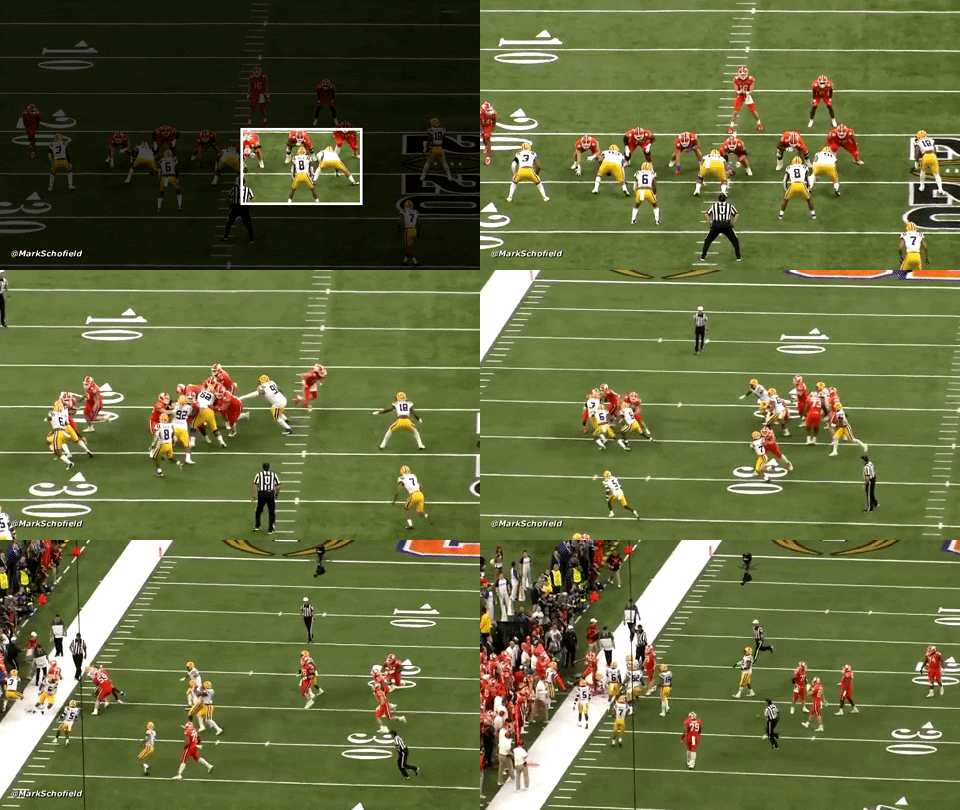
Queen slides down the line of scrimmage perfectly under control, and by filling the hole he forces the running back to try and bounce this run into the boundary. When the RB runs out of real estate, Queen closes the gap and slams into him, driving him to the turf and out of bounds for no gain.
Queen is impressive playing down in traffic. He does a good job at sifting through the bodies in front of him, finding the ball-carrier, and putting him to the turf. When tasked with blitzing or stunting he is equally adept at slicing through the traffic and getting into the pocket.
His athleticism shines in a few different ways. He was able to chase down speedy Alabama wide receiver Jaylen Waddle on a jet sweep early in LSU’s win over the Crimson Tide, but he also shows good change-of-direction ability in the open field when running with receivers or tracking ball-carriers in space. His footwork when dropping into zones is more reminiscent of a cornerback than a linebacker.
Weaknesses: Queen is built more like a safety than a linebacker, and that does cause some problems. He can get swallowed up by offensive linemen at times and struggle to disengage. He sometimes tries to load up in space and deliver a shot, and that can lead to missed tackles. In the National Championship Game he tried to bring the wood to Trevor Lawrence in the open field, dropped his eyes, and caught nothing but turf as the Clemson QB danced by him. Queen also can take some poor angles in pursuit, and while sometimes his athleticism keeps him in position to make a play, sometimes it does not.
Conclusion: Similar to Isaiah Simmons, for where the game is trending Queen seems like the perfect linebacker. A decade or so ago he would be viewed as more of a strong safety, but with the prevalence of sub packages and athletic linebackers in today’s NFL Queen is perhaps the prototype at the position. His ability in coverage, in both zone and man situations, makes him a three-down linebacker. But it is his ability against the run that will make defensive coordinators value him highly. He needs to perhaps show more awareness against play-action, but for the most part, he is as solid as it gets.
Comparison: Over at NFL.com, Lance Zierlein brought out the Thomas Davis comparison, and it is hard to come up with a better answer to this question.
3. Troy Dye, Oregon

Height: 6’4″ Weight: 224
40-Yard Dash: N/A
Bench Press: N/A
Vertical Jump: N/A
Broad Jump: N/A
3-Cone Drill: N/A
20-Yard Shuttle: N/A
60-Yard Shuttle: N/A
Bio: Troy Dye was a three-star safety recruit coming out of Norco High School in Norco, California. Only a handful of schools expressed interest in him, mostly Pac-12 schools like Colorado and Washington State. He decided to enroll early with Oregon in January 2016, and has been a force on the Ducks’ defense ever since. He has played over 700 defensive snaps in all four of his seasons in Oregon, notching 386 career tackles during his time on campus.
Stat to Know: Dye was a stud, plain and simple, in 2018. He played 926 snaps, a career-high, and tallied 92 total tackles.
Strengths: During each draft cycle there are players that you watch on tape, and at a point you know just who they are as a prospect. But yet you keep watching, because the experience of studying them and seeing what they can do is too enjoyable to end. That was my experience with Dye. His experience comes through on every single play. He is always patient and focused, and does not over-react to misdirection plays, play-action designs, or really anything. He led off his season by staying patient on a misdirection design from Auburn, stacking and shedding a pulling guard in space, and making a tackle on a misdirection jet sweep.
His entire season was like that.
Some might point to what he does against the run – at his size – and find problems. But I am of a different mindset. I think Dye can handle the run defense responsibilities just as well as any other linebacker in this group. He is solid with his run fits. He is strong enough to play lead blockers/pullers/trappers to a stalemate in the hole and then scrape off them at the right time to make the tackle. Dye has a great feel for navigating traffic at the line of scrimmage against the run, getting to the ball carrier and making tackles at or near the line of scrimmage.
I mean, are we really concerned about what he can do against the run when he makes plays like this:
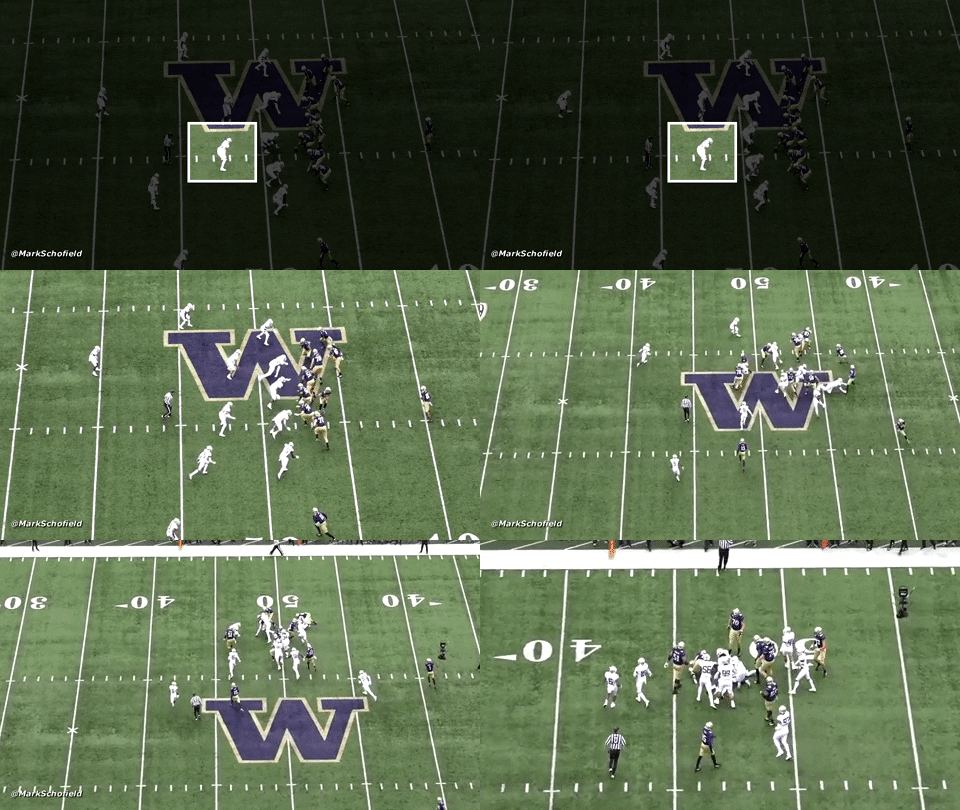
As I wrote in my notes, “[a]re we really worried about him against the run when he can evade, seek and destroy like this working down the line of scrimmage?” He evades a pair of blockers and still gets to the football, stopping this for a minimal gain from the backside.
Dye does some of his best work in the coverage game. Again, his level of experience helps him a great deal in this aspect of the position. He has good feel for zone coverage situations, always peeling off at the right time and not getting baited by routes in front of his face when he knows there is likely something a bit deeper that is more of a threat. He had a great play against Hunter Bryant at the catch point, breaking back to help on a crossing route and raking up through the pocket like a cornerback taught by Matt Patricia. (You can watch Patricia’s clinic presentation on defense for a deeper understanding of this point). He gets jams on defenders if they come through his zone, and reads route concepts extremely well. Dye also has the athleticism to run with most routes and with most receivers and tight ends he is tasked with covering.
When tasked with blitzing, he does so without any care for his physical well-being. He will take on blockers and run through them, he will throw himself at the quarterback if he has to, but he is going to disrupt the pocket.
Weaknesses: Again, others view what he does against the run as a liability, but I am higher on him in that part of the game. He could be a better tackler in space, he gave up a touchdown on a speed option play against Washington when he missed the tackle on the running back. Simmons and others might have more athleticism, but he makes up for a lack of burst and explosiveness with how he reads and reacts to plays as they unfold.
Conclusion: Again, my thoughts on the future of the position were laid out at the start. With where offenses are trending, I value athleticism at the position more than how people traditionally view the linebacker position, and the rankings reflect that. That being said, Dye was one of the true joys I have had this draft cycle, studying him on film and seeing what he can do. He is a modern NFL linebacker, built for today’s game. But he also has the heart of an old school LB inside him, with the ability to seek and destroy against the run. I will gladly bang the table for him and think that today’s crop of defensive coordinators will do the same. He can be a three-down linebacker who handles what matters most in the modern game – defending the pass – extremely well.
Comparison: Given that I am high on him, the comparison is going to be to a solid player. But I see some Jaylon Smith in Dye. The athletic profile matches, and I believe that Dye has that three-down potential at the next level, including the ability to play down near the line of scrimmage.
4. Kenneth Murray, Oklahoma

Height: 6’2″ Weight: 241
40-Yard Dash: 4.52 seconds
Bench Press: 21 reps
Vertical Jump: 38 inches
Broad Jump: 10 feet 9 inches
3-Cone Drill: N/A
20-Yard Shuttle: N/A
60-Yard Shuttle: N/A
Bio: Kenneth Murray was viewed as a three-star recruit coming out of Elkins High School in Missouri City, Texas. According to his biography on the University of Oklahoma website, Murray played all 11 positions on the defensive side of the football in high school before settling on middle linebacker. He notched 104 tackles, four sacks and six pass breakups as a senior. Murray entertained offers from Baylor, Texas and Michigan, but chose to head to Norman and the Sooners.
Murray was immediately inserted into the starting lineup as a true freshman, and endured some bumps along the way during his first season. But as a sophomore in 2018 he took a big step forward, tallying a career-high 104 total tackles. Last year was another solid campaign for Murray, as he tallied 78 total tackles and recorded a career-high coverage grade of 80.6 from Pro Football Focus.
Stat to Know: The athleticism that Murray showed on tape was reflected in how he tested at the Combine. He was in the 91st percentile or better in everything but the bench press. Murray’s 40-yard dash was in the 96th percentile among linebackers, his vertical jump was in the 91st percentile, and his broad jump was in the 97th percentile.
Strengths: Murray is a guided missile on the football field. He is a very aggressive player that thrives being down near the line of scrimmage. Oklahoma let him play downhill often, allowing him to be aggressive and attack towards the football. He is stout against the run, with the ability to read designs, blow up lead blockers and stop the play at or near the line of scrimmage. His run fits are generally solid. Murray shows good feel for reading run schemes and fitting into the right gap. He is good in the open field, and does not fall for jukes or hesitation moves from the ball-carrier. He does a solid job of breaking down and getting into position, often in a near-textbook fashion. Murray can be devastating on screen plays, as he is here against TCU:
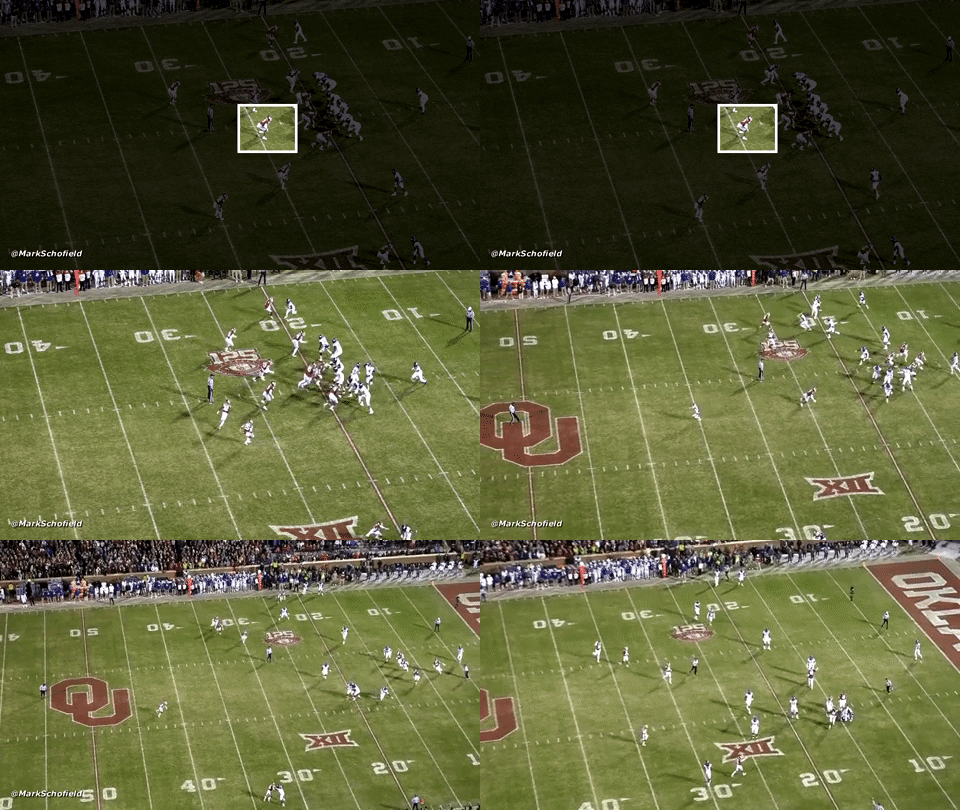
It is hard to read a screen play better than that (although there is another linebacker in this class who does this just as well. More on him in a moment).
Murray is used often as a blitzer. He can put some shots on the quarterback, and when asked to serve as a pure pass rusher off the edge his speed and athleticism puts him on solid footing against most offensive tackles.
Weaknesses: Scheme fit is going to be a huge question with him. Oklahoma let him play downhill as much as possible, often using him as a blitzer in passing situations. So his ability to play in coverage is a bit of a question mark. He is a bit slower to recognize threats to his zone than others in this class. He does not always get to his landmark when spot dropping. He is slower to get to underneath zones when recovering after play-action fakes. He wants to be playing in attack mode towards the line of scrimmage, rather than working back away from the football in coverage. There is certainly a plus to what he brings to the table, but he might not be for everyone. In their draft guide Pro Football Focus wrote of Murray that his “…success at the next level is going to rely heavily on usage. He’s not Mr. Do-it-all. He’s a hunter in the middle of the field who will limit YAC and make plays in the opposing backfield.” If used that way, he can flourish. If not, well…
Conclusion: Look, there is always a way to utilize someone who is a heat-seeking missile on the defensive side of the football. If implemented as a strong-side linebacker with the freedom to flow downhill as much as possible and just make plays, he can be an impact player at the next level. Think of Jamie Collins. When used properly as such a player, he was successful. But when tasked with making reads and reacting, rather than just playing, he struggled. The NFL can always find a home for aggressive, explosive linebackers, but he might not be the player you rely on to run with receivers or operate underneath in complex zone schemes. At least, not immediately as a rookie.
Comparison: Having just mentioned him, we can roll with Collins. The former New England Patriot is at his best when attacking the pocket and flowing towards the football. Dropping into coverage and making plays in underneath zones was not him at his best.
5. Willie Gay Jr., Mississippi State

Height: 6’1″ Weight: 243
40-Yard Dash: 4.46 seconds
Bench Press: 21 reps
Vertical Jump: 39.5 inches
Broad Jump: 11 feet 4 inches
3-Cone Drill: 7.08 seconds
20-Yard Shuttle: 4.3 seconds
60-Yard Shuttle: N/A
Bio: Willie Gay Jr. was a four-star linebacker for Starkville High School in Starkville, Mississippi. Growing up around the corner from Davis Wade Stadium at Scott Field, it was widely expected that Gay would stay home and play for Mississippi State. While in high school, Gay played both linebacker and at times quarterback, and tallied 83 combined tackles – nine for a loss – as a senior. He entertained offers from LSU and Michigan, but in the end stayed home to play for the Bulldogs.
Playing time was hard to come by for him, thanks to a few team suspensions. But when he was on the field, he shined. His 2018 sophomore campaign was his breakout performance, when he played 455 snaps and notched 31 total tackles.
Stat to Know: Eight. That is how many games Gay missed this season due to suspension.
Strengths: Gay has the kind of athleticism that might make general managers overlook the off-the-field issues. He lit the Lucas Oil Stadium turf on fire, from his 4.46 40-yard dash (99th percentile) to his 39.5 inch vertical leap (96th percentile) through his 11 foot 4 inch broad jump (once more, the 99th percentile). But this athleticism was on full display when he was able to get onto the field. He truly plays sideline-to-sideline against both the run and the pass. He is explosive when blitzing, flying downhill with reckless abandon. He also shows good balance, with the ability to run through cut block attempts that he does not see coming and somehow manage to stay upright. In space he flashes good change-of-direction ability, both when sticking on receivers or in trying to take down ball-carriers in the open field.
Against the run, Gay is generally solid. He has a good nose for the football, and can fight through traffic in front of him and still put his facemask on the ball-carrier. He fits well in the running game, taking his gap responsibility to heart and attacking it with controlled abandon. Gay has the vision to identify threats in the passing game and shows the penchant for keeping one eye on the quarterback and the other on the nearest threat when in zone coverage. He gets into his zones with more fluidity than Murray. When rushing the passer he has a good stutter/hesitation move that has worked for him.
Weaknesses: There are the character issues that teams will need to work through with him. He was suspended for cheating on a test, and was also suspended for punching a teammate in the face. In addition, even when eligible he was just a rotational player for the Bulldogs. Those are questions he will need to answer.
Beyond those issues, Gay can sometimes struggle to stack and shed blockers down near the line of scrimmage. He would rather evade blockers than take them on as a result, which works well in space but limits his effectiveness at times when playing in the box.
Conclusion: With his athleticism and ability to play in space, as well as what he offers in coverage, Gay is going to generate interest from NFL clubs. But the red flags are issues to consider, and one cannot help but wonder how teams are going to feel about drafting him without the ability to work through some of these issues during a final Top 30 visit. Will teams be comfortable enough to use an early pick on him based on what they learned over Zoom? If they are, they’re getting a potential modern linebacker with the ability to still play down near the line of scrimmage, but the questions are real.
Comparison: Athletically, Gay compares favorably to Bobby Wagner. The more you watch Gay play, you can see that potential inside of him on the field.
6. Akeem Davis-Gaither, Appalachian State

Height: 6’1″ Weight: 224
40-Yard Dash: N/A
Bench Press: 21 reps
Vertical Jump: N/A
Broad Jump: N/A
3-Cone Drill: N/A
20-Yard Shuttle: N/A
60-Yard Shuttle: N/A
Bio: Akeem Davis-Gaither was a multi-sport athlete in high school, lettering in baseball, basketball, football and track-and-field for Thomasville High School in North Carolina. He received multiple offers as a two-star recruit, including from Charlotte and Boston College. But Davis-Gaither chose App State. He got the starting job as a redshirt junior in their overhang defender role, and registered 59 total tackles. Last year he was allowed to be more of a weapon as a blitzer, and on 190 pass rush chances he generated 25 pressures. He also tallied 67 total tackles from his overhang spot.
Stat to Know: Something to watch with Davis-Gaither are the 15 or more missed tackles he tallied in each of the past two seasons.
Strengths: For what he does, Davis-Gaither is one of the best at in the class, and what he does is play as that overhang defender in space or in the slot for a majority of his snaps. He has a quick trigger with good burst when he identifies the play and comes downhill in response. He has a powerful jam which he puts on receivers, re-routing them or even throwing them to the turf with his hands. He is comfortable playing in curl/flat or hook zones and buzzing between targets. He can play sideline-to-sideline both against the run, and in coverage. We mentioned in the discussion of Kenneth Murray the ability to diagnose and explode downhill on screen plays, and Davis-Gaither checks that box as well. He had a play against UNC where if it were not for the pass getting tipped, he might have intercepted the screen pass given the read and jump he had on the play.
Davis-Gaither does prefer to evade blocks rather than taking them on, but he manages to do this well. On this play against South Carolina he is defending against a potential screen to the boundary, but when he reads the inside give, he manages to get to the ball-carrier:
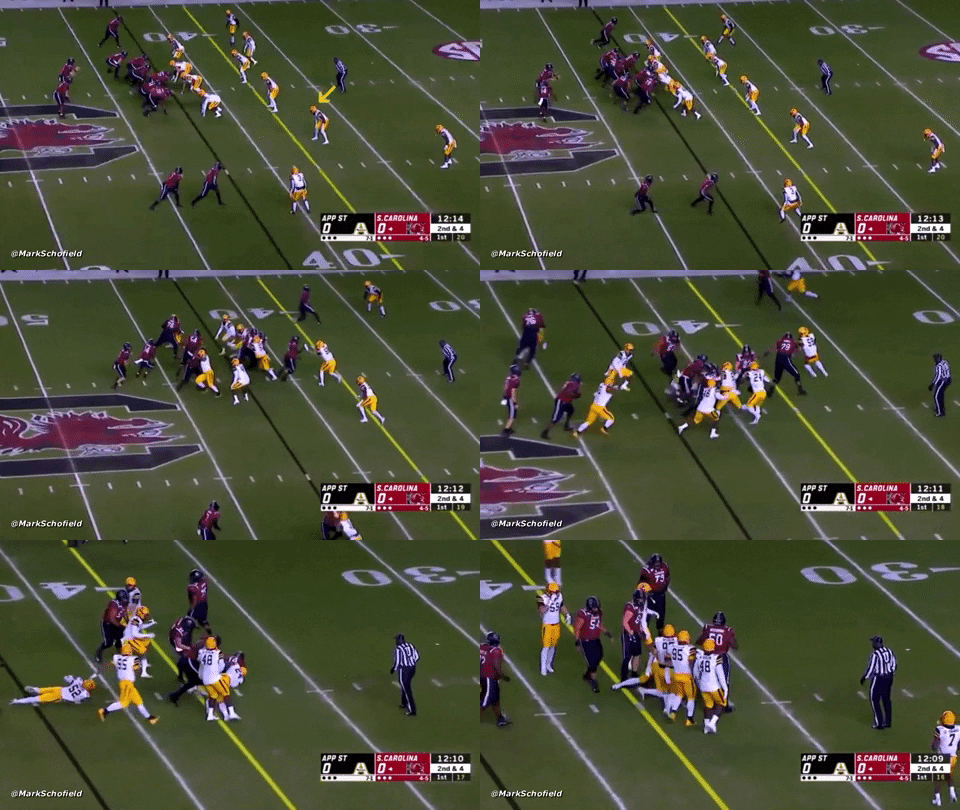
What I love about this play is not that he gets to the ball-carrier, but how he almost uses a jump-stop move at the end to avoid the bodies in front of him, and get to the running back. That is impressive change-of-direction ability, something we would covet from an offensive player.
When he gets down near the line of scrimmage, he manages to have a feel for getting to the football. This was a tremendous play to see from him, and it is actually the very next snap against South Carolina:
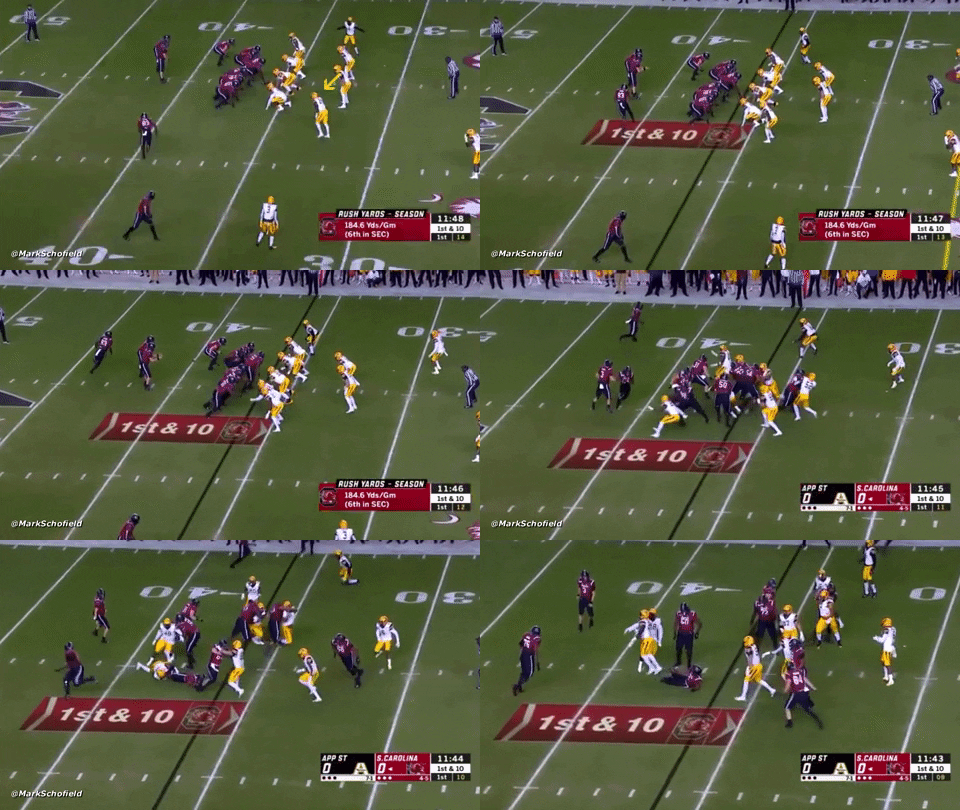
Davis-Gaither walks down into the box before the snap, and cuts across the line of scrimmage as the play begins. The Gamecocks run a power design here and pull the guard and H-Back in his direction. But the linebacker ducks around them both, showing the kind of bend that would make an EDGE defender jealous. He stops this play in the backfield before it gets going.
He also takes very good pursuit angles, and always seems to be ahead of the play rather than behind it.
Weaknesses: He is undersized, which leads to why he tries to evade blocks rather than take them on. His bench press numbers from the Combine speak to perhaps more play-strength than he showed on film. He does have those missed tackle numbers, which show up on film when he actually overruns plays either working down the line of scrimmage or in pursuit. Then there is the matter of his scheme fit. Playing the overhang position does not have a one to one transition to the NFL, although as we will talk about in the “Comparison” part of this report, there is a roadmap for him – and his NFL team – to follow. Projecting him to playing in the box for the bulk of his snaps is just that – a projection.
Conclusion: Davis-Gaither fits the mold of a hybrid linebacker-safety player who can contribute on all three downs in the NFL for a defense that is creative in how they employ him. Right now he does not look like someone you can align as a inside linebacker and count on to stuff the run, but he has the play-making ability, coverage skills and nose for the football that will be helpful for any defense in the league. He has flashed the ability to stop the run on the edge, the ability to be effective as a blitzer, and the coverage skills to shut down receivers in man coverage while also faring well in zone schemes. That is a really good starting point.
Comparison: When watching him I see a Fred Warner type of player. Fred Warner type player. PFF wrote that he “plays an overhang role that is not necessarily translatable to the NFL,” and while that might be true, Warner is an example of a player that has made the transition and I believe Davis-Gaither can as well. Yes he is undersized, and he can get overwhelmed when he sticks his nose inside against the run. But he plays so well in space as that overhang defender, he is the perfect player for today’s NFL. Find ways to use him as he adjusts to the league and see how he develops. I promise you will not be sorry.
7. Jordyn Brooks, Texas Tech

Height: 6’0″ Weight: 240
40-Yard Dash: 4.54 seconds
Bench Press: N/A
Vertical Jump: N/A
Broad Jump: N/A
3-Cone Drill: N/A
20-Yard Shuttle: N/A
60-Yard Shuttle: N/A
Bio: At Stratford High School in Houston, Jordyn Brooks was a two-sport athlete, starring at outside linebacker for the football team and serving as a sprinter on the school’s track-and-field team, running a leg on the 4×100 relay team. Brooks was graded as a three-star recruit and was given offers from Colorado State, Arkansas, Houston, Iowa State, Missouri and Washington, but chose to enroll at Texas Tech.
Brooks was a starter from the day he set foot on campus. He slid into an inside linebacker roll and showed the ability to be a force against the run while still able to handle his coverage responsibilities. Last year he registered 86 total tackles, a career-high number for him.
Stat to Know: Brooks was also disruptive as a pass rusher. He had 117 pass rush chances last season and came away with 44 total pressures, according to Pro Football Focus. That was eight more pressures than he had in his first three seasons combined.
Strengths: Brooks is an explosive downhill player with the athleticism to contribute against the pass in both zone and man coverage schemes. He has a great nose for the football and when he diagnoses the play, he explodes in the direction of the ball-carrier and does his best to eliminate them as a threat. He has impressive range, with the ability to work sideline-to-sideline against the run.
When dropping into underneath zones, he is able to jam and re-route crossing routes or threats to his zone, while keeping his eyes trained on the quarterback. Texas Tech also allowed him to spy or freelance in underneath areas at times. He has the athleticism to play man coverage, best against bigger tight ends or running backs but he can stick on more athletic players from time to time.
Against the run he is both powerful and agile. He has the ability to sift through traffic and get to the ball-carrier, but he is also willing – and powerful enough – to stone blockers in the hole, disengage and make the tackle. He has the throwback ability to play down near the line of scrimmage and between the tackles.
Weaknesses: While Brooks is more athletic than some of the linebackers in this class, he is not an elite athlete. Against Arizona he was tasked with spying quarterback Khalil Tate from time to time, and there are examples of him losing contain against him and grasping for turf as the QB danced around him. Unlike some of the overhang, space linebackers in this group Brooks is best suited in a traditional alignment, down near the line of scrimmage or between the tackles. While his straight-line speed is impressive, as was the 40-yard dash he ran at the combine, his change-of-direction ability is lacking. Being tasked with covering slot receivers in space, or shiftier tight ends, might be a difficult ask.
Conclusion: Along with the next player we will discuss, Brooks is more of a throwback type of player. He belongs near the line of scrimmage and between the tackles, using his power against the run to blow up lead blockers, stack and shed them in the hole and chop down ball-carriers near the line. Brooks can handle some man coverage responsibilities given his athleticism and experience, but sticking him on more agile receivers will be a tough ask. That might limit his opportunities at the next level. But teams that are looking for someone to fill more of the downhill role will live with that, given how well he plays when flowing towards the line of scrimmage.
Comparison: From time to time I employ fictional comparisons. We compared Isaiah Simmons to superheros, and when breaking down quarterback I compared Cole McDonald to “Maverick” from Top Gun. Brooks reminds me of Alvin Mack from The Program. A downhill, throwback kind of linebacker with experience and explosiveness when attacking the line of scrimmage.
8. Malik Harrison, Ohio State

Height: 6’2″ Weight: 247
40-Yard Dash: 4.66 seconds
Bench Press: N/A
Vertical Jump: 36 inches
Broad Jump: 10 feet 2 inches
3-Cone Drill: 6.83 seconds
20-Yard Shuttle: 4.32 seconds
60-Yard Shuttle: N/A
Bio: In his prep days, Malik Harrison was a quarterback, safety and punter for Walnut Ridge High School. He threw for 1,161 yards and eight touchdowns his senior year in 2015. He was also a standout on the hardwood, averaging a double-double for the school’s basketball team. A three-star recruit, Harrison committed to Ohio State in February of 2016.
He played as a rotational player as a true sophomore during the 2017 season, and took over a starting role in 2018. That year Harrison tallied 59 total tackles and a career-high 865 snaps. Last year was his most productive season, as he registered 62 total tackles.
Stat to Know: Ohio State loved to use him as a blitzer. Over the past few seasons Harrison generated 38 pressures on 168 pass rushing opportunities, according to charting data from Pro Football Focus.
Strengths: Harrison is the first of the “throwback” style of linebackers in this draft class. While others do most of their work in space or rely heavily on athleticism, the Ohio State product is reminiscent of the two-down thumpers of yesteryear. He displays solid power at the point of attack, against both gap/power designs and zone blocking schemes. He plays through lead blockers, forces ball-carriers to cut behind the line of scrimmage, and seems to pride himself on stopping the run.
Playing downhill is when he is at his best. He has the power to stand up offensive linemen in the hole, scrape off of them and make the tackle.
In pass coverage, Harrison is best utilized in underneath zones rather than in man coverage. On third down situations the Buckeyes would often let him spy or freelance underneath, and as the numbers illustrate he can generate pressure as a blitzer. He displays good hand usage when rushing the passer, with a few chop or swat type of moves he can engage blockers with.
Weaknesses: For the modern NFL, Harrison might not be the best fit. He is not the most athletic linebacker of the group – although his testing at the Combine was better than expected given his size – but his lateral movement skills and change-of-direction ability on film are lacking. He is an aggressive, downhill-minded player who wants to attack the line of scrimmage first, which leaves him susceptible to play-action designs. Harrison lacks the patience of a player like Troy Dye, and tends to react first, think second. He is not a player you want handling a lot of man coverage responsibilities. This adds up to a player that might have to come off the field on third down and/or in passing situations, and those players tend to wait to hear their name called on draft night.
Conclusion: Ten or fifteen years ago, Harrison might be LB1. In today’s game, he might be a Day Three pick. The game has changed and players with his mentality and skill-set are not valued as highly as more athletic linebackers who can run with tight ends, play man coverage and stay on the field on third down or in sub packages. However, the fact that NFL teams are still run by people who value stopping the run, playing physical on defense and “imposing their will” means that Harrison is not exactly out of luck. The ability to play downhill, blow up a lead blocker and stop the run is a trait some will still value. There will be some that value what he brings to the table, and as such he’ll get a shot.
Comparison: Harrison reminds me of a young Dont’a Hightower. A player who is at his best working downhill against the run and attacking the passer as a rusher. When the opposing QB drops to pass it is best if he is used as a spy or in an underneath zone. Sure, Hightower was picked in the first round of the 2012 NFL draft, but a lot has changed since then.
9. Cameron Brown, Penn State

Height: 6’5″ Weight: 233
40-Yard Dash: 4.72 seconds
Bench Press: 16 reps
Vertical Jump: 35.5 inches
Broad Jump: 10 feet 3 inches
3-Cone Drill: N/A
20-Yard Shuttle: N/A
60-Yard Shuttle: N/A
Bio: Cameron Brown was a three-year letter winner for The Bullis High School in Potomac, Maryland. Over three seasons of play he notched 260 total tackles, and led Bullis to back-to-back conference titles in 2014 and 2015. He was a four-star recruit according to 247Sports.com, and entertained offers from Arizona State, Boston College, Duke and Illinois before selecting to play at Penn State. He was a rotational player for the Nittany Lions in 2017 before earning a starting spot in their overhang role, and has locked down that role for the school ever since.
Stat to Know: Something to watch with him is the number of missed tackles. From Pro Football Focus’ charting data, he missed 15 tackles on 83 attempts last season.
Strengths: Brown is a long, rangy outside linebacker type of player with length to lock down tight ends in man coverage. He is comfortable playing in space, with most of his snaps coming from a slot alignment. He will jam and re-route receivers with force and power, and breaks to his zone quickly and constricts throwing windows almost immediately after the snap. He evades blockers well when given the green light to blitz. Brown also shows good awareness in space, from scanning targets, passing off receivers in zone coverage and knowing where he is on the field and whether he can initiate contact with receivers or not. He can handle man coverage responsibilities well, particularly against tight ends of all types and running backs. He is athletic enough to stay on vertical routes from slot receivers as well.
Against the run, Brown is solid. He is more than willing to stick his nose down into traffic, and is willing to take on blockers at the point of attack, stack and shed them as best he can, and make the play. He has some moves that he can employ against both run blockers and pass blockers when he is tasked with blitzing. As a blitzer, his timing is almost immaculate. Brown has a good array of pass rushing moves, including a stutter-step, a hesitation move and a violent hand chop that he uses when attacking slower offensive tackles.
Athletically, Brown changes directions well, moves well in space, and shows the athleticism to handle the man coverage responsibilities he will face in the NFL.
Weaknesses: The missed tackles are a concern, especially when you consider his length and tackle radius. His 34 inch arms allow him to get to almost anything along his path, so the missed tackle numbers are surprising. Brown sometimes struggles to disengage from blockers, which is something he’ll need to work on as he transitions to the NFL. He also is sometimes a step or two late to a play, which given his athleticism can be attributed more to a processing speed issue. While other linebackers in this class trust their instincts and explode once they make a decision, Brown is a bit slower to react.
Conclusion: Brown is more of the modern NFL linebacker, who will rely on length and athleticism in space rather than instincts and downhill aggression. His size and ability to handle tight ends show up at times, and will make him a player who can stick on the field for all three downs. There are things that he needs to clean up and improve upon, but given where the game is trending, he is likely to get a chance to stick at the next level.
Comparison: Brown reminds one of Kyler Fackrell, the former Utah State linebacker who now plays for the New York Giants. Both players rely on above-average height and length for the position to make an impact.
10. Logan Wilson, Wyoming

Height: 6’2″ Weight: 241
40-Yard Dash: 4.63 seconds
Bench Press: 21 reps
Vertical Jump: 32 inches
Broad Jump: 10 feet 1 inch
3-Cone Drill: 7.07 seconds
20-Yard Shuttle: 4.27 seconds
60-Yard Shuttle: N/A
Bio: Logan Wilson wore many hats for Natrona County High School in Wyoming. He was named to the Wyoming Coaches Association Class 4A All-Star team as a defensive back and wide receiver in both 2013 and 2014. He was also an All-State punter for three seasons in high school. Despite this versatility, he was graded as a two-star recruit and had just one offer waiting for him: Wyoming.
Wilson took that offer and redshirted as a freshman, where he spent his time as a linebacker on the scout team. He stepped into the starting lineup as a redshirt freshman and has been a starter ever since for the Cowboys.
Stat to Know: Wilson played 3,618 career snaps at Wyoming. Those are Cal Ripken-esque numbers in today’s landscape.
Strengths: Wilson is another throwback type of linebacker, who does his best work down near the line of scrimmage against the run. But what also shows up both on film and in testing is his athleticism. He has the explosiveness and the straight-line speed to handle some of what the pro game will ask of him. Wyoming let him function in underneath zone coverage as well as relying on him as a blitzer, and he is good enough at applying pressure to be a pass rushing specialist linebacker early in his career. His experience allows him to be very patient and comfortable in underneath zone coverage, and he will pass off receivers at just the right time before moving to the next player. He will come downhill and lay a stick on a ball-carrier, and is a sure tackler.
This play against San Diego State ties together his patience, his experience and his ability to explode downhill:
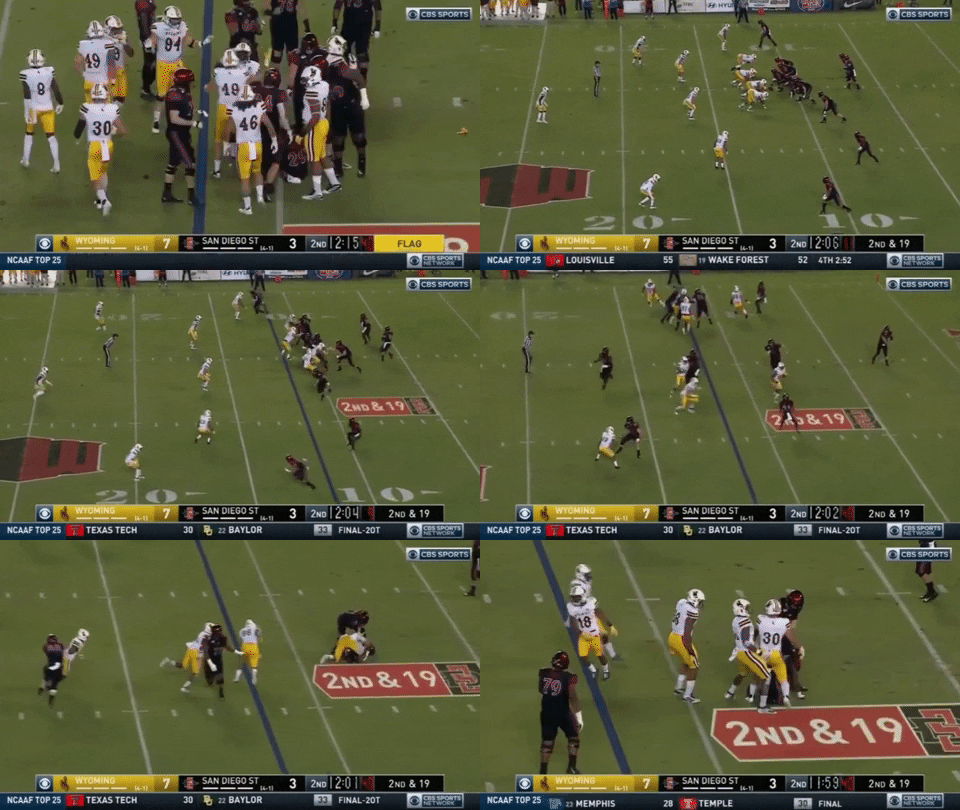
Wilson does not panic as the play unfolds, he displays patience and route recognition before firing downhill and stopping this screen play behind the line of scrimmage. This combination of awareness and explosiveness works in the NFL, last I checked.
Weaknesses: Wilson does not change direction that well, his straight-line athleticism is more his calling card. Covering shiftier players or option-type routes will be more of an adjustment for him. Man coverage is a bit of a question mark, as Wyoming’s defense relied heavily on zone schemes with a lot of spot-dropping. As you saw in the above clip, Wilson was often able to keep his eyes trained on the QB and everything unfolding in front of him. More complex coverages, as well as man coverage designs, will require a bit of a learning curve.
Conclusion: With what he does against the run, and his experience, Wilson is going to be loved by some NFL decision-makers. He might be the Plan B for teams that are looking to target Kenneth Murray in this draft but miss out. He can be a force against the run and a weapon as a pass rusher/blitzer until he figures out the rest of the professional game.
Comparison: Wilson reminds me of Ja’Whaun Bentley, the former Purdue linebacker who now plays for the Patriots. Bentley was pigeon-holed as more of a two-down thumper, throwback type that might struggle in pass coverage. But the Patriots found a role for him and his straight-line athleticism has made him less of a liability in coverage than most expected. That is the path forward for Wilson.
11. Davion Taylor, Colorado

Height: 6’0″ Weight: 228
40-Yard Dash: 4.49 seconds
Bench Press: 21 reps
Vertical Jump: 35 inches
Broad Jump: 10 feet 7 inches
3-Cone Drill: 6.96 seconds
20-Yard Shuttle: 4.26 seconds
60-Yard Shuttle: N/A
Bio: There are fascinating backgrounds that you come across researching prospects, then there is Davion Taylor’s. He played in just one – yes one – high school football game. His mother is a Seventh-Day Adventist Church member, and as such Saturday is a day of observation. Athletic activities from sundown Friday night until Sunday morning are not allowed. So absent one game his senior year where the sun set at 8:30 at night, Taylor was sidelined. He would practice with the team but spend game nights at home. He did participate in both basketball and track-and-field.
When he turned 18 Taylor was free to make his own choices, and enrolled at Mississippi’s Coahoma Community College to play football. That turned into a scholarship offer from Colorado, which he accepted. He has been a starter in Colorado’s defense for the past two season, in their overhang role.
Stat to Know: Unlike Cameron Brown, Taylor was solid at the tackle point. Pro Football Focus charted him with just 20 missed tackles on 144 attempts during his Colorado career.
Strengths: Taylor is a raw talent with impressive athleticism, as his Combine performance illustrates. He gets to his zone responsibilities well, and in Colorado’s defense he was tasked with a lot of spot-dropping. He can run with tight ends and wide receivers on seam routes well, and can handle man coverage responsibilities. Against the run he is solid, and he does a very good job at setting the edge and turning plays back to the inside. He has the ability to fight through blockers and get to the ball-carrier against the run. Taylor changes directions well, but it is a bit more sudden and violent rather than fluid and natural, which could show up when covering shiftier receivers or running backs out of the backfield.
Weaknesses: Taylor is very raw, and at times seemed like he was still learning the position as a senior. He can lose his feet when taking on blocks, and needs to refine his stack and shed technique. He gets caught peeking into the backfield at times, leaving him susceptible to play-action designs or misdirection plays. He also takes poor angles at times, including when he comes down to set the edge, and this might also be a matter of experience. A final nitpicky thing is his stance: At times he stands with his hips opened towards the sideline, rather than the middle of the field. He almost aligns with his back to the football, forcing him to peek back over his inside shoulder to the play.
Conclusion: A bet on Taylor is a bet on potential. The athleticism is off-the-charts, and someone this raw with that level of athletic ability has a chance to be a true diamond in the rough. The problem is that in this current climate, where practice time is limited to begin with, and rookie mini-camps are up in the air given the COVID-19 crisis, how willing is a team going to be to place that bet?
Comparison: Nate Ebner. This might be a bit of an odd comparison, but Ebner, the special teams ace for the New England Patriots and now the New York Giants, is a hybrid type player who comes from a rugby background. Taylor’s athleticism and potential are going to allow him to stick on a roster, particularly if he contributes on special teams, and given his background and profile that seems likely. What he does beyond that depends on how well he develops. His floor could be that of Ebner’s, a special teams ace for years in the league. But with the right coaching, it could be much more…
Before we close out, just a few Honorable Mention candidates that are also worth keeping and eye on as the draft approaches:
David Woodward (Utah State)
Evan Weaver (California)
Markus Bailey (Purdue)
Shaquille Quarterman (Miami)


.png?w=600)